Speech Pathologist · Referral letter · Grade B worked sample
Speech Pathologist Referral to ENT (Grade B Sample)
Worked example showing a Grade B referral letter from a speech pathologist to an ENT consultant for persistent dysphonia and suspected laryngeal pathology.
In short
- →Referral requests urgent ENT assessment (flexible nasoendoscopy ± stroboscopy) for persistent hoarseness.
- →Includes concise clinical history, voice assessment findings and red-flag risk factors (smoking, duration).
- →Offers continuing voice therapy input and requests guidance on investigation and management priorities.
The case notes
The OET writing task you would receive in this scenario.
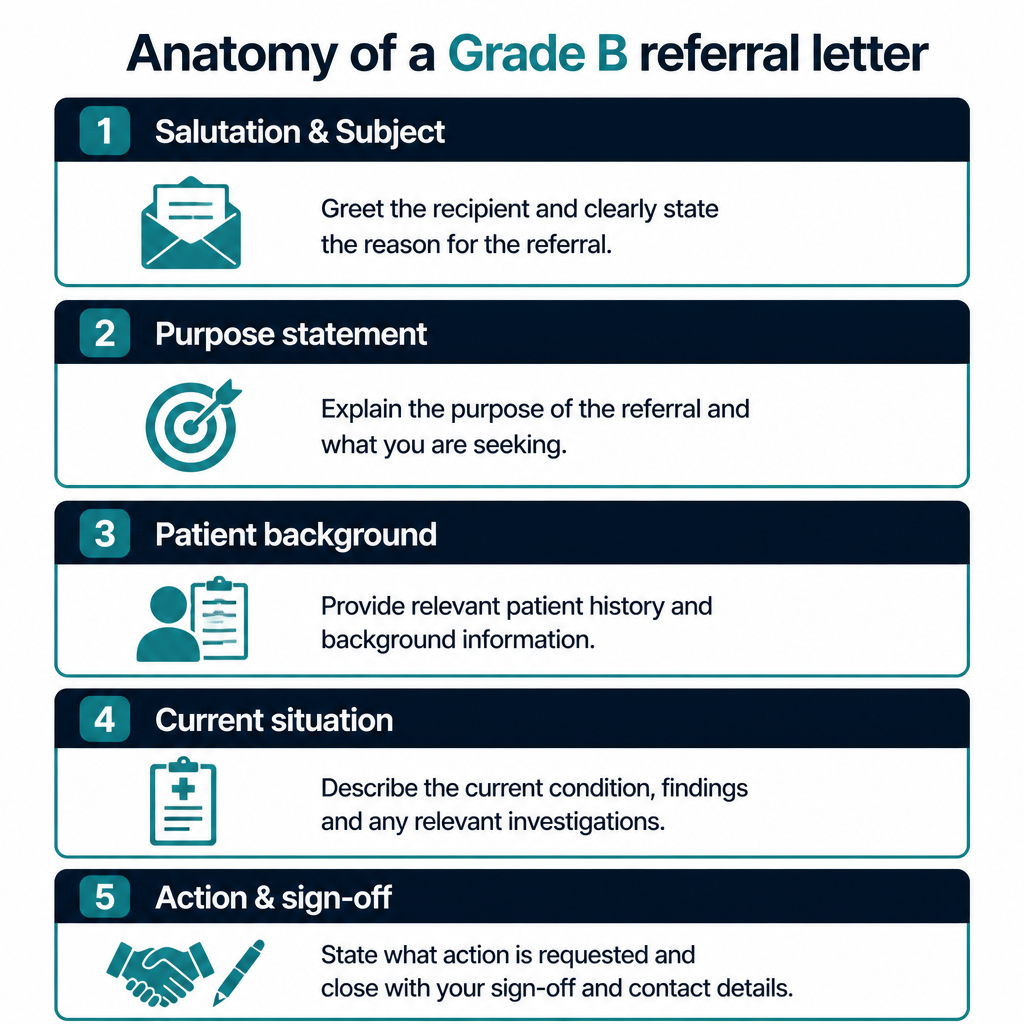
Anatomy of this letter
The Grade B sample letter
A complete worked example written to score Grade B (350+) against all six criteria.
Dr Smith
ENT Consultant
16/05/2026
Referral: Persistent dysphonia — Ms J. Patel (DOB 12/03/1968)
Dear Dr Smith,
I am writing to refer Ms J. Patel, a 58-year-old woman, for urgent ENT assessment due to persistent hoarseness of six weeks' duration and risk factors for laryngeal pathology.
Ms Patel reports onset of hoarseness following an upper respiratory tract infection approximately six weeks ago. She describes progressive voice roughness, intermittent globus sensation and occasional throat discomfort. She is a current smoker (20 cigarettes/day, ~30 pack-year history) and has been taking omeprazole 20 mg daily for three weeks for reflux symptoms.
My assessment on 09/05/2026 demonstrated a breathy, rough voice with reduced pitch range (GRBAS: G3 R2 B2), maximum phonation time 6 seconds, reduced vocal endurance and intermittent coughing during speech tasks. These findings suggest glottic insufficiency; I am concerned about a possible structural lesion or unilateral vocal cord paresis and therefore request flexible nasoendoscopy and stroboscopic evaluation.
Please advise on urgency for imaging, biopsy or ENT intervention. I will continue conservative voice management and have scheduled SLT review in two weeks; I am available to share therapy notes and to collaborate on post-assessment rehabilitation planning.
Yours sincerely, A. Walker, Speech Pathologist
Why this letter scores Grade B — annotation by annotation
Each highlighted phrase maps to one of the six OET writing criteria.
| Phrase from the letter | Criterion | Examiner comment |
|---|---|---|
| "I am writing to refer Ms J. Patel, a 58-year-old woman, for urgent ENT assessment due to persistent hoarseness of six weeks' duration and risk factors for laryngeal pathology." | Purpose | Clear, explicit purpose and urgency stated at the start; could be marginally shorter to improve conciseness. |
| "She is a current smoker (20 cigarettes/day, ~30 pack-year history) and has been taking omeprazole 20 mg daily for three weeks for reflux symptoms." | Content | Includes relevant risk factors and current medication, improving clinical usefulness for ENT triage. |
| "My assessment on 09/05/2026 demonstrated a breathy, rough voice with reduced pitch range (GRBAS: G3 R2 B2), maximum phonation time 6 seconds, reduced vocal endurance and intermittent coughing during speech tasks." | Conciseness & Clarity | Concise presentation of objective SLT findings; technical terms are used appropriately but could use one-sentence interpretation for non-specialists. |
| "These findings suggest glottic insufficiency; I am concerned about a possible structural lesion or unilateral vocal cord paresis and therefore request flexible nasoendoscopy and stroboscopic evaluation." | Genre & Style | Professional tone and specific, actionable request aligned with referral conventions; avoids prescriptive management outside scope. |
| "Please advise on urgency for imaging, biopsy or ENT intervention." | Organisation & Layout | Clear final request placed near the close, making it easy for the recipient to identify required actions. |
| "I will continue conservative voice management and have scheduled SLT review in two weeks; I am available to share therapy notes and to collaborate on post-assessment rehabilitation planning." | Language | Polite collaborative offer uses appropriate register; language is professional though one sentence is slightly long. |
Criterion-by-criterion score breakdown
| Criterion | Score | Why |
|---|---|---|
| Purpose | 3 / 3 | Purpose and urgency are explicit and appropriate for referral. |
| Content | 6 / 7 | Relevant clinical history, objective SLT findings and risk factors are included; minor missing items (vital signs) not critical. |
| Conciseness & Clarity | 5 / 7 | Information is generally concise and clear, with a few sentences that could be tighter. |
| Genre & Style | 5 / 7 | Professional tone and appropriate requests; occasionally uses specialist terms without brief explanation. |
| Organisation & Layout | 6 / 7 | Well-structured paragraphs with logical flow; requests and offers of follow-up are easily found. |
| Language | 5 / 7 | Accurate clinical language with good grammar; some long sentences slightly reduce readability. |
5 Speech Pathologist pitfalls to avoid
1. Vague purpose without urgency
Fix: State explicit reason and timeframe for referral in the opening sentence.
2. Omitting objective SLT findings
Fix: Include measures (MPT, GRBAS) and date of assessment.
3. Using unexplained technical jargon
Fix: Provide a brief interpretation for terms like 'glottic insufficiency'.
4. Failing to mention red-flag risk factors
Fix: List smoking history, duration of symptoms and weight loss if present.
5. Unclear requested action
Fix: Specify the exact investigations or procedures you want (e.g. flexible nasoendoscopy ± stroboscopy).
2026 update
What changed in 2026 for Speech Pathologist letters
From 2026, examiners expect sharper, clinically focused referrals with less room for vague language.
You must state the referral purpose clearly, include succinct objective SLT measurements, and make specific, justified requests (for example, nasoendoscopy ± stroboscopy). Ensure every clinical statement supports triage decisions and avoid long, rambling sentences that obscure key actions or red flags. Conciseness and precise clinical language are more heavily weighted than before.
Failure to do so risks lower scores even if content is otherwise relevant.
Frequently asked questions
How long should a referral letter be?
Aim for one page; 180–220 words is ideal for OET referrals — enough to convey key history, findings and clear requests.
What objective SLT data should I include?
Include date of assessment, perceptual rating (e.g. GRBAS), maximum phonation time, pitch range issues and any task-specific observations.
Should I suggest investigations?
Yes — request specific investigations you consider necessary (e.g. flexible nasoendoscopy, stroboscopy) and note why.
How do I show urgency without being dramatic?
State factual reasons: duration (>3 weeks), red flags (smoking, weight loss), and request 'urgent' or 'prompt' assessment with a brief justification.
Can I interpret findings for ENT?
Provide your clinical impression (e.g. possible glottic insufficiency) but avoid definitive diagnoses; ask ENT for confirmation and next steps.
What tone should I use?
Use a professional, collaborative tone. Be concise, factual and offer to provide further therapy notes or follow-up details.
Keep learning
Relevant scoring criteria
Related guides
Want Dr Mariam to mark YOUR speech pathologist letter against all six criteria?
See OET Writing Correction packs →