Decision guide · For nurses · 2026 update
OET vs IELTS for Nurses — 2026 Decision Guide
A concise 2026-current comparison to help nurses choose between OET and IELTS for registration, employment and visa purposes. Focuses on regulator needs, test design and practical transfer to clinical practice.
In short
- →OET is designed for healthcare communication; many nursing regulators prefer its clinical tasks (check regulator).
- →IELTS is more widely accepted across non-clinical institutions and academic routes; it tests general academic English.
- →Score and format rules tightened in 2026; confirm your regulator’s exact band or grade requirement before booking.
OET vs IELTS at a glance
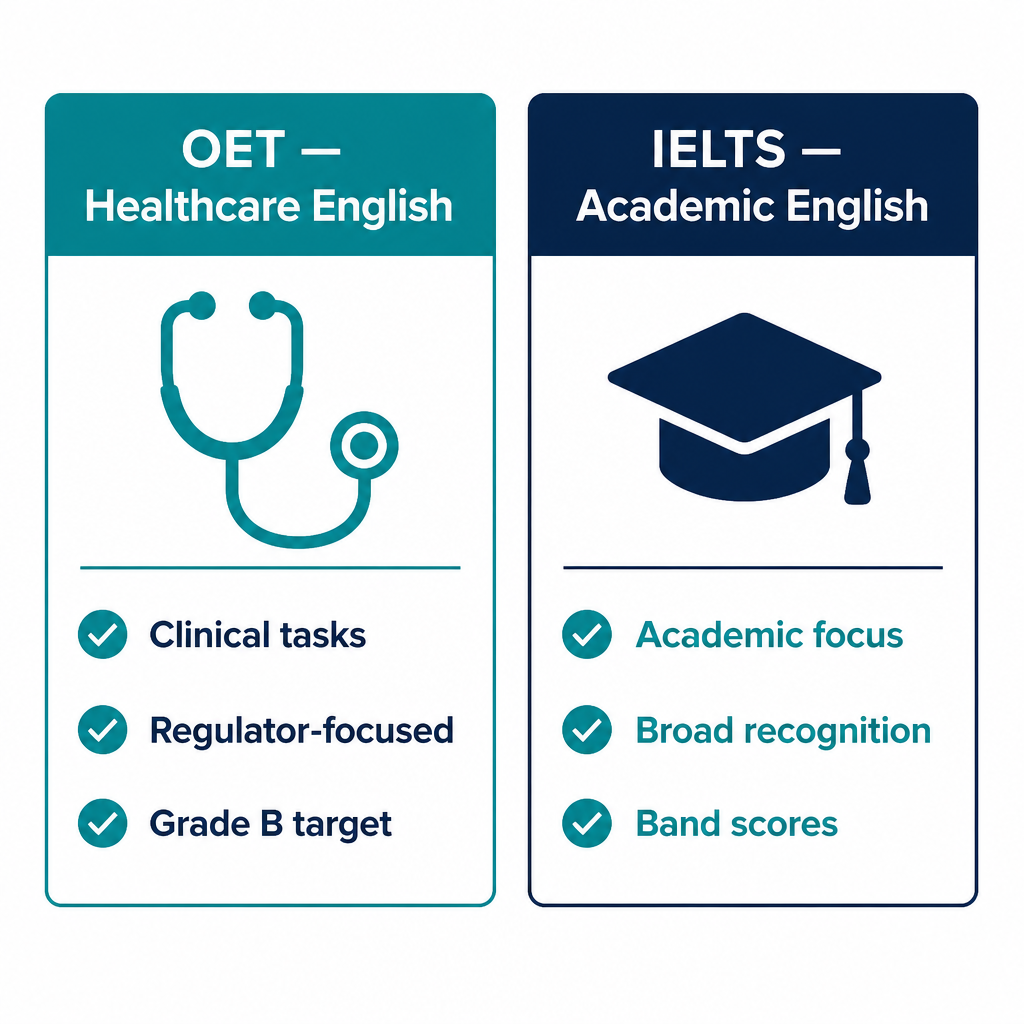
The full comparison
| Dimension | OET | IELTS |
|---|---|---|
| Accepted by | Widely accepted by healthcare regulators and employers in many countries | Accepted broadly across professions; not healthcare-specific but widely recognised |
| Exam length | About three hours thirty minutes for four subtests in one session | About two hours forty‑five minutes plus a separate speaking test |
| Scoring band | Grades A–E, with Grade B commonly required for registration | Band scores 0–9; many regulators ask for 7.0–7.5 overall |
| Cost | Usually higher test fee; varies by country and test centre | Generally lower fee options; price varies with test centre |
| Retake rules | No limit; pay per sitting; can retake individual subtests if needed | No limit; must retake whole test; pay per sitting for each attempt |
| Writing skill transfer | Tasks mirror nursing scenarios—higher direct clinical relevance | Academic tasks are general academic writing; less directly clinical |
| Healthcare relevance | Designed for healthcare: vocabulary, tasks aligned to clinical practice | General academic test; focuses on academic rather than clinical communication |
| Computer / paper | Available computer-delivered and paper formats depending on centre | Available on computer and paper; speaking often face‑to‑face or online |
| Results turnaround | Results usually within seven working days for paper; faster online | Results typically within 3–13 days; computer delivery is faster |
When to choose OET
Choose OET if your immediate priority is clinical communication that maps directly to nursing tasks and vocabulary. OET’s writing and speaking tasks are healthcare-specific, so your preparation transfers directly to workplace interactions and regulator evidence.
Also choose OET when your regulator explicitly lists OET as accepted or preferred (many nursing regulators do). Remember the 2018 OET writing criteria are applied under the stricter 2026 scoring regime, so aim for a consistent Grade B across subtests where required.
Pros
- • Clinical tasks closely match workplace communication
- • Higher perceived relevance by healthcare employers and assessors
- • Subtest retake flexibility in some jurisdictions
- • Clear task types for nurses (ref: 2018 OET writing criteria)
Cons
- • Generally higher test fees and fewer test dates in some locations
- • Less recognised outside health and academic sectors
- • Stricter 2026 scoring enforcement increases pass standards
When to choose IELTS
Choose IELTS when you need a broadly recognised academic English test for education, general immigration or non-clinical employers. IELTS is widely accepted by universities and by regulators that list either test as acceptable.
Also consider IELTS if cost, test availability or familiarity with academic task types matter. If your desired regulator accepts both tests, balance accessibility, fees and your own strengths in academic versus clinical task types.
Pros
- • Widely accepted by academic institutions and many regulators
- • More test centres and frequent dates in some countries
- • Familiar academic task types useful for study routes
Cons
- • Tasks are not healthcare-specific, so clinical transfer is indirect
- • Must retake the whole test if one subskill is weak
- • Some regulators prefer OET for clinical evidence
What each healthcare regulator currently accepts
| Profession | Requirement (2026) |
|---|---|
| Nurse (NMC, UK) | NMC commonly requires OET Grade B or Grade C+ in Writing if other three subtests are Grade B (check NMC site for 2026 confirmation). |
| Nurse (AHPRA, Australia) | AHPRA commonly accepts OET Grade B across subtests or equivalent IELTS scores; confirm exact thresholds with AHPRA. |
| Doctor (GMC, UK) | GMC accepts recognised English tests; some routes accept OET Grade B or IELTS 7.0+ with minimums—verify the current GMC guidance. |
| Pharmacist (GPhC, UK) | GPhC recognises both tests in many cases; typical requirement is OET Grade B or IELTS band 7.0+—check GPhC for 2026 specifics. |
| Dentist (GDC, UK) | GDC and similar regulators commonly require high-level English; both OET and IELTS are accepted depending on the route—refer to GDC guidance. |
| Allied Health (AHPs, various regulators) | Requirements vary widely by profession and regulator; many accept OET Grade B or IELTS 7.0+, so confirm with the specific regulator. |
2026 update
What changed in 2026 for this comparison
Since 2026 several testing bodies and regulators have tightened how they interpret English-test evidence. That means published grade or band thresholds are being applied more strictly and examiners are enforcing task criteria closely.
For nurses this matters because some regulators now emphasise single-sitting evidence, shorter validity windows and clearer proof of clinical communication ability. Always confirm the current rule on your regulator’s official page before booking a test, and prepare to meet the 2018 OET writing criteria under the stricter 2026 scoring regime where OET is required.
Frequently asked questions
Which test do nurses usually pick for registration?
Many nurses choose OET because its tasks map to clinical practice; if your regulator accepts OET, it is often the preferred choice. Always confirm current regulator guidance before booking.
Is OET easier than IELTS for nurses?
‘Easier’ depends on your strengths. OET tasks are clinical and predictable; IELTS asks for academic writing and reading skills. Choose the format that matches your skills and regulator needs.
Can I use OET or IELTS for visa applications?
Both tests are accepted for many visa streams, but acceptance varies by country and visa type. Check the immigration authority’s official guidance for the precise test and score requirements.
How many times can I retake the tests?
There is no universal limit for either test; you may retake as often as required, paying the fee each time. Some regulators allow subtest evidence from separate sittings—check their rules.
How should I prepare the OET writing subtest?
Practice task-specific letter formats from the 2018 OET writing criteria, focus on purposeful clinical content, clear structure and professional tone. Target consistency at Grade B level under 2026 scoring.
Are computer-delivered versions available?
Yes. Both OET and IELTS offer computer-delivered formats in many centres; availability depends on location. Check your local test centre for dates and delivery options.
Keep learning
Scoring criteria
Decided on OET? Get expert feedback on your letters.
See OET Writing Correction packs →