Decision guide · For international healthcare graduates · 2026 update
OET vs PLAB / NCLEX / AHPRA pathways: decision guide for international healthcare grads
A concise 2026-current guide to choosing between proving English with OET and pursuing local licencing routes (PLAB, NCLEX, AHPRA). Use this to match your profession, regulator and timeline.
In short
- →OET is a profession-specific English test used by many regulators; check required minimum grades per regulator (source: regulator websites, 2026).
- →PLAB/NCLEX/AHPRA are clinical/licensing pathways that prove clinical competence, often alongside English evidence (source: GMC, NMC, AHPRA, 2026).
- →Choose OET if English is the primary barrier; choose a licencing pathway if clinical registration or local practice is the goal (source: regulator guidance, 2026).
OET vs PLAB / NCLEX / AHPRA pathways at a glance
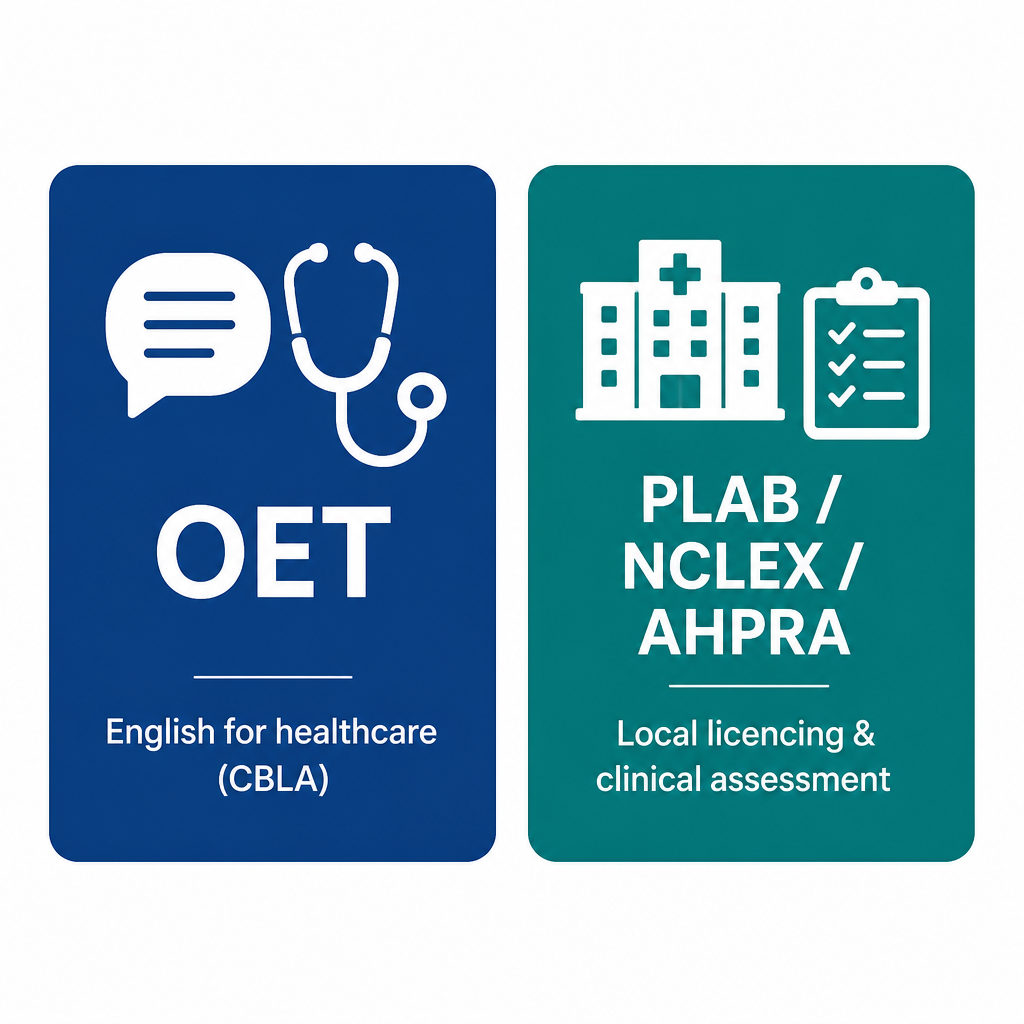
The full comparison
| Dimension | OET | PLAB / NCLEX / AHPRA pathways |
|---|---|---|
| Accepted by | Many regulators worldwide as English evidence (CBLA-owned OET). | Specific national regulators for practice and licensure (GMC, NMC, AHPRA, state boards). |
| Primary purpose | Measure profession-specific English communication skills for healthcare. | Assess clinical knowledge, skills and fitness to practise in-country. |
| Exam length | Around 3.5 hours for four sub-tests (Listening, Reading, Writing, Speaking). | Varies widely: PLAB/NCLEX/AHPRA include multiple parts, clinical OSCEs or computer tests. |
| Scoring / pass | Graded A–C; regulators commonly require Grade B (or regulator-specified equivalent). | Pass/fail or competence standard set by each regulator; exam-specific rules apply. |
| Typical cost | Moderate per test (registration fee only; varies by country and centre). | Generally higher: multiple fees (applications, exams, OSCEs, registration fees). |
| Retake rules | Multiple sittings allowed; local booking rules and waiting periods apply. | Retake permitted subject to regulator rules; some parts require waiting or remediation. |
| Writing skill transfer | Direct transfer: assesses letter/report writing used in clinical practice. | Indirect: licencing exams assess clinical reasoning; may not test written clinical letters. |
| Healthcare relevance | High relevance to workplace communication and interprofessional tasks. | High relevance to local practice, prescribing and clinical decision-making. |
| Computer / paper | Mostly computer-delivered; speaking recorded or face-to-face depending on centre. | Computer-based and practical OSCE elements; formats vary by exam. |
| Results turnaround | Typically 2–3 weeks for full results (varies by session). | Varies: immediate pass/fail (computer) or weeks after OSCE results processed. |
When to choose OET
Choose OET when the main barrier to registration or employment is English communication rather than clinical knowledge. OET is profession-specific, assesses real clinical tasks (letters, referrals, patient interactions) and is widely accepted by nursing, pharmacy and allied health regulators. The 2018 OET writing criteria remain in use under a stricter 2026 scoring regime; preparing to meet regulator-specified subtest grades (commonly Grade B) is essential.
If you already meet clinical competency requirements but need to satisfy English evidence quickly, OET is often the faster, more targeted option than repeating full licensing exams.
Pros
- • Profession-specific tasks closely match clinical workplace communication.
- • Widely accepted by many healthcare regulators as English evidence.
- • Generally quicker and lower cost than full licensure routes for English proof.
Cons
- • Only proves English competence; does not grant clinical registration.
- • Some regulators require specific minimum subtest grades (strict scoring).
- • Preparation must focus on medical English, not clinical practice skills.
When to choose PLAB / NCLEX / AHPRA pathways
Choose PLAB/NCLEX/AHPRA pathways when your priority is full local registration or when regulators require demonstration of clinical competence in-country. These routes test clinical knowledge, safe practice and local prescribing rules and are mandatory for many doctors, nurses and allied health professionals aiming to practise independently.
If you lack local clinical credentials or need recognition of qualifications rather than just English evidence, invest time and resources in the licencing pathway — note this generally takes longer and costs more than sitting an English test alone.
Pros
- • Leads directly to local registration and right to practise.
- • Assesses clinical knowledge, safety and local practice standards.
- • Often required for prescribing and independent practice rights.
Cons
- • More expensive and time-consuming than an English test alone.
- • Often requires travel, supervised practice or OSCEs in-country.
- • May still require separate English evidence in addition to exams.
What each healthcare regulator currently accepts
| Profession | Requirement (2026) |
|---|---|
| Nurse | NMC (UK): commonly accepts OET Grade B in each subtest; alternative is CBT/OSCE on registration pathway. |
| Doctor (GP / Surgeon) | GMC (UK): registration via PLAB or recognised postgraduate qualification; OET Grade B often accepted as English evidence. |
| Pharmacist | GPhC (UK) / AHPRA (Aus): OET commonly accepted as English evidence; local registration exams or supervised practice may also apply. |
| Dentist | GDC (UK) / AHPRA (Aus): clinical registration pathways plus accepted English tests (including OET) for language evidence. |
| Allied Health Professions (AHP) | AHPRA (Aus) and UK regulators: many AHP regulators accept OET Grade B as English evidence; clinical competency routes vary. |
| Pharmacy Technician / Other | Regulator-specific: some accept OET; others require local practical assessments or supervised practice. |
2026 update
What changed in 2026 for this comparison
By 2026 many regulators have tightened English evidence policies: they increasingly demand specific subtest grades and shorter validity windows for language tests. OET remains a leading English test for healthcare, assessed under the 2018 writing criteria but marked with stricter moderation in recent years.
Simultaneously, several regulators emphasise single-sitting or recent test results when accepting language evidence. Licence routes (PLAB, NCLEX, AHPRA) have also formalised staged assessments and clearer remediation rules; always confirm the regulator’s current guidance before applying.
Frequently asked questions
Can OET replace PLAB/NCLEX/AHPRA?
No. OET proves English competence only. PLAB/NCLEX/AHPRA are separate licencing pathways required for clinical registration (source: regulator guidance, 2026).
How long do OET results take?
Typical turnaround is 2–3 weeks, though timing varies by session and centre (source: CBLA/OET, 2026).
Do regulators accept mixed English tests?
Some accept different tests; others require a single test sitting or specified test types. Always confirm your regulator’s exact rules (source: regulator websites, 2026).
Which is faster to get registration?
OET is faster to obtain as proof of English. Full registration via licencing exams usually takes longer and includes additional steps (source: regulator process pages, 2026).
Will OET writing criteria change again?
The 2018 criteria remain in use, but marking has become stricter. Follow OET/CBLA updates and regulator notices for any future changes (source: CBLA/OET, 2026).
Do I need both OET and a licencing exam?
Often yes: many regulators require English evidence plus successful completion of the licencing pathway for full registration (source: GMC, NMC, AHPRA, 2026).
Keep learning
Scoring criteria
Decided on OET? Get expert feedback on your letters.
See OET Writing Correction packs →