IELTS vs OET: Which Exam Should Healthcare Professionals Choose?
OET Grade B (350) is equivalent to IELTS 7.0, and most healthcare professionals reach it faster with OET because the writing and speaking are built around clinical scenarios rather than general academic topics. OET costs more per sitting (~USD 587 vs ~USD 245 for IELTS Academic) but is often passed in fewer attempts. The right choice depends on your profession and target country — see the breakdowns for doctors and nurses.
View Correction Packages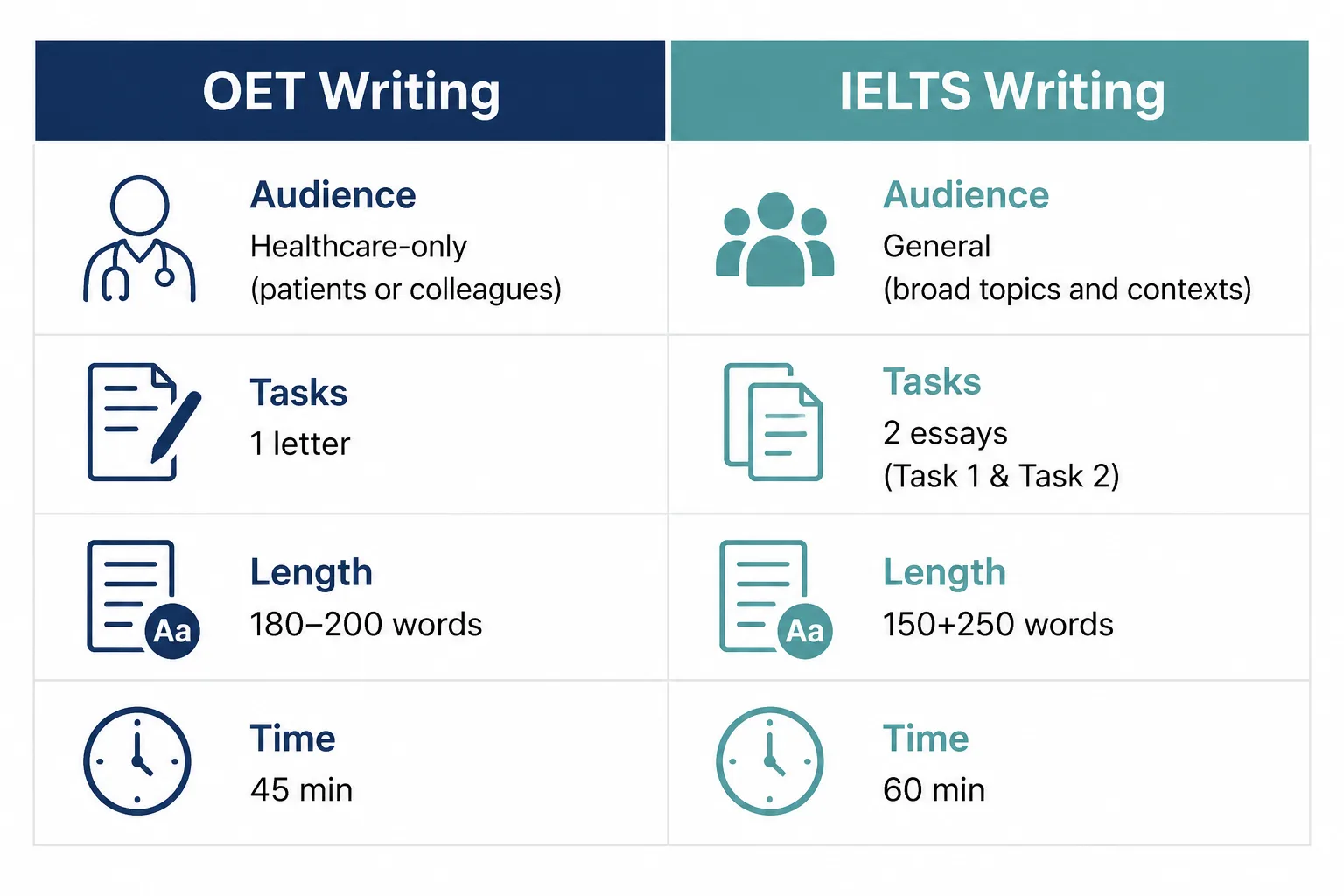
IELTS vs OET: Side-by-Side Comparison
This comparison covers the key differences between IELTS Academic and OET across format, content, scoring, and acceptance. Data is based on official information published by the British Council (IELTS) and Cambridge Boxhill Language Assessment (OET).
Sources: British Council IELTS Official Information; Cambridge Boxhill Language Assessment (CBLA) OET Official Guide. Fees vary by location and are subject to change.
The 60-Second Decision: Five Questions
Answer these five questions in order. The first answer that points clearly to one exam is your answer — you don't need to score the whole list.
- 1
Are you registering with a healthcare regulator that explicitly accepts OET?
Yes → OET is almost always the easier route for healthcare professionals. The content is your daily clinical work.No / unsure → check your regulator's website. The major regulators that accept OET are NMC (UK nurses), GMC (UK doctors), AHPRA (Australia), NMBI (Ireland), Medical Council of NZ, GPhC (UK pharmacists), and DHA (Dubai). - 2
Are you in one of OET's 12 covered professions (medicine, nursing, dentistry, pharmacy, physiotherapy, occupational therapy, optometry, podiatry, dietetics, radiography, speech pathology, veterinary)?
Yes → OET is built for you. The exam content reflects your profession.No → IELTS is your only option. OET is profession-specific. - 3
Are you also applying to a university (Master's, PhD, postgraduate medical course)?
No → stay with OET if your regulator accepts it.Yes → check the university's English requirements. Most universities require IELTS specifically; OET is rarely accepted for academic admission. Consider IELTS if you must satisfy both. - 4
Are you applying for skilled migration before securing a healthcare job?
No → stay with OET.Yes → many immigration authorities require IELTS specifically (e.g. Australian skilled visas, UK Skilled Worker outside healthcare sponsorship). Check before deciding. - 5
Are you stronger in clinical English than in academic essay writing?
Yes → OET plays to your strengths. Writing about a patient case is closer to your daily work than discussing 'whether children should be allowed to use mobile phones'.Honestly stronger at general academic essays → IELTS may suit you better, even if your regulator accepts both.
Most healthcare professionals reading this page will land on OET after the first question. The remaining questions exist for the edge cases — non-healthcare professions, university admissions, and migration without a healthcare offer.
Recommended Exam by Profession × Destination Country
At-a-glance recommendation by your profession and where you intend to register. "OET" means the regulator accepts OET and most candidates find it easier; "Either" means the regulator accepts both at equivalent scores; "IELTS" means OET is not currently accepted by that body.
| Profession | UK | Australia | Ireland | New Zealand | Canada | USA |
|---|---|---|---|---|---|---|
| Doctor | OET (GMC) | OET (AMC) | OET (MCI) | OET (MCNZ) | IELTS | IELTS |
| Nurse | OET (NMC) | OET (AHPRA) | OET (NMBI) | OET (NCNZ) | Either (NCAS) | IELTS |
| Pharmacist | OET (GPhC) | OET (PBA) | Either (PSI) | OET (PCNZ) | IELTS | IELTS |
| Dentist | OET (GDC) | OET (DBA) | OET (DCI) | OET (DCNZ) | IELTS | IELTS |
| Physiotherapist | Either (HCPC) | OET (PBA) | Either (CORU) | OET (PBNZ) | IELTS | IELTS |
| Other allied health | Varies (HCPC) | OET (AHPRA) | Varies (CORU) | Varies | IELTS | IELTS |
Sources: official regulator websites — NMC, GMC, GPhC, GDC, HCPC (UK); AHPRA member boards (AU); NMBI, MCI, DCI, PSI, CORU (IE); MCNZ, NCNZ, PBNZ, DCNZ, PCNZ (NZ); NCAS (CA). The USA does not currently use OET for licensure of internationally trained healthcare professionals — IELTS or TOEFL is required by ECFMG and equivalent bodies.
Who Should Choose OET?
OET is available for 12 healthcare professions. If your regulatory body accepts OET, it is often the more natural choice because the test content mirrors your daily clinical work.
Doctors
OET writing tasks involve referral and discharge letters that mirror real clinical correspondence. Medical terminology and patient history summaries are familiar from daily practice.
Nurses & Midwives
Nursing OET tasks focus on transfer letters, discharge summaries, and referrals to allied health. The NMC, AHPRA, and NMBI all accept OET for registration.
Pharmacists
OET for pharmacy includes medication-related correspondence. The GPhC and Pharmacy Board of Australia accept OET as proof of English proficiency.
Dentists & Allied Health
OET covers dentistry, physiotherapy, occupational therapy, radiography, speech pathology, podiatry, dietetics, and veterinary science with profession-specific scenarios.
When IELTS May Be the Better Choice
IELTS is more widely accepted outside healthcare and may be required in certain situations. Consider IELTS if any of the following apply to you.
Academic Study Requirements
If you are applying to a university programme (such as a postgraduate medical degree or nursing degree), many institutions require IELTS specifically. OET is not always accepted for academic admission, even in healthcare-related courses.
Immigration Without Healthcare Registration
If you are applying for a skilled migration visa without immediate plans for healthcare registration, IELTS is typically the required test. Immigration authorities in most countries accept IELTS but may not accept OET for general visa applications.
Non-Healthcare Professions
OET is only available for 12 specific healthcare professions. If your profession is not covered (for example, hospital administration, health informatics, or biomedical science), IELTS is your primary option.
OET and IELTS Score Equivalencies
The following equivalencies are based on the official score comparison published by Cambridge Boxhill Language Assessment. These are used by regulatory bodies when assessing applications from candidates who have taken either exam.
Key benchmark: Most healthcare regulatory bodies require OET Grade B (350+) or IELTS 7.0. This includes the UK NMC (nursing), UK GMC (medicine), AHPRA (Australia), and the Medical Council of Ireland. Always verify the current requirements with your specific regulatory body, as these can change.
Source: Cambridge Boxhill Language Assessment (CBLA) Official Score Comparison Guide.
Key Differences in Writing: OET Letter vs IELTS Essay
The writing component is where OET and IELTS differ most significantly. Understanding these differences is essential for choosing the right exam and preparing effectively.
1 Task Type and Format
OET Writing
You write one professional clinical letter (referral, discharge, or transfer) based on provided case notes. The task simulates real workplace communication. You have 45 minutes and should write approximately 180-200 words.
IELTS Writing
You complete two tasks in 60 minutes. Task 1 (150+ words) requires describing visual data such as graphs, charts, or diagrams. Task 2 (250+ words) requires writing an argumentative or discursive essay on a general topic.
2 Assessment Criteria
OET: 6 Criteria
- Purpose
- Content
- Conciseness and Clarity
- Genre and Style
- Organisation and Layout
- Language
IELTS: 4 Criteria
- Task Achievement / Task Response
- Coherence and Cohesion
- Lexical Resource
- Grammatical Range and Accuracy
3 Content and Vocabulary
This is the most significant practical difference. In OET, you use the medical vocabulary and clinical reasoning you already possess. In IELTS, you must write about topics such as urbanisation, education policy, or technology, which may be unfamiliar and require different vocabulary.
IELTS Challenge
"Write about whether governments should invest more in public transport or road infrastructure."
OET Advantage
"Write a referral letter to a physiotherapist for a patient recovering from knee replacement surgery."
Which Exam is Easier for Healthcare Professionals?
There is no universal answer, but research and candidate experience consistently point to OET being more accessible for most healthcare professionals. Here is an honest comparison of the difficulty factors.
Why OET Feels Easier
Familiar content
You are writing about patients, conditions, and treatments you work with every day. There is no need to generate ideas about unfamiliar academic topics.
Shorter writing task
One letter of 180-200 words in 45 minutes, compared to two IELTS tasks totalling 400+ words in 60 minutes.
Guided by case notes
OET provides case notes as stimulus material, so you do not need to generate content from scratch. You select and transform given information.
Professional vocabulary advantage
Your existing medical vocabulary counts toward your score. In IELTS, specialised medical terms are largely irrelevant.
Where OET is Harder
Stricter tone requirements
OET demands consistent professional register. Examiners assess whether your letter reads as authentic clinical correspondence, not just good English.
Content selection judgement
You must decide what to include and omit from case notes. Including irrelevant information is penalised, unlike IELTS where you describe all given data.
Paraphrasing requirement
Copying case notes verbatim loses marks. You must transform clinical shorthand into professional sentences while maintaining accuracy.
Genre-specific conventions
You need to know the conventions of clinical letter writing, including appropriate salutations, request forms, and professional closings.
Our recommendation: If your regulatory body accepts OET and you are an active healthcare professional, OET is likely the better choice. The clinical context gives you a significant advantage in both writing and reading. If you need the score for academic admission or immigration purposes outside of healthcare registration, IELTS may be necessary regardless.
Frequently Asked Questions
Which is easier for healthcare professionals, IELTS or OET?
Most healthcare professionals find OET easier because the content is drawn from familiar clinical scenarios. You write about patients, conditions, and treatments you encounter daily. However, OET has stricter requirements for professional tone and clinical judgement, so the answer depends on your individual strengths.
Can I take both IELTS and OET?
Yes, there is no restriction on taking both exams. Some candidates take both to maximise their options. However, this means preparing for two different formats, which requires more study time. Most candidates benefit from focusing on one exam and preparing thoroughly.
Which countries accept OET for healthcare registration?
OET is accepted in the United Kingdom (NMC, GMC, GPhC, GDC), Australia (AHPRA), New Zealand, Ireland (NMBI, Medical Council), Singapore, Dubai (DHA), and Ukraine. The list of accepting bodies continues to grow. IELTS is accepted more broadly for general immigration and academic purposes.
Is OET cheaper than IELTS?
IELTS is cheaper per sitting (approximately USD 245-310) compared to OET (approximately USD 587). However, many healthcare professionals achieve their required score in fewer OET attempts because the content is clinically familiar, which can make OET more cost-effective overall.
Whichever Exam You Choose, We Can Help
Our correction service supports both OET and IELTS writing. Submit your practice letter or essay and receive detailed, criteria-specific feedback from experienced teachers who specialise in healthcare candidate preparation.