OET Discharge Letter Guide
Discharge letters require a different approach from referral letters. This guide explains the structure, content selection, and medication presentation that OET examiners expect in discharge summaries for Grade B (350/500) and above, based on the official assessment criteria developed by Cambridge Boxhill (the joint venture that runs OET).
View Correction Packages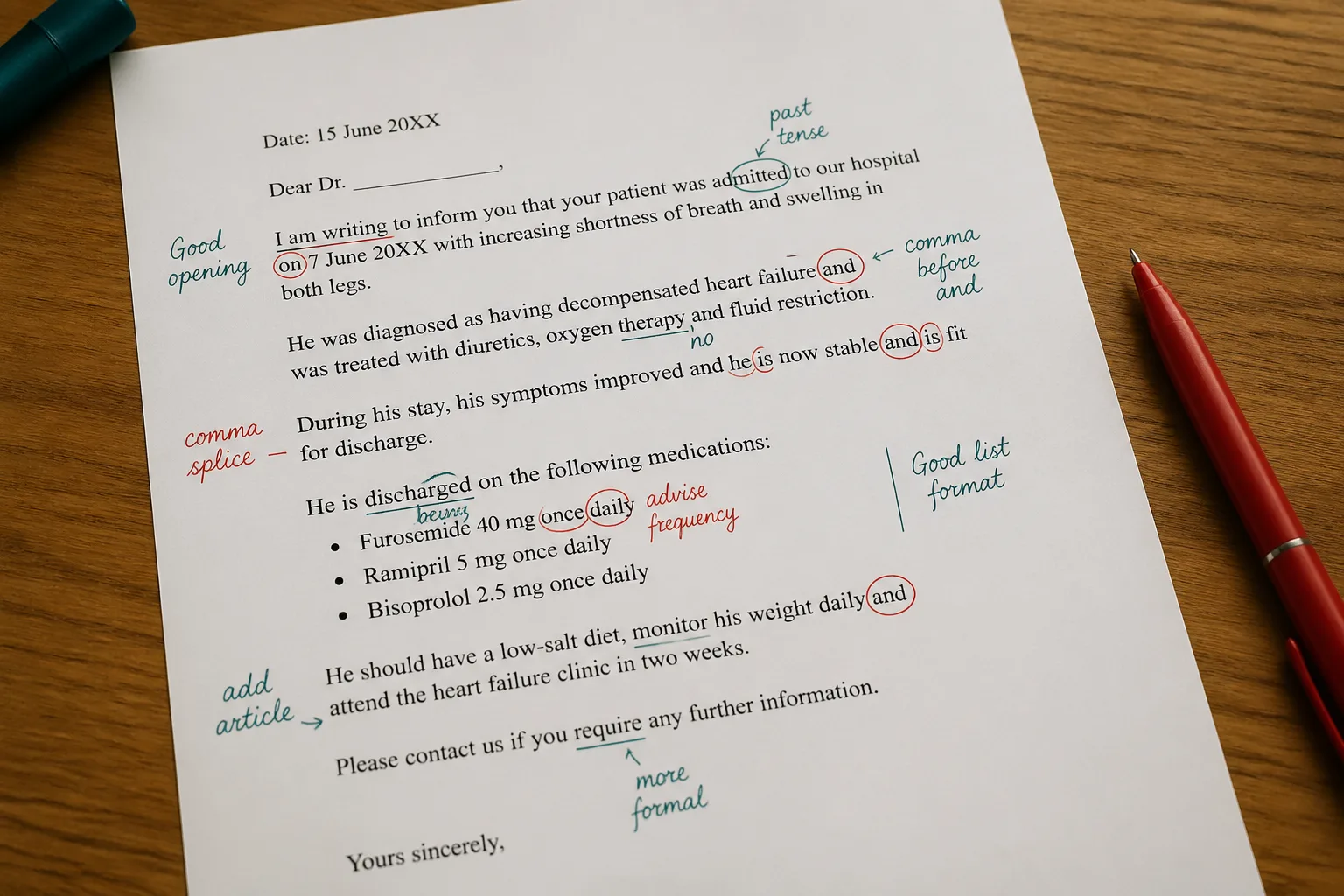
What Makes Discharge Letters Unique
Discharge letters serve a fundamentally different communicative purpose from referral or transfer letters. Understanding this difference is the first step toward achieving a strong score.
A discharge letter is written after a patient's hospital stay has concluded. The letter communicates to the patient's general practitioner or community care team what happened during the admission, what treatment was provided, and what needs to happen next. According to the OET official assessment framework developed in collaboration with Cambridge Boxhill (the joint venture that runs OET), the letter must demonstrate that the candidate can summarise clinical information concisely and provide actionable follow-up instructions.
Analysis of published OET writing tasks indicates that approximately 30% involve discharge or post-admission communication. Candidates who prepare exclusively for referral letters may be unprepared for the different content selection and organisational demands of discharge summaries.
Backward-Looking Summary
Unlike referral letters that present a current problem, discharge letters summarise what has already happened during an admission.
Medication Focus
Discharge letters must clearly list current medications with dosages, new prescriptions, and any changes made during the stay.
Follow-Up Instructions
The letter must specify what monitoring, appointments, or actions the GP or community team needs to arrange.
Appropriate Reader Level
The level of clinical detail should match the reader. A letter to a GP requires practical management information, not specialist-level analysis.
Discharge Letter Structure
A well-organised discharge letter follows a logical sequence from admission reason through to follow-up plan. Each section has a clear purpose in ensuring continuity of care.
Opening: Discharge Statement
Begin by confirming the patient has been discharged and stating the reason for admission. This immediately orients the reader.
Example
I am writing to inform you that Mrs Chen, a 74-year-old patient, was discharged from Westfield General Hospital on 18 February following a five-day admission for management of community-acquired pneumonia.
Hospital Course Summary
Provide a concise summary of key findings, investigations, and treatment during the stay. Avoid a day-by-day account — focus on clinically significant events and outcomes.
Example
On admission, she presented with a productive cough, fever of 38.7 degrees Celsius, and right-sided pleuritic chest pain. A chest X-ray confirmed right lower lobe consolidation. She was commenced on intravenous amoxicillin-clavulanate, which was later stepped down to oral antibiotics following clinical improvement.
Condition at Discharge
Describe the patient's clinical status at the time of discharge. This helps the receiving clinician understand the patient's baseline when they present for follow-up.
Example
At discharge, Mrs Chen was afebrile, with oxygen saturations of 96% on room air. Her appetite had returned and she was mobilising independently.
Discharge Medications
List all medications the patient was discharged on, including dosages, frequency, and duration where applicable. Clearly note any new medications started or previous medications changed during the admission.
Example
Her discharge medications include: amoxicillin-clavulanate 625 mg three times daily for a further five days, paracetamol 1 g four times daily as required for pain, and her regular medications including metformin 500 mg twice daily and ramipril 5 mg once daily.
Closing: Follow-Up Plan
Specify what needs to happen next: follow-up appointments, repeat investigations, monitoring requirements, and red flags that should prompt re-presentation. Offer availability for further discussion.
Example
I would be grateful if you could arrange a repeat chest X-ray in six weeks to confirm resolution. Please advise Mrs Chen to re-present if she develops worsening breathlessness, fever, or haemoptysis. Do not hesitate to contact me should you require further information.
What to Include vs What to Exclude
Content selection is one of the most challenging aspects of discharge letters. The OET assessment criteria specifically evaluate whether candidates include appropriate information and omit irrelevant details.
Include
- Reason for admission (presenting complaint)
- Key investigation results that affect ongoing care
- Treatment provided and response to treatment
- All discharge medications with dosages
- Changes to pre-admission medications
- Follow-up appointments and monitoring needed
- Red flags or warning signs for the patient
- Functional status at discharge
Exclude
- Detailed day-by-day account of the admission
- Normal investigation results unless specifically relevant
- Nursing observations that do not affect GP management
- Social history details unrelated to discharge care
- Verbatim case note entries
- Administrative details (bed number, ward name)
- Detailed operative notes (summarise outcomes instead)
- Information the GP already knows from their own records
Common Mistakes in OET Discharge Letters
Based on patterns observed across thousands of OET candidate submissions, these are the errors that most frequently prevent candidates from reaching Grade B.
Chronological Case Note Dumping
Candidates recount the entire admission chronologically, listing every observation and event from the case notes. Examiners expect a concise clinical summary, not a timeline. Select only the events that affect the reader's ongoing management of the patient.
Missing or Incomplete Medication Information
Failing to include discharge medications, or listing medication names without dosages and duration, is a significant content omission. The OET assessment criteria penalise letters that do not provide the reader with the practical information they need for patient management.
No Clear Follow-Up Plan
A discharge letter without follow-up instructions leaves the GP without a clear next step. Always specify what appointments, investigations, or monitoring the reader should arrange, including timeframes where the case notes provide them.
Inappropriate Level of Detail for the Reader
Writing at specialist level when the reader is a general practitioner, or providing overly basic information to a specialist colleague. The OET genre criterion assesses whether the candidate has adjusted their communication for the specified reader.
Verbatim Case Note Copying
Copying phrases directly from the case notes rather than paraphrasing into professional letter format. This affects scores across multiple criteria including language, genre, and overall task fulfilment. Examiners specifically check for evidence of paraphrasing ability.
Presenting Medications Effectively
Medication presentation is a critical component of discharge letters that many candidates handle poorly. Here is how to present medication information clearly and professionally.
Weak Medication Presentation
Issue: No specific medication names, no dosages, no duration. The GP cannot safely manage the patient's medications from this information.
Strong Medication Presentation
Strength: Specific medication names with dosages, frequency, and duration. Changes to pre-existing medications are highlighted for the GP's attention.
Medication Presentation Tips
- Always include generic drug names, dosages, frequency, and route of administration where provided in the case notes
- Specify duration for new or temporary medications (e.g., 'for seven days,' 'until review')
- Clearly flag any changes to the patient's pre-admission medications — this is critical for GP safety
- Use consistent formatting: drug name, dose, frequency, then additional instructions
- If a medication was stopped during admission, state this explicitly so the GP does not inadvertently continue it
Frequently Asked Questions
What should be included in an OET discharge letter?
An OET discharge letter should include: a clear statement that the patient is being discharged and the reason for the original admission, a summary of treatment and investigations during the hospital stay, current medications with dosages and instructions, follow-up appointments or recommended actions, and any specific instructions for the receiving clinician or patient. The OET assessment criteria, developed with Cambridge Boxhill (the joint venture that runs OET), emphasise that content selection must be appropriate for the reader and clinical context.
How is a discharge letter different from a referral letter in OET?
A discharge letter summarises care that has already been provided and communicates what the patient's GP or community team needs to know going forward. A referral letter requests a new consultation or specialist assessment. The key structural difference is that discharge letters look backward (what happened) and forward (what needs to happen next), while referral letters present a problem and request action. Discharge letters typically include medication lists and follow-up plans, which are less prominent in referral letters.
What are common mistakes candidates make in OET discharge letters?
Common mistakes include: providing an overly detailed day-by-day account of the hospital stay instead of a concise summary, omitting discharge medications or failing to specify dosages, copying case notes verbatim without paraphrasing, neglecting to include follow-up instructions, and using an inappropriate level of detail for the reader (for example, providing specialist-level detail to a GP who needs a practical management summary).
How long should an OET discharge letter be and what structure should it follow?
An OET discharge letter should be approximately 180-200 words, written within the 40-minute time allocation. The recommended structure is: (1) opening statement confirming discharge and the reason for admission, (2) summary of hospital course including key findings and treatment, (3) condition at discharge, (4) discharge medications with clear dosage information, and (5) follow-up plan and any instructions for ongoing care. According to OET official guidance, clear organisation and appropriate content selection are assessed as distinct criteria.
Get Expert Feedback on Your Discharge Letters
Our OET-specialist correctors assess your discharge letters against all six official criteria. Receive detailed feedback on content selection, medication presentation, and follow-up instructions.