Decision guide · For doctors · 2026 update
OET vs IELTS for Doctors: which English test should you choose?
A 2026 decision guide comparing OET and IELTS for medical professionals. Use this to match test format and regulator requirements before you book.
In short
- →OET targets workplace communication for healthcare; often quicker transfer to clinical tasks (2026).
- →IELTS has broader global acceptance and immigration use; better for non‑clinical pathways (2026).
- →Check your regulator’s 2026‑site for exact score and single‑sitting rules before booking.
OET vs IELTS at a glance
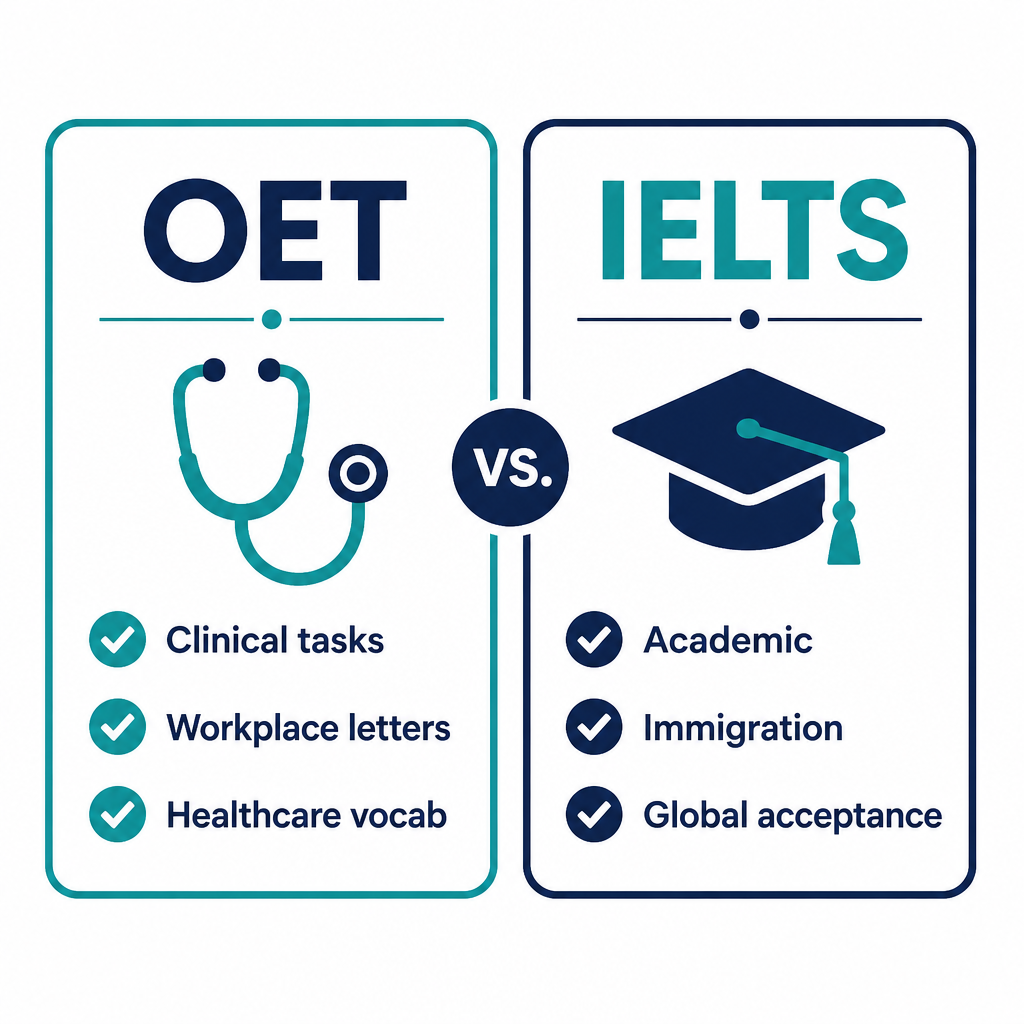
The full comparison
| Dimension | OET | IELTS |
|---|---|---|
| Accepted by | Widely accepted by many health regulators and employers; preferred by healthcare employers. | Accepted by universities, immigration and many regulators; broader non‑clinical recognition. |
| Exam length | About 2.5–3 hours total across four subtests tailored to clinical scenarios. | About 2 hours 45 minutes for Listening, Reading, Writing and a separate Speaking test. |
| Scoring band | Grades A–E; regulators commonly require Grade B in subtests for registration. | Scores 0–9 band scale; many regulators request 7.0 overall and 7.0 minimum in components. |
| Cost | Typically similar to IELTS; varies by country and test centre (check local fees). | Fee varies by test centre and country; often comparable to OET locally. |
| Retake rules | You may retake individual OET subtests on later dates; check local scheduling. | You retake the full IELTS test; some centres offer computer or paper retakes. |
| Writing skill transfer | High transfer: task types model real clinical letters and referrals. | General academic tasks; useful for academic writing but less clinical realism. |
| Healthcare relevance | Designed around clinical tasks and vocabulary; higher face validity for jobs. | General English; vocabulary and tasks not specific to clinical practice. |
| Computer / paper | Available on paper and computer; subtest delivery depends on test centre. | Available paper‑based and computer‑delivered; speaking often face‑to‑face or online. |
| Results turnaround | Results typically within 7–16 days depending on delivery method. | Results from 2–13 days depending on computer or paper mode and test centre. |
When to choose OET
Choose OET if most of your immediate need is clinical communication: patient history, referrals, discharge letters and handovers. OET tasks map closely to everyday doctor duties, so scores and feedback usually reflect workplace use rather than purely academic skill.
Choose OET also when your regulator or employer explicitly lists OET as an accepted test or where demonstrable workplace language is prioritised. Many doctors find OET preparation improves clinical written communication directly and can be more time‑efficient for workplace language needs.
Pros
- • Tasks model real clinical communication and letters.
- • High face validity for employers and clinical teams.
- • Writing feedback maps directly to workplace tasks.
- • You can retake individual subtests in many locations.
Cons
- • Less recognised outside healthcare and academia.
- • Some regulators still prefer IELTS in migration cases.
- • Test availability varies by centre and country.
When to choose IELTS
Choose IELTS if you need broad recognition beyond healthcare — for university entry, migration or workplaces that list IELTS specifically. IELTS remains the most commonly requested academic test for many governments and higher‑education institutions.
Choose IELTS when you prefer general academic tasks or when your regulator accepts IELTS and you already have preparation geared to band scores. IELTS can be advantageous where overall band and component thresholds are the explicit requirement.
Pros
- • Broad global recognition for education, immigration and work.
- • Standardised banding widely understood by employers.
- • Multiple delivery modes (paper/computer).
Cons
- • Writing tasks are academic, not clinical.
- • May require higher overall bands to satisfy some regulators.
- • Less direct feedback on workplace writing.
What each healthcare regulator currently accepts
| Profession | Requirement (2026) |
|---|---|
| NMC (Nurses) | NMC commonly accepts OET Grade B in each subtest or IELTS Academic 7.0 overall with 7.0 minimum components; verify current NMC guidance. |
| GMC (Doctors, UK) | GMC accepts OET Grade B in all subtests or equivalent IELTS Academic 7.0 bands; check GMC pages for single‑sitting rules. |
| AHPRA/AMC (Australia) | Australia’s regulators often accept OET Grade B or IELTS 7.0 for registration; medical registration pathways have specific single‑sitting and verification rules. |
| GPhC (Pharmacists) | GPhC accepts recognised English tests; many overseas pharmacists use OET (Grade B) or IELTS (7.0); confirm current GPhC criteria. |
| GDC (Dentists) | GDC and dental registration routes accept either test; typical request is OET Grade B or IELTS 7.0; check GDC for exact thresholds. |
| HCPC (Allied Health Professions) | HCPC commonly recognises IELTS and OET; typical requirements mirror 7.0 or OET Grade B levels; always verify with HCPC. |
2026 update
What changed in 2026 for this comparison
From 2026 regulators and test providers have tightened verification and scoring practices: OET continues to use the 2018 writing criteria but with stricter marking enforcement and clearer descriptors for Grade B and above. Many regulators now publish single‑sitting stipulations and stricter proof‑of‑identity rules.
Before you book, check your regulator’s 2026‑update page: some boards require all components at a named threshold within one test window, or they require specific test versions. These operational changes affect scheduling and retake planning, so confirm the exact requirement directly with the regulator.
Frequently asked questions
Is OET better than IELTS for a medical CV?
OET is often seen as more relevant on a medical CV because tasks mirror clinical practice, but employers and regulators sometimes state a preference. Check the employer or regulator first.
Can I mix OET and IELTS subtests for registration?
Most regulators require a single test type; some accept either test but not mixed results. Always confirm on the regulator’s official guidance.
Which test is easier to prepare for as a doctor?
Doctors often find OET preparation feels more efficient because materials map to clinical tasks; ease depends on your strengths in academic versus workplace language.
How long are OET results valid?
Most regulators accept results for two years, but validation periods vary by body. Check the specific regulator for exact validity rules.
Can I retake only the OET writing subtest?
Many test centres allow retaking individual OET subtests rather than the full test, but local availability varies. Check the OET booking options in your country.
Do medical schools prefer IELTS for postgraduate training?
Postgraduate training programmes and universities often list IELTS Academic; some accept OET. Confirm the programme’s posted language requirement.
Keep learning
Scoring criteria
Decided on OET? Get expert feedback on your letters.
See OET Writing Correction packs →