Criterion 6 of 6 · Score 0–7 · 2026 Update
OET Writing: The Language Criterion (Score 0–7) Explained
The Language criterion judges grammatical accuracy, range and appropriateness of vocabulary and spelling in your OET letter.
TL;DR
- →Marks reflect accuracy, range and appropriateness of your language.
- →Errors that impede understanding lose marks quickly.
- →Use correct healthcare vocabulary and consistent register.
Scoring matrix: Language 0–7
Examiner descriptor and a healthcare-specific example for each band.
| Band | Examiner descriptor | Healthcare example |
|---|---|---|
| 0 | No effective use of language; communication is unintelligible or absent. | Letter largely incomprehensible: sentences unclear, key clinical details unreadable, patient care cannot be determined. |
| 1 | Very limited language; frequent errors seriously impede communication. | Multiple sentence fragments and wrong words: ‘patient chest pain yesterday no take medicine’ — meaning unclear. |
| 2 | Severe and frequent errors; only isolated recognisable language, meaning often lost. | Confused tense and vocabulary: ‘She have operation last week… bleeding still’ — critical details missing or ambiguous. |
| 3 | Frequent errors that often impede communication; limited range of structures and vocabulary. | Grammar errors and wrong collocations: ‘Patient is feeling much more bad’ — clinician must infer intended meaning. |
| 4 | Some control of language but errors frequent; meaning usually clear but repair needed. | Noticeable grammar and preposition errors: ‘discharged on past Monday, follow up in two weeks’ — dates and instructions mostly clear. |
| 5 | Generally effective language with occasional errors that do not hinder overall communication. | Mostly accurate: ‘prescribed analgesia PRN’ with occasional awkward phrasing but overall clear plan. |
| 6 | Good range and control with occasional lapses; vocabulary appropriate and mostly accurate. | Clear clinical summary with minor slips: ‘wound looks well, no sign infection’ (missing article), but management is explicit. |
| 7 | Highly accurate, appropriate and flexible use of grammar and vocabulary; errors very rare. | Precise, natural language: ‘Patient remains stable post-op and may commence physiotherapy tomorrow; analgesia plan attached.’ |
When I mark Language I look for reliable, accurate language that lets me read the clinical content without pausing to decode mistakes. I notice repeated error types — tense shifts, wrong prepositions, inconsistent terminology — because these are the slips that slow understanding and lower the band.
Accuracy matters most: a single clear instruction can be worth more than several impressive words used incorrectly. I expect healthcare vocabulary used appropriately (for example, ‘analgesia’ vs ‘painkiller’) and consistent register; you should sound like a clinician writing to a colleague.
Finally, I look for errors that affect meaning. Spelling mistakes that don’t change clinical content are less serious than grammar that alters intent or timeline. If your language allows me to follow the story, the reason for referral, and the recommended actions without guesswork, you will be rewarded here.
— Dr Mariam, OET writing tutor and marker for 20+ years (marked 11,000+ letters). Usually I prefer simple, correct language to complex but error-prone phrasing. I mark consistently against the descriptors above and prioritise clarity for patient safety and continuity of care.
Worked example: before and after
Scenario: Mr Patel, 68, T2DM, referred for wound review after left foot ulcer debridement three days ago. On insulin. Wound shows minimal serous discharge, no fever. Taking oral antibiotics started two days ago. Requests dressing change and community nursing follow-up.
Before
Dear Dr Brown,
Mr Patel, 68, had debride of left foot ulcer three days ago. He is diabetic and insulin at home. Wound little discharge, no fever. He on oral antibiotics since two days. Please change dressing and arrange nurse for follow up.
Regards, Nurse A
- • Tense and verb forms incorrect or inconsistent: ‘had debride’ instead of ‘had debridement’ or ‘underwent debridement’.
- • Missing articles and prepositions reduce clarity: ‘He on oral antibiotics since two days’ obscures timeline and continuity.
- • Inaccurate collocations and register: ‘Please change dressing’ lacks details and clinical tone; ‘arrange nurse’ is vague.
After
Dear Dr Brown,
Mr Patel is a 68-year-old man with type 2 diabetes mellitus who underwent debridement of a left foot ulcer three days ago. He remains on a basal-bolus insulin regimen at home. The wound has minimal serous discharge and he remains afebrile.
He commenced oral antibiotics two days ago. Please arrange community nursing for dressing changes and wound review; recommend next review in 48–72 hours. If you would like, I can provide daily wound observations until first community visit.
Kind regards, Nurse A
- • Corrected verb forms and medical nouns make the timeline clear: ‘underwent debridement’ and ‘three days ago’.
- • Improved grammar and articles clarify treatment and status: ‘commenced oral antibiotics two days ago; he remains afebrile’.
- • Precise requests use appropriate clinical register and clear actions: ‘arrange community nursing for dressing changes and wound review’ with timeframe.
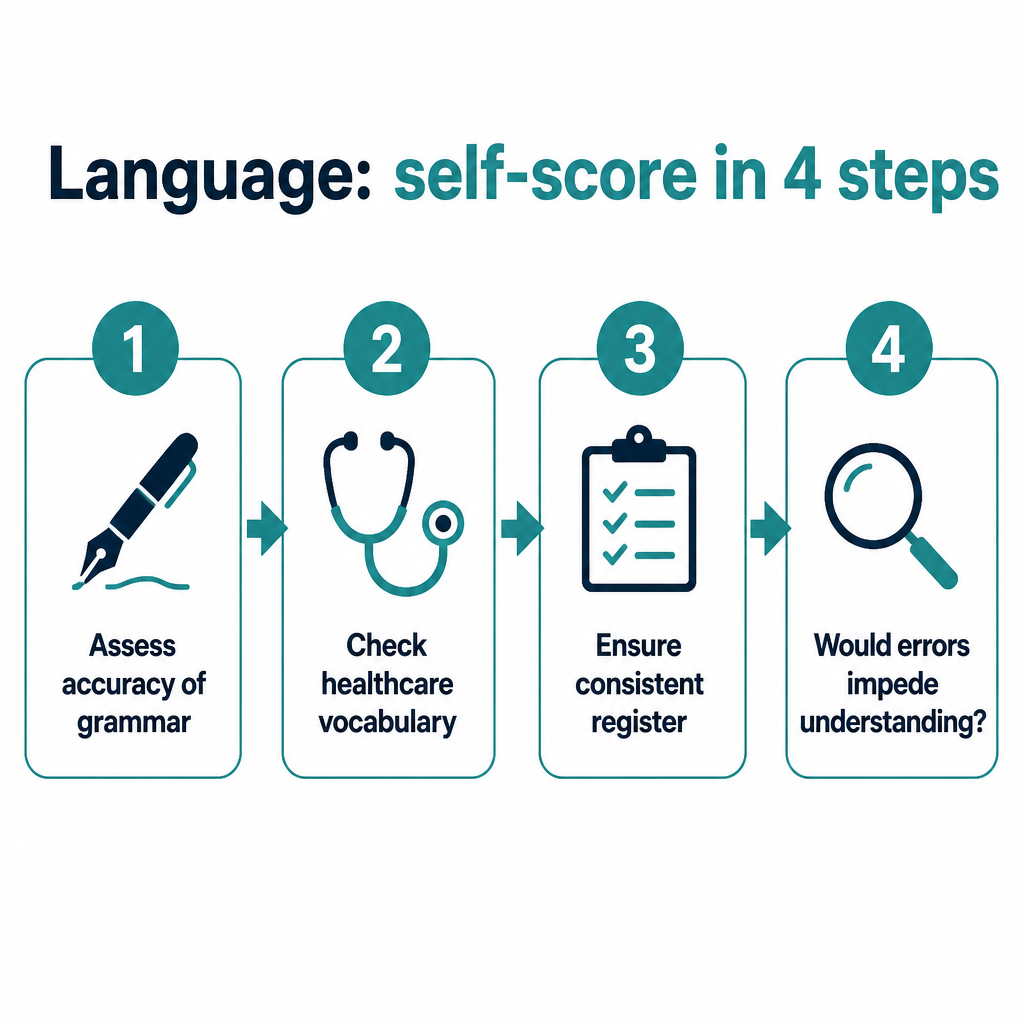
Self-score: a 4-step decision flow
How Language interacts with the other criteria
Language interacts with every other OET Writing criterion because wording is the vehicle for content, purpose and professional tone.
If your language is accurate and appropriate, Content and Purpose are easier to demonstrate: a clear request, accurate clinical details and correct terminology let the reader act on the letter. Conversely, poor grammar or wrong vocabulary will make well-organised content look weak and can reduce your Organisation and Genre-Style scores because examiners struggle to follow intended sequencing or tone.
Language also affects Conciseness and Clarity. You can be concise but still unclear if grammar or word choice is faulty. Finally, errors that change meaning (wrong tense, missing negation) will damage multiple criteria, because a sentence that misstates the plan affects clinical safety and the fulfilment of the task.
In short: strong language supports the other criteria; weak language can nullify otherwise good content and layout by creating ambiguity or extra work for the reader. Aim for precise, error-free clinical phrasing to protect all scores at once.
5 failure patterns (and how to fix them)
1. Tense inconsistency that changes clinical timeline.
Fix: Use simple, consistent tenses: 'The operation was on 2 May. He remains stable post‑op.'
Impacts: Language: creates ambiguity about when events occurred, losing marks.
2. Incorrect or imprecise clinical vocabulary.
Fix: Replace vague words with precise terms: 'antibiotic started' → 'amoxicillin 500 mg twice daily started'.
Impacts: Language: wrong terms reduce accuracy and professionalism.
3. Missing articles and prepositions that obscure meaning.
Fix: Add necessary small words: 'discharged on Monday' not 'discharged Monday'.
Impacts: Language: errors decrease clarity and can impede communication.
4. Overly complex sentences with multiple errors.
Fix: Split into short, correct sentences: 'He has chest pain. It started 2 hours ago.'
Impacts: Language: complexity with errors reduces comprehensibility and score.
5. Inconsistent register — informal phrasing in a clinician letter.
Fix: Use professional register: 'Please see for assessment' not 'Can you check him out?'.
Impacts: Language: inappropriate tone lowers professionalism and marks.
Profession-specific notes
| Profession | Typical pitfall | Quick fix |
|---|---|---|
| Nurse | Using conversational phrasing and missing articles. | Use clinical nouns and add necessary articles: 'the wound is clean' rather than 'wound clean'. |
| Doctor (GP) | Assuming specialist terms without precise context. | Specify details: 'hypertension, controlled on lisinopril 10 mg' not just 'HTN'. |
| Pharmacist | Inconsistent drug names or incorrect dosing expressions. | Use full drug name and standard dose format: 'prednisolone 20 mg daily'. |
| Physiotherapist | Vague function descriptions and weak verbs. | Use objective phrasing: 'able to walk 20 metres with frame' rather than 'walking OK'. |
| Dentist | Mixing lay and technical terms within the same sentence. | Choose one register: 'periapical radiolucency' or 'area of bone loss', not both together. |
2026 update
What changed in the 2026 scoring regime
The 2026 scoring update tightened expectations for consistent accuracy and appropriate vocabulary under the Language criterion. Examiners now penalise repeated mid-level errors more severely, especially where they affect clinical meaning or action.
You must demonstrate steady control across the whole letter; occasional slips are tolerated, but recurrent mistakes in grammar, small words or terminology will drop the band. Focus on consistent tense use, precise healthcare vocabulary and professional register throughout the letter to meet the stricter standard in 2026. Errors that alter timelines or treatment risk multiple-criterion penalties and a lower Language score.
Frequently asked questions
What exactly does 'range' mean in Language?
Range refers to the variety of grammar and vocabulary you use. Examiners expect enough range to describe clinical events, explain plans and make professional requests accurately.
Do spelling mistakes always lose marks?
Minor spelling errors that do not change meaning are less serious. Repeated spelling mistakes or errors that alter clinical terms will cost marks under Language.
Which errors are most harmful to my Language score?
Errors that change meaning — wrong tense, missing negation, incorrect dose or timing — are most harmful because they affect patient care and clarity.
Can I use contractions in OET letters?
Avoid contractions. Use professional register without colloquial language; contractions can appear informal and reduce your Language and Genre-Style scores.
How much vocabulary accuracy is enough?
Use common, accurate clinical vocabulary. You do not need rare words, but you must use the correct terms consistently and appropriately for the clinical situation.
How should I practise to improve Language?
Practice focused error correction: rewrite sample letters, target recurring mistakes, and learn set phrases for referrals. Seek feedback on whether language changes meaning.
Keep learning
Sample letters with feedback
Sibling criteria
Want Dr Mariam to mark your letter against all six criteria?
See OET Writing Correction packs →