Criterion 5 of 6 · Score 0–7 · 2026 Update
OET Writing: The Organisation & Layout Criterion (Score 0–7) Explained
Organisation & Layout assesses how clearly you structure and present a healthcare letter so the reader can find and act on the information.
TL;DR
- →Checks clear paragraphs, headings and sequencing.
- →Needs logical order and salient details up front.
- →Good layout helps readers act quickly and safely.
Scoring matrix: Organisation & Layout 0–7
Examiner descriptor and a healthcare-specific example for each band.
| Band | Examiner descriptor | Healthcare example |
|---|---|---|
| 0 | No organisation; writing is unintelligible or so fragmented it cannot be followed. | Letter has no salutation, one long rambling block with mixed dates, medications and irrelevant detail; recipient cannot identify reason for contact. |
| 1 | Very poor organisation; minimal use of paragraphs; reader struggles to identify purpose or key actions. | Clinical facts, social history and urgent requests are mixed in a single paragraph; no clear request for patient follow-up. |
| 2 | Limited organisation; some attempt at paragraphs but sequencing is unclear or details are misplaced. | History and management are present but reversed: treatment details appear before the presenting complaint, causing confusion about urgency. |
| 3 | Some organisation; paragraphs present but transitions or emphasis are inconsistent, making reader work to find key information. | Paragraphs separate background and plan, but the urgent medication change is buried in the background rather than in the action section. |
| 4 | Competent organisation; logical paragraphing and sequencing but occasional lapses in emphasis or signposting. | Reason for referral and plan are clear; minor details (allergies) are mentioned later rather than with medication information. |
| 5 | Well organised; clear paragraphing, logical order and good emphasis on immediate actions for the recipient. | Greeting, brief history, current findings, clear request and follow-up plan in separate paragraphs; actions are easy to locate. |
| 6 | Very good organisation; structure is purposeful, priorities are clear and layout aids rapid understanding and safe action. | Short, labelled sections: reason, findings, medications, urgent request; immediate action highlighted and signed-off clearly. |
| 7 | Excellent organisation; exemplary layout and sequencing that makes the letter immediately usable and prioritises safety. | Concise heading, bullet points for urgent actions, clear chronology and precise signposting so the recipient can act without clarification. |
I look for a letter a busy clinician can scan and act on within seconds. That means a clear opening that states why you are writing, then short paragraphs that separate background, findings, and the actions you want the reader to take.
Poor layout is the single fastest way to lose marks: walls of text, important details buried mid-paragraph, or requests scattered across the letter make it unsafe. I expect signposting — brief phrases or a listed action — so the reader does not need to hunt for the plan.
When I mark, I imagine the recipient reading at the end of a long shift. If they can find the patient identity, the reason, immediate risks, and the exact request without re-reading, I award higher bands. Conversely, if I must reorder information mentally to find the action, the Organisation & Layout score will be low. Clear paragraphs, logical sequence and emphasis on urgent items are what I prioritise most in this criterion, every time I mark a healthcare letter, including referrals and discharge summaries.
Dr Mariam, OET writing tutor and marker with 20+ years' experience marking healthcare letters and teaching layout skills to clinicians of many professions and specialties.
I never penalise profession-specific content so long as it is placed where a clinician would expect it — history near presentation, management and medication details grouped together, and the request clearly signed off.
Worked example: before and after
Scenario: Mrs Patel, 68, admitted with shortness of breath and productive cough. Temp 38.3°C, HR 110, O2 90% on room air. CXR: right lower lobe consolidation. Started on oral amoxicillin 500 mg TDS. Allergy: penicillin rash. Please advise on ongoing treatment and follow-up.
Before
Dear Colleague
Mrs Patel was admitted with cough, breathlessness and fever. She has consolidation on chest x‑ray and oxygen saturations down to 90% in room air. She was given amoxicillin 500 mg three times daily. She had a rash with penicillin in the past. What do you want to do about her antibiotics and when should she be seen again? Also arrange physiotherapy if needed. Regards, Dr S
- • No clear opening sentence stating purpose; reader must infer reason for contact.
- • Important allergy and drug info scattered and not grouped with plan, risking misinterpretation.
- • Request vague and buried at end; no clear action or timescale.
After
Dear Dr Ahmed,
Re: Mrs Patel, 68 — admitted 12 May with acute lower respiratory infection. I am writing to request antibiotic review and advice on follow-up.
Clinical findings: productive cough, T 38.3°C, HR 110, SpO2 90% on room air. CXR shows right lower lobe consolidation.
Treatment initiated: oral amoxicillin 500 mg tds (started 12 May). Allergy: previous penicillin rash (documented).
Request: Please advise whether to continue amoxicillin given the reported penicillin reaction, and recommend inpatient vs outpatient follow-up. If outpatient, please specify timing (e.g. review in 48–72 hours).
Kind regards, Dr S
- • Opening states reason and request up front, so recipient knows the purpose immediately.
- • Allergy and current antibiotic are grouped under treatment, reducing safety risk.
- • Request is explicit, includes options and a suggested timescale for follow-up.
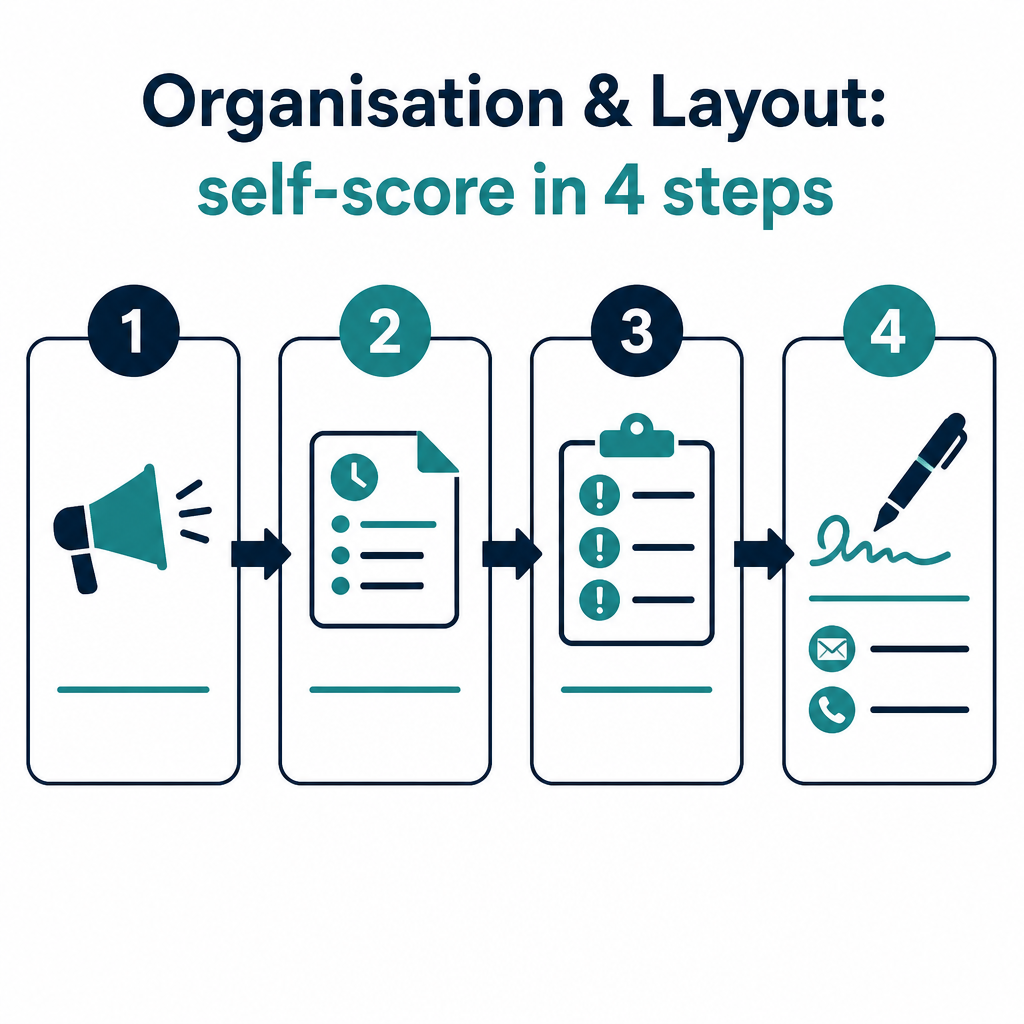
Self-score: a 4-step decision flow
How Organisation & Layout interacts with the other criteria
Organisation & Layout interacts strongly with Purpose and Content. A well-ordered letter makes the purpose obvious and highlights the essential clinical content. When you place the reason, salient findings and requested action in predictable locations, the reader identifies what you want and why without searching.
Poor organisation forces the reader to parse language and infer content, which penalises Language and even Conciseness & Clarity. If an examiner must re-read to understand the order, Language marks fall because unclear sequencing makes even correct grammar seem ineffective. Conversely, strong layout can partially compensate for minor language slips by making the meaning easy to extract.
Organisation also supports Genre & Style: a referral or discharge must follow the professional pattern expected by that recipient. If you follow the genre with clear sections, your letter better meets both the purpose and content requirements and reduces cognitive load for the clinician who will act on your recommendations.
In short: organise well to protect your Content and Language scores, and to demonstrate you understand the clinical genre the recipient expects. Good layout is the hub that improves the rest of the response.
5 failure patterns (and how to fix them)
1. Important action buried in a long paragraph without signposting; recipient may miss urgent request.
Fix: Break into short paragraphs and add a clear action line: "Request: please review antibiotics today and advise."
Impacts: Organisation & Layout
2. Medication, allergy and plan are separated across the letter, creating risk of mismatch.
Fix: Group medication and allergy under a single 'Medications / Allergies' paragraph for clarity.
Impacts: Organisation & Layout
3. No opening sentence stating reason for the letter; reader must infer purpose.
Fix: Start with a one-line purpose: "I am writing to request review of Mrs X's antibiotic therapy."
Impacts: Organisation & Layout
4. Single-wall-of-text paragraph containing background, current findings and requests.
Fix: Separate into labelled paragraphs: 'History', 'Findings', 'Request'.
Impacts: Organisation & Layout
5. Vague request at the end with no timing or action, leaving reader uncertain.
Fix: Make the request specific and time-framed: "Please review within 24 hours and advise whether discharge is safe."
Impacts: Organisation & Layout
Profession-specific notes
| Profession | Typical pitfall | Quick fix |
|---|---|---|
| Nurse | Too much narrative detail in one paragraph; action items hidden. | Use bullet-style short paragraphs: presenting problem, observations, and clear nursing request. |
| Doctor (GP) | Assumes recipient knows context; omits explicit reason and urgency. | Open with the specific request and a one-line clinical summary to set priorities. |
| Pharmacist | Medication changes scattered across text without a consolidated list. | Provide a single 'Medications & Allergies' paragraph or short table listing current drugs and issues. |
| Physiotherapist | Therapy goals and referrals mixed into general notes. | Separate 'Functional status' and 'Request for physiotherapy' into distinct, clearly headed paragraphs. |
| Dentist | Procedural details and follow-up plans are merged, confusing next steps. | Use concise headings: 'Procedure', 'Findings', 'Recommended follow-up' to guide the reader. |
2026 update
What changed in the 2026 scoring regime
The 2026 scoring regime tightens expectations for Organisation & Layout by requiring clearer prioritisation and signposting of actions. Examiners now expect immediate visibility of the reason for contact and any urgent actions, not merely acceptable paragraphing.
This means minor layout lapses that previously sat in mid-bands now more often reduce scores. Candidates must place the purpose, salient findings and explicit requests in predictable, easy-to-find positions to retain higher bands under the stricter marking rules. Clear headings, short paragraphs and concise action lines are more important than ever.
Dr Mariam, marker and tutor, notes that examiners may deduct marks when important actions are buried or when the sequence forces re‑reading; rectify these with a one-line request and grouped clinical facts.
Frequently asked questions
How many paragraphs should my OET letter have?
There is no fixed number, but use short paragraphs for: reason, brief background, findings, treatment, and clear request. Each paragraph should serve one purpose to aid quick scanning.
Can I use bullet points or headings?
Yes. Bullets and short headings help highlight urgent actions and medication lists. Keep them concise and clinically relevant; avoid long prose under a bullet.
Will short sentences score higher for Organisation & Layout?
Short sentences help, but organisation depends on structure too. Use short sentences within logically ordered paragraphs so the reader can find information fast.
Does layout affect Language marks?
Indirectly. Poor organisation makes meaning unclear, which can lower Language and Conciseness & Clarity scores because examiners must infer order and emphasis.
What is the fastest way to lose marks for this criterion?
Burying the request or urgent safety information in a long paragraph or failing to state the purpose up front. Make the action explicit and easy to find.
How do I practise Organisation & Layout effectively?
Rewrite real clinical notes into short, labelled letters. Time yourself and ask a colleague to locate the patient identity, reason, urgent risks, and requested actions within 10 seconds.
Keep learning
Sample letters with feedback
Want Dr Mariam to mark your letter against all six criteria?
See OET Writing Correction packs →