Criterion 1 of 6 · Score 0–3 · 2026 Update
OET Writing: The Purpose Criterion (Score 0–3) Explained
The Purpose criterion checks whether your letter has one clear, appropriate and explicit purpose aligned to the task and recipient.
TL;DR
- →State one clear purpose early and explicitly.
- →Purpose must match the case notes and recipient role.
- →Avoid vague or multiple conflicting purposes.
Scoring matrix: Purpose 0–3
Examiner descriptor and a healthcare-specific example for each band.
| Band | Examiner descriptor | Healthcare example |
|---|---|---|
| 3 | The purpose is clearly and explicitly stated, appropriate to the task and recipient, and maintained through the letter. | Dear Dr Ahmed, I am writing to request a follow-up review for Mr Khan, whose blood pressure remains uncontrolled despite two medication changes. Please see blood pressure chart and advise further management. Kind regards, Nurse Sara |
| 2 | The purpose is identified but may be only partially explicit or not consistently maintained; some irrelevant detail may be present. | Dear GP, I am referring Mrs Lee because she has dizziness and falls. I have listed current medications and results. Please see whether further investigations are needed. Regards, Physiotherapist Tom |
| 1 | Purpose is vague, unclear or only implied; the reader must infer the writer’s intent and may be uncertain how to respond. | Dear Doctor, Mrs Patel has had episodes of dizziness. I have attached some notes about her symptoms and tests. Sincerely, Nurse A. |
| 0 | No discernible purpose related to the task or an entirely inappropriate purpose; text is irrelevant to the case notes. | Hello, I am writing. There are many details about a patient here that do not make clear what action is required. Thanks, Staff |
I look first for a single, explicit sentence that tells me why the letter exists. In practice, that means a clear request, referral, update or discharge instruction placed where the reader expects it — normally the opening or the final paragraph. If the purpose is prolonged, diluted by irrelevant information, or only implied, I cannot award full marks.
I also check alignment with the recipient and the task. A request to prescribe should go to a clinician who can prescribe; a physiotherapy plan to the primary therapist. The wording must make the requested action obvious. Finally, I look for consistency: the whole letter should support that purpose. If you state a referral but then spend most of the letter listing routine observations without linking them to the decision, the purpose looks unsettled and marks fall accordingly. Clear, early, appropriate and maintained — that is what earns a Band 3 for Purpose.
Small structural cues help me as an examiner: a specific subject line or first sentence that names the action, and a closing line that repeats what you want. These are simple to learn and reliably demonstrate purpose under the 2026 standards I apply when marking scripts as Dr Mariam.
Worked example: before and after
Scenario: Mr David Ali, 58, Type 2 diabetes, BP 165/95, HbA1c 78 mmol/mol. On metformin 1g twice daily and gliclazide 80 mg daily. Nurse requests GP review for antihypertensive initiation and diabetes medication adjustment.
Before
Dear Dr Kumar,
I am writing about Mr David Ali who saw clinic today. He has diabetes and high blood pressure. His BP today was 165/95 and HbA1c 78 mmol/mol. He takes metformin and gliclazide. We discussed lifestyle and monitoring. I have attached his blood results. Please see and advise.
Yours sincerely, Nurse Ayesha
- • Purpose is weak: 'Please see and advise' is vague — what action is needed?
- • Important clinical data present but not linked to a clear request (start antihypertensive? change diabetes meds?).
- • Recipient role not referenced — does the GP need to prescribe, investigate, or review now?
After
Dear Dr Kumar,
I am writing to request a GP review and initiation of antihypertensive therapy for Mr David Ali, 58, Type 2 diabetes, whose clinic BP today was 165/95. His HbA1c is 78 mmol/mol on metformin 1g twice daily and gliclazide 80 mg daily. Please consider starting an ACE inhibitor and advise whether glycaemic medication adjustment is needed.
Please contact me if you need further information. Thank you for reviewing.
Kind regards, Nurse Ayesha
- • Purpose explicit: request to review and start antihypertensive therapy named in first line.
- • Data linked to action: BP and medications justify the specific request (ACE inhibitor).
- • Recipient clarity: action assigned to GP with invitation to contact — maintains professional boundaries.
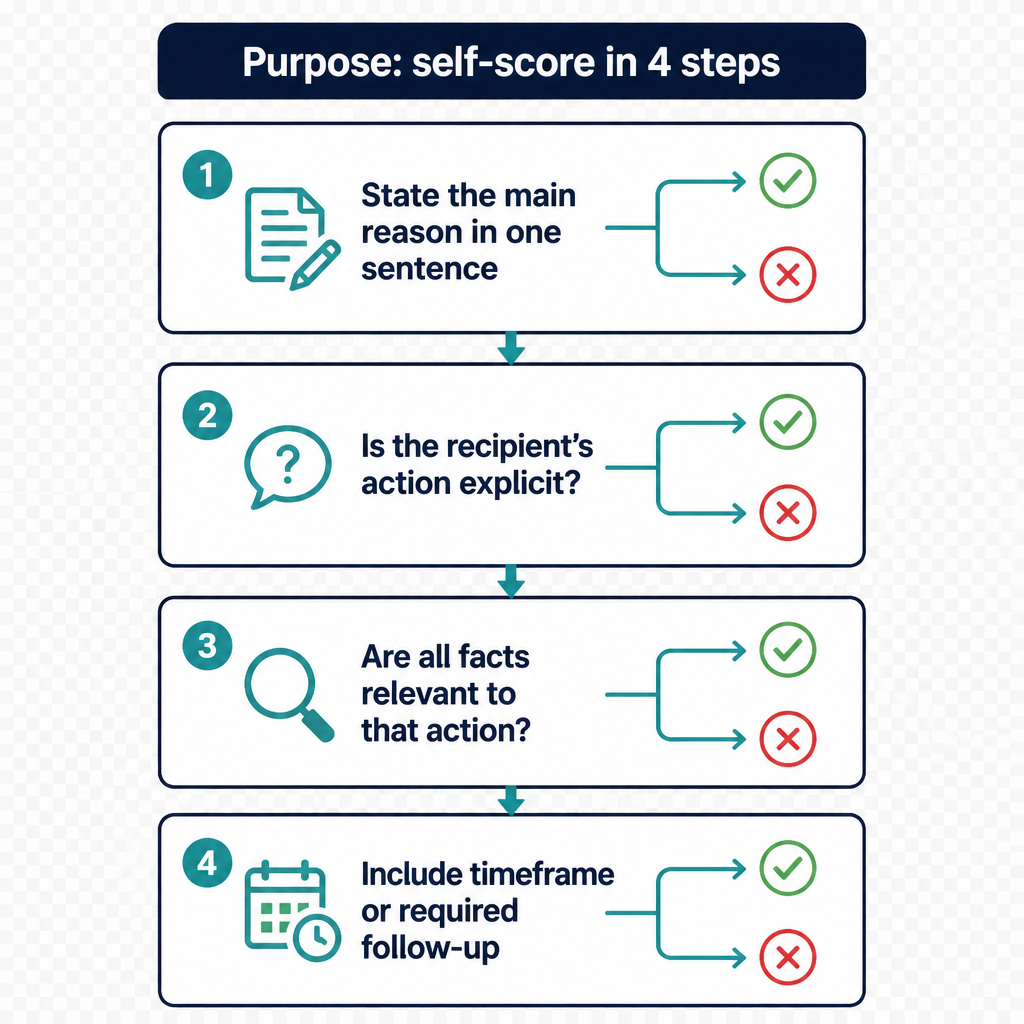
Self-score: a 4-step decision flow
How Purpose interacts with the other criteria
Purpose is the anchor for the other OET Writing criteria: it defines what content is relevant, guides organisation, and constrains language choices. If purpose is unclear, Content is likely to include irrelevant detail or omit necessary actions; the examiner cannot tell which facts matter.
Organisation depends on purpose to order information logically. A clear purpose tells you which information to put first (e.g., request then supporting facts), which improves layout and signposting. Conciseness & Clarity are easier to achieve when you focus only on material that supports the stated purpose; vague purpose often produces long, unfocused sentences.
Genre & Style also follow purpose: a referral needs professional tone and specific clinical requests, while a patient discharge needs clear instructions. Language (grammar and lexis) is judged against whether it communicates the purpose precisely; if the purpose is ambiguous, even accurate language may be penalised because it fails to deliver the task the reader expects.
In short, Purpose pulls the other criteria into alignment. When you fix purpose first, the rest — content selection, paragraphing, concise expression and appropriate genre — fall into place more easily.
5 failure patterns (and how to fix them)
1. Vague closing request
Fix: Rewrite the final request specifically: 'Please start an ACE inhibitor and inform our clinic whether additional antihypertensive monitoring is planned.'
Impacts: Purpose (unclear what action is required)
2. Purpose implied but not stated
Fix: Open with a clear statement: 'I am referring Ms Jones for orthotic assessment to manage her recurrent foot ulcers.'
Impacts: Purpose (implied intent loses marks)
3. Multiple conflicting purposes
Fix: Pick one primary action: 'This letter requests a specialist opinion on anticoagulation; routine medication queries follow in a separate note.'
Impacts: Purpose (confused or competing aims)
4. Action given to wrong recipient
Fix: Address the correct professional and state the action: 'Dear Pharmacist, please review Mr X's prescriptions and advise on interactions.'
Impacts: Purpose (recipient-action mismatch)
5. Excess background before purpose
Fix: Start with the action, then support: 'Please review Mrs Brown for insulin initiation. Her HbA1c is 92 mmol/mol despite oral therapy.'
Impacts: Purpose (purpose delayed or buried)
Profession-specific notes
| Profession | Typical pitfall | Quick fix |
|---|---|---|
| Nurse | Stating observations without a clear request to the appropriate clinician. | Begin with 'I request...' or 'Please review and prescribe...' and link observations to the request. |
| Doctor (GP) | Assuming the specialist will infer the reason for referral without explicit instruction. | State the specific question or action required from the specialist in the opening line. |
| Pharmacist | Reporting medication issues but not specifying whether you want a change, clarification, or monitoring. | Use a direct request: 'Please advise on alternative therapy' or 'Please authorise an urgent supply.' |
| Physiotherapist | Giving therapy details without indicating what the referrer should do next. | Open with 'Please review for home exercise progression' or 'Please consider referral to hydrotherapy.' |
| Dentist | Providing dental findings but not clarifying the required medical or surgical action. | State the purpose: 'I am referring for extraction under GA' or 'Please advise on antibiotic prophylaxis.' |
2026 update
What changed in the 2026 scoring regime
The 2026 scoring regime expects a more explicit, early and task-aligned purpose than earlier versions. Examiners now penalise letters where the required action is only implied, delayed or split across unrelated paragraphs.
You must state the primary action in the opening or subject line, ensure supporting details are directly tied to that action, and assign responsibility to the correct recipient. Multiple equal purposes are discouraged unless clearly separated and justified by the task notes. These stricter expectations make explicit purpose the decisive feature of a Band 3 response for this criterion.
(Apply these changes in all practice letters: make the purpose unmistakable.)
Frequently asked questions
Where should I state the purpose in my letter?
State the purpose in the opening sentence or a clear subject line. If you must, repeat it briefly in the closing to remind the reader of the required action.
Can I include more than one purpose?
Only if the task requires multiple actions. Make one purpose primary and present any secondary purposes clearly separated and justified.
What if my case notes contain a lot of information?
Select only details that support your stated purpose. Exclude irrelevant history or routine data that do not change the requested action.
How specific must my request be?
Specific enough for the recipient to act without further inference. Name tests, treatments or referrals you want, or explicitly ask the clinician to choose and explain why.
Does tone affect the Purpose score?
Tone itself does not score Purpose, but an inappropriate recipient tone can obscure intent. Maintain professional, task-appropriate tone to make your purpose clear.
If I make a mistake, can I restate the purpose later?
You may restate the purpose, but it's best to state it clearly at the start. Restating helps, but a delayed purpose can still limit the band you can achieve.
Keep learning
Sample letters with feedback
Sibling criteria
Want Dr Mariam to mark your letter against all six criteria?
See OET Writing Correction packs →