Criterion 2 of 6 · Score 0–7 · 2026 Update
OET Writing: The Content Criterion (Score 0–7) Explained
The Content criterion judges whether your letter contains the clinically relevant information the recipient needs to act safely and appropriately.
TL;DR
- →Marks depend on inclusion of all relevant clinical and administrative details.
- →Irrelevant or missing information reduces the Content score quickly.
- →Prioritise recipient needs, not everything you know about the patient.
Scoring matrix: Content 0–7
Examiner descriptor and a healthcare-specific example for each band.
| Band | Examiner descriptor | Healthcare example |
|---|---|---|
| 7 | All relevant information is included; no important omissions; nothing irrelevant to the recipient’s actions. | Dear Dr Jones, Mrs Patel’s antihypertensive plan is adjusted: stop lisinopril 20 mg, start amlodipine 5 mg; BP target <140/90. See attached ECG. Review in 1 week and check renal function. |
| 6 | Most relevant information is included; one or two minor omissions that do not affect safe clinical action. | Dear GP, Mr Lee was treated for UTI with IV fluids and IV gentamicin; change to oral trimethoprim 300 mg twice daily for five days. Arrange urine culture follow-up. Regards, Ward Doctor |
| 5 | Several relevant points are included but there are omissions or unclear details that may affect patient management. | Dear Dr Ahmed, Patient had chest pain and raised troponin; given aspirin. Needs cardiology follow-up. (No time of onset or ECG details provided.) Sincerely |
| 4 | Only some relevant information is given; major omissions or ambiguous items mean the recipient cannot safely act without further clarification. | Dear GP, Mrs Brown feels dizzy; likely medication issue. Please review meds. (No list of current drugs, vital signs, or recent labs included.) Thanks |
| 3 | Insufficient relevant content; much of the letter is irrelevant or does not help the recipient make clinical decisions. | Hello, Patient history given in full narrative with social details but no problem list or clear request. No diagnostic data or actions suggested. Regards |
| 2 | Very little relevant information is present; key facts missing so recipient cannot act clinically. | Dear Doctor, Patient unwell. Needs review. (No diagnosis, medication, or urgency indicated.) Nurse |
| 1 | Content is largely irrelevant, misleading or contradictory; the recipient would be confused or misinformed. | Dear Sir/Madam, Patient admission story with unrelated family history and personal opinions; request unclear and clinical facts absent. Yours |
| 0 | No relevant content for the task or the writing is illegible/off-topic. | Bunch of unrelated sentences, no patient identifiers, no clinical data and no request; not a functional referral or discharge letter. |
I read each letter as a clinician who must decide or act based on your words. My primary question is: does this letter give me everything I need to make a safe, timely decision?
I look for clear patient identifiers, the problem list, recent findings (vitals, test results), current medications, treatment given, and a specific request or plan. Omitting a single essential item — like medication changes after an adverse reaction, the time of symptom onset, or whether the patient can safely return home — changes the clinical decision and costs marks.
I also expect economy: relevant details only. Long narratives of irrelevancies show the writer has not prioritised information for the recipient. Small omissions that do not affect action will cost a band or two; missing major items or providing misleading content drops you further. In short, give the recipient the right facts, clearly ordered, so they can act without asking for more information.
As a marker, I mentally tick off required items and imagine acting on the letter; gaps are penalised under Content every time.
Dr Mariam, OET writing tutor and marker for over 20 years, marking experience with 11,000+ letters (not CBLA-certified).
Worked example: before and after
Scenario: Mr John Smith, 68, type 2 diabetes, hypertension, on metformin and gliclazide. Found confused at home after morning low BGL 2.8 mmol/L; paramedics gave oral glucose. Lives alone, no recent sick contacts. Recommend reduce gliclazide dose and GP review in 48 hours; arrange community nursing check tonight.
Before
Dear GP,
Mr John Smith attended ambulance services this morning after confusion at home. Ambulance staff found low blood glucose of 2.8 mmol/L; glucose was given. He takes metformin and gliclazide and has hypertension. He lives alone.
Please follow up.
Sincerely, ED Nurse
- • Missing: no clear instruction on specific gliclazide dose change or monitoring instructions (affects Content).
- • Missing: no urgency or arranged community check documented; recipient cannot prioritise (affects Content).
- • Too general: 'Please follow up' provides no specific request for medication change or timing (affects Content).
After
Dear Dr Ahmed,
Mr John Smith (D.O.B. 04/11/1957) presented via ambulance today after confusion at home. Arrival capillary blood glucose was 2.8 mmol/L; oral glucose resolved symptoms. Current meds: metformin 1 g morning and evening, gliclazide 80 mg morning.
Recommendation: reduce gliclazide to 40 mg morning and recheck fasting capillary glucose daily for 5 days. Arrange GP review within 48 hours and a community nurse home visit tonight to assess cognition and ability to self-manage.
If further hypoglycaemia occurs, consider stopping sulfonylurea and urgent review.
Regards, ED Nurse
- • Specific medication change and dose provided so recipient can act immediately (resolves prior omission).
- • Clear monitoring plan, timing (daily for 5 days) and follow-up window (48 hours) enable safe clinical decisions.
- • Arranged community nurse visit and contingency advice reduce need for clarification — strong Content performance.
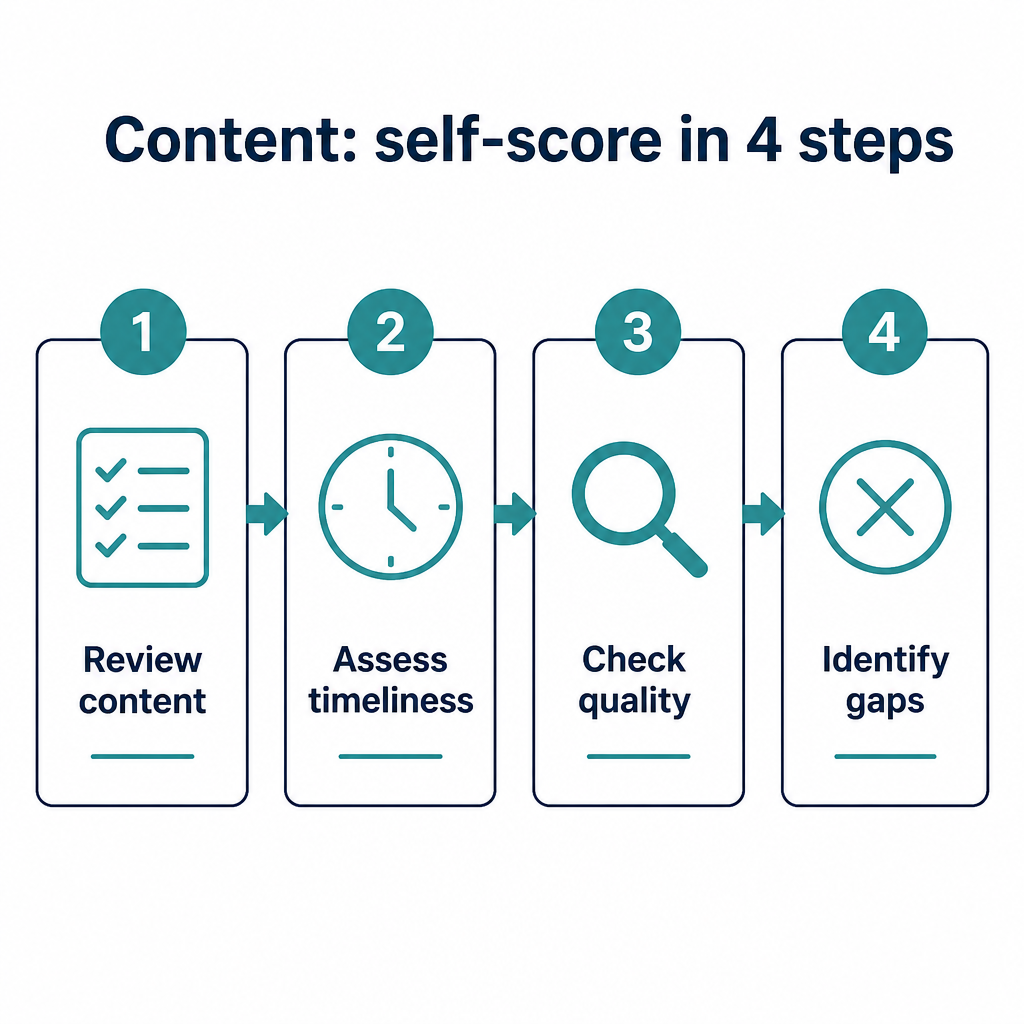
Self-score: a 4-step decision flow
How Content interacts with the other criteria
Content connects directly with every other criterion because what you include determines purpose, organisation and language choices.
If Content is incomplete, Purpose suffers: a clear request cannot exist without the relevant clinical facts. Organisation and Layout depend on Content too; you must sequence the facts so the recipient can find them quickly. Conciseness & Clarity are affected when writers include irrelevant detail to 'cover everything' — Content overload reduces clarity and wastes space. Language is influenced by Content because missing technical specifics force vague wording or hedging; conversely, excessive jargon with no context harms readability.
In marking, examiners mentally move between criteria: we check Content first, then scan Organisation so the required items are easy to locate, then judge Language and Concision. A strong Content score can be undermined by poor organisation; likewise, excellent layout and language cannot fully compensate for missing, incorrect or irrelevant clinical information. Aim to align Content with a clear Purpose, tidy Organisation, concise phrasing and appropriate professional tone to maximise combined scores across criteria.
Dr Mariam
5 failure patterns (and how to fix them)
1. Omitting essential medication changes after an adverse event.
Fix: State the specific medication adjustment, dose, and follow-up timeframe so the recipient can implement it.
Impacts: Content — major omission prevents safe action.
2. Giving long patient narratives but no problem list or request.
Fix: Summarise into a short problem list and end with a clear request for the recipient.
Impacts: Content — relevant facts buried; recipient unclear what to do.
3. Reporting test results without dates or reference ranges.
Fix: Include test date and relevant reference ranges or normal values alongside results.
Impacts: Content — results unusable for clinical decisions.
4. Using vague instructions such as 'review soon' with no timeframe.
Fix: Give a specific timeframe (eg, review within 48 hours) and indicate urgency.
Impacts: Content — lack of temporal detail undermines prioritisation.
5. Adding extraneous social details that obscure clinical needs.
Fix: Limit social information to what affects management (eg, lives alone, needs carer).
Impacts: Content — irrelevant material reduces clarity and completeness.
Profession-specific notes
| Profession | Typical pitfall | Quick fix |
|---|---|---|
| Nurse | Providing narrative incident reports but omitting vital signs or medication details. | Include a concise ABC/VITALS line and current meds at the top of the note. |
| Doctor (GP) | Assuming the recipient knows the patient; omitting identifiers and dates. | Always start with full name, DOB, and date/time of consultation and tests. |
| Pharmacist | Giving recommendations without specifying brand/generic names, doses or interactions. | State exact drug name, dose, formulation and any safety monitoring needed. |
| Physiotherapist | Describing therapy progress but not outlining functional goals or safety concerns. | List functional limitations, goals, and clear recommendations for activity or precautions. |
| Dentist | Describing oral findings without linking them to systemic risks or next steps. | State diagnosis, urgency, required treatment and any medical considerations for the GP. |
2026 update
What changed in the 2026 scoring regime
From 2026 the marking emphasis on Content is stricter: examiners now penalise even small but clinically important omissions more consistently. Letters that previously lost only a minor mark may now lose a full band if an omission affects safe decision-making.
You must therefore explicitly state any medication changes, monitoring plans, timescales and contingency actions. Prioritise action-oriented facts for the recipient rather than discursive background to meet the updated standard and avoid larger penalties for missing essentials.
Dr Mariam, writing tutor and marker with long experience of OET writing assessment practices (not CBLA-certified).
Frequently asked questions
What counts as 'relevant' information for Content?
Relevant information is any clinical or administrative fact the recipient needs to make a decision: identifiers, diagnosis, current meds, recent observations/tests, treatment given, and a clear request or plan.
How specific must medication details be?
Include drug name, dose, route, frequency and recent changes. If safety is a concern, add monitoring requirements and contingency actions.
If I lack a test result, should I guess or omit it?
Do not guess. State that the result is pending or unavailable and recommend if/when the recipient should review it.
How do I show urgency in the Content without sounding alarmist?
Use precise timeframes (eg, 'review within 24 hours') and a clear instruction of actions required rather than emotive language.
Will including extra social details harm my score?
Only include social details that affect management (eg, lives alone, mobility limits). Extraneous narrative can dilute important clinical facts and harm the Content score.
Can excellent language compensate for missing content?
No. Good language helps, but missing or incorrect clinical facts cannot be fully compensated by style; Content must be correct and complete for a high score.
Keep learning
Sample letters with feedback
Sibling criteria
Want Dr Mariam to mark your letter against all six criteria?
See OET Writing Correction packs →