Criterion 3 of 6 · Score 0–7 · 2026 Update
OET Writing: The Conciseness & Clarity Criterion (Score 0–7) Explained
The Conciseness & Clarity criterion assesses how clearly and briefly you present clinical information so the recipient can act without extra effort.
TL;DR
- →Aim for necessary detail, no extra words.
- →Use clear clinical language and logical order.
- →Remove repetition, irrelevant background or jargon.
Scoring matrix: Conciseness & Clarity 0–7
Examiner descriptor and a healthcare-specific example for each band.
| Band | Examiner descriptor | Healthcare example |
|---|---|---|
| 0 | No attempt to meet the criterion; writing is incomprehensible or irrelevant. | Letter contains unconnected facts and no clear message: ‘Patient seen. Many notes. Please do something.’ |
| 1 | Very limited conciseness and clarity; ideas are unclear and reader struggle to identify action. | ‘Patient has problems, tests, medication changed, follow up maybe.’ The recipient cannot determine next steps. |
| 2 | Limited conciseness; message is partially unclear, with irrelevant detail or repetition that obstructs action. | Long paragraph of history with unnecessary social details; referral request buried and unclear. |
| 3 | Some clarity but inconsistent conciseness; essential information present but wordy or disorganised. | Referral includes medical facts and request, but repeated symptoms and tangential background slow comprehension. |
| 4 | Generally clear and reasonably concise; occasional verbosity or minor irrelevance that does not prevent action. | Clear treatment summary and request; a sentence or two of extra detail that could be omitted. |
| 5 | Mostly concise and clear; information is relevant and sequenced so the reader can act with minimal inference. | Short, focussed discharge note: diagnosis, current meds, clear follow-up plan and outstanding test. |
| 6 | Concise and very clear; minimal non-essential information, precise phrasing, reader requires no clarification. | Concise referral: problem, relevant history, current treatment, explicit request for opinion and timescale. |
| 7 | Highly concise and crystal clear; every word serves the reader, information prioritised and effortlessly actionable. | One-page letter with succinct summary, explicit request, and necessary attachments listed for immediate action. |
I look for whether a busy clinician can read the letter and act immediately. That means the purpose and request must be obvious, the clinical facts must be prioritised, and irrelevant or repeated material must not distract. I note where the reader has to hunt for the problem, the current treatment, or the required action — any hesitation costs marks.
I also expect language that helps speed comprehension: short sentences for key facts, standard clinical terms used consistently, and a logical sequence (problem, relevant history, current status, request). A candidate who trims background detail and avoids wordy constructions usually scores higher. Finally, presentation matters: paragraph breaks that separate the request from the supporting facts make the letter far easier to follow — and that simplicity is what I reward in Conciseness & Clarity.
As Dr Mariam, after marking thousands of letters, I value precision over flowery language. Concise does not mean choppy; it means economical and readable clinical communication that reduces cognitive load for the recipient. If the receiver can act without asking for more information, the criterion is met well. I make this judgement within the context of the whole letter, comparing whether the same information could have been presented in fewer words without losing safety or clarity.
Worked example: before and after
Scenario: Mrs Khan, 68, with type 2 diabetes and hypertension, presented after a fall with hip pain. X-ray shows nondisplaced intertrochanteric fracture. She takes metformin, lisinopril. Pain controlled with paracetamol. Mobilising with frame, awaiting orthopaedic review tomorrow. Needs community physiotherapy and review of anticoagulation status prior to surgery.
Before
Dear Orthopaedic Team,
Mrs Khan is an elderly patient who was admitted after a fall at home. She has type 2 diabetes and hypertension and is normally independent. On assessment she complained of pain in her right hip and an X-ray was performed which showed a fracture in the region of the proximal femur, specifically an intertrochanteric fracture which appears nondisplaced. She is currently taking metformin and lisinopril and had pain relief with paracetamol. She is mobilising with a frame at the bedside but requires assistance. Please see and advise on management and whether anticoagulation needs changing before any operation.
Regards, Dr S. Ahmed
- • Callout 1: Wordy opening and unnecessary social detail delay the urgent problem statement.
- • Callout 2: Long sentence describing the X-ray result is bulky; key finding should come earlier.
- • Callout 3: The request is buried at the end; split explicit requests (orthopaedic review, anticoagulation advice, physio) into clear lines.
After
Dear Orthopaedic Team,
Re: Mrs Khan, 68. Acute right intertrochanteric femoral fracture (nondisplaced) on X-ray. Fall at home. Background: type 2 diabetes (metformin), hypertension (lisinopril). Pain controlled with paracetamol. Mobilises with frame, needs assistance.
Request: Urgent ortho review tomorrow; please advise surgical plan and whether perioperative anticoagulation review is required. Please arrange community physiotherapy for mobilisation if surgery delayed.
Regards, Dr S. Ahmed
- • Callout 1: Immediate identification of diagnosis and urgency in the opening line improves actionability.
- • Callout 2: Relevant meds and status now concise; removes narrative and keeps essential facts.
- • Callout 3: Explicit, bulleted request separates actions needed, removing ambiguity and speeding response.
Self-score: a 4-step decision flow
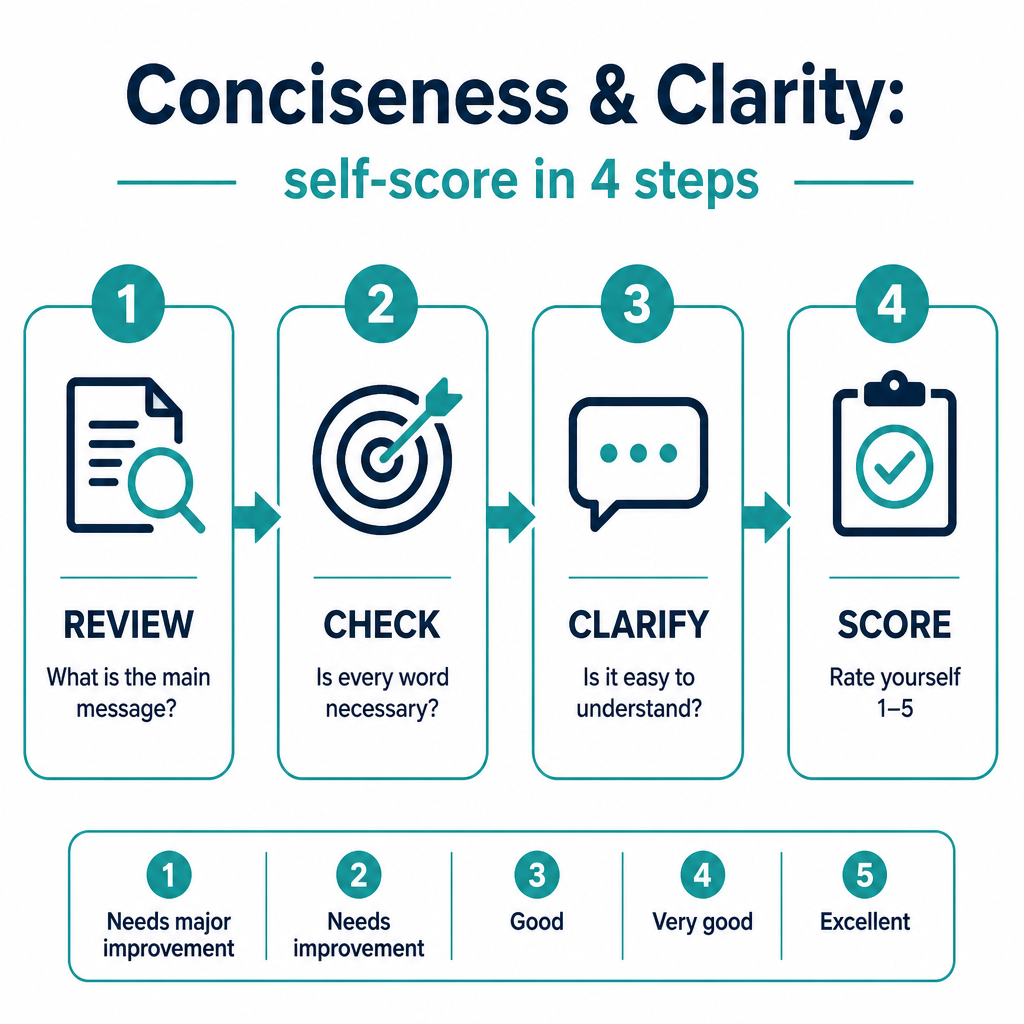
How Conciseness & Clarity interacts with the other criteria
Conciseness & Clarity directly supports Content and Organisation & Layout: a concise letter makes the required information more visible, which helps the reader identify the purpose and follow the sequence. If you remove irrelevant detail and sequence facts logically, your Content appears more focused and your Layout benefits from clearer paragraphing and headings.
However, excessive brevity can harm Language and Genre & Style. Omitting necessary clinical detail to be brief may create ambiguity that forces the reader to infer missing information, lowering Language precision and Genre appropriateness. Equally, an overly terse tone may fail to meet expected professional style. Balance is therefore essential: be concise, but include all clinically necessary specifics in an organised, professionally styled letter.
Assessors therefore view Conciseness & Clarity in relation to these siblings. A strong candidate achieves clarity by pruning redundancy, choosing precise medical vocabulary, and using layout to highlight action points — this improves scores across Content, Organisation & Layout, and Language simultaneously, but never at the cost of necessary detail or professional tone required by Genre & Style.
5 failure patterns (and how to fix them)
1. Buried request—recipient must read whole letter to find the action needed.
Fix: Move the request to its own paragraph or opening line, clearly labelled 'Request:'.
Impacts: Conciseness & Clarity (information not clearly prioritised)
2. Excess background—long social history irrelevant to the referral.
Fix: Remove non-essential social details and keep only background that affects management.
Impacts: Conciseness & Clarity (irrelevant detail included)
3. Repetition—same clinical fact repeated in several sentences.
Fix: State each fact once, in the most relevant section, and delete duplicates.
Impacts: Conciseness & Clarity (redundant wording)
4. Wordy constructions—long, multi-clause sentences obscure key facts.
Fix: Break into short sentences with one fact per sentence for key clinical points.
Impacts: Conciseness & Clarity (inefficient phrasing)
5. Missing prioritisation—supporting detail listed before the diagnosis or request.
Fix: Lead with the diagnosis and request, then provide concise supporting facts.
Impacts: Conciseness & Clarity (poor information prioritisation)
Profession-specific notes
| Profession | Typical pitfall | Quick fix |
|---|---|---|
| Nurse | Including long narrative of bedside observations without a clear action. | Summarise observations in bullet points and end with a clear nursing-specific request. |
| Doctor (GP) | Overloading referral with full past medical history rather than relevant comorbidities. | List only comorbidities and meds that affect specialist decisions or perioperative risk. |
| Pharmacist | Providing exhaustive medication history with unclear clinical relevance. | Highlight current critical meds, allergies, and the specific medication query or action required. |
| Physiotherapist | Describing long rehabilitation background instead of present functional status. | State current mobility, aids, pain score, and a specific therapy goal or request. |
| Dentist | Including detailed dental procedure history that does not affect medical management. | Focus on oral findings that influence medical decisions and end with a concise request to the clinician. |
2026 update
What changed in the 2026 scoring regime
From 2026, examiners apply stricter expectations for prioritisation and elimination of irrelevant material. Candidates now lose marks earlier if the reader must search for the action or diagnosis. Conciseness is judged not just by length but by whether every sentence helps the recipient act.
You must therefore present the problem and request clearly and remove any background that does not influence clinical care. Examiners expect paragraphing and headings that highlight requests; failure to use these will reduce scores under the tightened regime. Clear, necessary detail remains essential for safety; brevity must not sacrifice critical information.
Frequently asked questions
How short should my sentences be to score well for Conciseness & Clarity?
Use short sentences for key facts (diagnosis, meds, request) and combine related supporting details. Avoid chopping every clause into a fragment; clarity matters more than rigid sentence length.
Can I use bullet points to be concise?
Yes. Bullets help present problem lists, medications or explicit requests clearly. Use them sparingly and only for critical, actionable items.
Will removing background information ever harm my score?
Yes—omit only genuinely irrelevant details. If background affects management, include it briefly. Safety and actionability take priority over minimal word count.
Does concise writing mean using fewer medical terms?
No. Use precise clinical terms where appropriate. Avoid unnecessary jargon, but prefer accurate terminology over vague simplification.
How do I decide what is 'necessary' information?
Ask: will the recipient need this to act safely and promptly? If the answer is no, remove it. Keep diagnosis, current status, meds, and explicit requests.
How does layout affect my Conciseness & Clarity score?
Good layout highlights priorities: separate paragraphs, labelled requests, and concise opening lines improve readability and tend to raise your score.
Keep learning
Sample letters with feedback
Sibling criteria
Want Dr Mariam to mark your letter against all six criteria?
See OET Writing Correction packs →