Criterion 4 of 6 · Score 0–7 · 2026 Update
OET Writing: The Genre & Style Criterion (Score 0–7) Explained
Genre & Style judges whether your letter uses the correct healthcare genre and an appropriate professional tone for the task and recipient.
TL;DR
- →Marks the right professional genre and register for a healthcare recipient.
- →Checks tone, formality and whether the document meets task expectations.
- →Lose marks if you use the wrong letter type or inconsistent professional voice.
Scoring matrix: Genre & Style 0–7
Examiner descriptor and a healthcare-specific example for each band.
| Band | Examiner descriptor | Healthcare example |
|---|---|---|
| 7 | Consistently appropriate genre and register: writing consistently meets the requirements of the task and recipient. | Referral letter: formal, concise, clinical summary and clear request for specialist opinion, using appropriate professional terms. |
| 6 | Generally appropriate genre and register: occasional minor lapses but overall appropriate for purpose and recipient. | Discharge summary: formal with one informal phrase, but clinical details and follow-up plan are clear and suitable. |
| 5 | Mostly appropriate genre and register: some inappropriate elements that do not seriously impede the task. | Sick note: uses mostly formal tone but includes a casual sentence such as 'Hope you understand,' which is unnecessary. |
| 4 | Partly inappropriate genre and register: several lapses which affect the suitability of the letter for the recipient. | Referral that mixes patient instruction language with specialist request language, causing role confusion. |
| 3 | Frequently inappropriate genre and register: register errors, wrong genre features or tone mismatches that impede purpose. | Clinical update written as a personal note with direct patient-facing phrases instead of professional summary. |
| 2 | Persistent inappropriate genre and register: limited attempt to meet task requirements; tone and format largely unsuitable. | Medication recommendation framed as casual advice rather than a formal prescription instruction to a pharmacist. |
| 1 | Minimal attempt to use required genre and register: serious mismatches with the recipient and task. | Discharge letter addressed to patient rather than GP, using colloquial language and no clinical sign-off. |
| 0 | No attempt to use required genre and register: task not recognisable as an appropriate professional document. | A set of unrelated sentences or notes that do not form a letter, referral or clinical document for any healthcare recipient. |
As a marker with two decades of OET teaching, I focus on whether the piece is recognisably the correct healthcare document and whether the voice fits the recipient.
I check simple, concrete things first: is this a referral, discharge, letter to a patient, or a notification? Does it contain the core features that recipient expects — clinical summary for a specialist, clear follow-up for a GP, or simple, non-technical language for a patient? Next I look at tone: is it consistently professional, objective and respectful? Small slips, like colloquial phrases or unnecessary first-person comments, often reduce marks.
Finally I consider whether the writer follows conventional format and expectations of the genre. Using patient-facing instructions in a referral, or addressing the wrong recipient, are common and costly mistakes. The best letters are succinct, formally phrased where necessary, and tailored to what the recipient will need to act on the information given. That combination of correct genre plus consistent register wins the top marks every time.
I expect to see that across the whole letter, not just in isolated sentences; inconsistency is what loses marks more than occasional minor wording issues.
Worked example: before and after
Scenario: 60-year-old male, type 2 diabetes, BP 150/95, recent chest pain investigation negative, continues to smoke; request GP follow-up for blood pressure review, smoking cessation referral, unchanged medications: metformin 1g twice daily, atorvastatin 20mg nocte.
Before
Dear Dr Patel,
Mr Khan, age 60, has T2DM and was seen after chest pain; investigations were negative. BP high; please check and consider stopping smoking services. He takes metformin and atorvastatin.
Regards, Dr Ahmed
- • Wrong level of formality and vague clinical detail — weak clinical summary (Genre & Style).
- • No clear request phrasing; too brief for a GP follow-up task (Genre & Style).
- • Patient-facing phrasing 'stop smoking services' is unclear and informal (Genre & Style).
After
Dear Dr Patel,
Thank you for accepting Mr Khan (D.O.B. 12/04/1965). He attended with exertional chest discomfort; urgent cardiac investigations were negative and he has stable angina excluded. Current observations: BP 150/95, pulse 82, BMI 29. He remains a smoker (20 pack-years).
Could you please review his blood pressure management and consider escalation of antihypertensive therapy if indicated, and refer him to your smoking cessation programme. Current medications: metformin 1000 mg twice daily, atorvastatin 20 mg nocte.
Kind regards, Dr Ahmed Consultant Physician
- • Formal tone, complete clinical summary and recipient-appropriate details improve genre and register.
- • Clear, actionable request phrased for GP decision-making demonstrates correct genre features.
- • Patient details and medication specifics use professional register, removing informal patient-facing language.
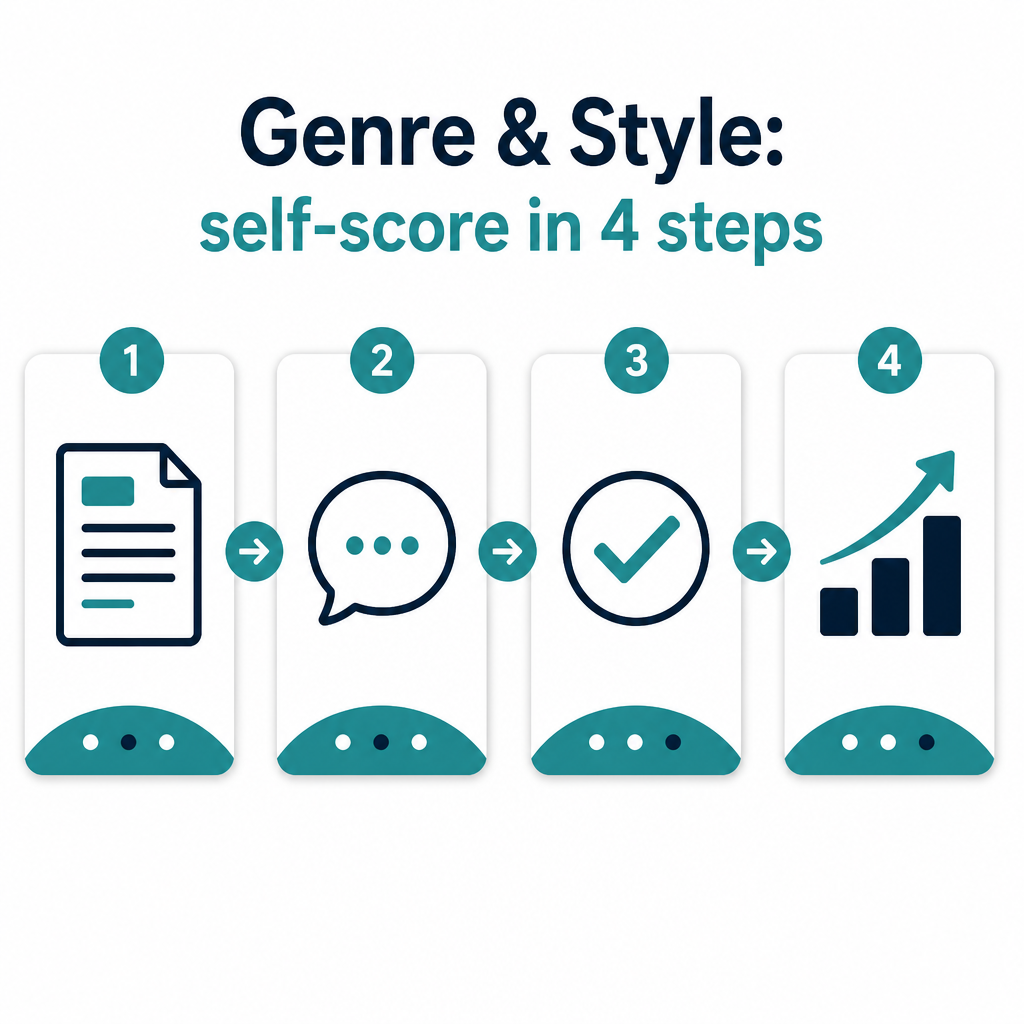
Self-score: a 4-step decision flow
How Genre & Style interacts with the other criteria
Genre & Style directly interacts with Content and Organisation & Layout. If you choose the wrong genre you often fail to include the correct content — a referral missing a clear request or a discharge letter omitting follow-up instructions. Genre choice determines what information the recipient expects and therefore shapes Content.
Organisation & Layout is influenced by Genre & Style because different genres require different structures: a referral needs a succinct clinical summary, assessment and specific request, while a patient letter requires plain-language explanation and explicit next steps. Poor register can therefore make well-organised content seem inappropriate.
Language and Conciseness & Clarity are also affected. Using an inappropriate register can force you into either long-winded explanations to clarify tone or overly terse clinical shorthand that the recipient cannot follow. Conversely, good genre awareness supports precise, audience-appropriate language and efficient use of space, helping you score across multiple criteria simultaneously.
In practice, improving Genre & Style usually lifts scores in Content and Organisation because the whole letter becomes aligned with recipient needs; neglecting it drags other criteria down.
5 failure patterns (and how to fix them)
1. Addressing the wrong recipient (e.g. patient instead of GP).
Fix: Begin: 'Dear Dr [Surname],' and include clinical summary, request and professional sign-off.
Impacts: Genre & Style
2. Using patient-facing language in a specialist referral.
Fix: Replace casual phrases with clinical terms and a precise request for specialist opinion.
Impacts: Genre & Style
3. Too informal tone with colloquialisms.
Fix: Use formal phrasing: 'Please consider' rather than 'Maybe have a look at'.
Impacts: Genre & Style
4. Incorrect document type (e.g. note instead of structured letter).
Fix: Format as a letter with salutation, clinical summary, action request and sign-off.
Impacts: Genre & Style
5. Mixing instruction levels (giving direct patient advice in a professional update).
Fix: Give clinical information and request recipient actions; leave patient advice to patient letters.
Impacts: Genre & Style
Profession-specific notes
| Profession | Typical pitfall | Quick fix |
|---|---|---|
| Nurse | Writing overly familiar updates using patient-facing reassurance language. | Switch to concise clinical facts and a clear request for the clinician’s decision. |
| Doctor (GP) | Using excessive background narrative that reads as a case history rather than a referral. | Prioritise the problem list, current findings and a single clear request. |
| Pharmacist | Using casual or conversational tone when informing prescribers of medication issues. | Adopt formal recommendation phrasing and specify exact drug actions needed. |
| Physiotherapist | Providing long patient-facing exercise explanations in a referral. | Summarise functional findings and request specific management or further assessment. |
| Dentist | Mixing clinical instructions for a specialist with patient appointment details. | Separate professional recommendations from administrative notes; keep clinical recommendations formal. |
2026 update
What changed in the 2026 scoring regime
From 2026, scoring is stricter on consistent register and correct genre features across the whole letter. Examiners now penalise intermittently appropriate tone more heavily: a single patient-facing sentence in a specialist referral is more likely to reduce your band.
You must demonstrate the correct document type, audience-appropriate language and consistent professional voice throughout. Small formatting lapses that contribute to genre confusion are also considered when awarding the band score, so align structure, tone and content tightly with the recipient’s needs now more than before. Attention to consistent genre features is essential to keep higher bands.
Frequently asked questions
What exactly is meant by 'genre' in OET Writing?
Genre means the type of document required (referral, discharge, patient letter, etc.). Each genre has expected content, structure and tone suited to its recipient.
How much does tone affect my Genre & Style score?
Tone is central: inconsistent or inappropriate register for the recipient will lower your score, even if content is accurate.
Can I use contractions in a professional letter?
Avoid contractions in letters to professionals; they make the tone more informal and may reduce marks for register.
If I include both patient and clinician information, how do I preserve genre?
Use clear sections. Keep clinical updates and action requests for clinicians; put patient-facing instructions in a separate paragraph labelled for the patient if required.
Does format like 'Dear' and 'Kind regards' affect the score?
Yes. Wrong or missing formal elements (salutation, sign-off) can signal the wrong genre and negatively affect the score.
How do I practise improving Genre & Style?
Practice writing each common genre, then check for correct recipient, formal register and whether the letter contains expected features and an actionable request.
Keep learning
Sample letters with feedback
Sibling criteria
Want Dr Mariam to mark your letter against all six criteria?
See OET Writing Correction packs →