Radiographer · Referral letter · Grade B worked sample
Radiographer Report referral to consultant (Grade B Sample)
Worked example showing a Grade B radiographer referral letter to a referring consultant after an urgent chest radiograph. Shows clear purpose, focussed findings and a directed request for review.
In short
- →Radiographer flags unexpected left lower zone consolidation and small effusion on urgent chest x-ray.
- →Images available on PACS; request consultant review and formal radiology report urgently.
- →Suggests consideration of further imaging (decubitus/CT) and correlation with clinical signs and oxygen requirement.
The case notes
The OET writing task you would receive in this scenario.
Anatomy of this letter
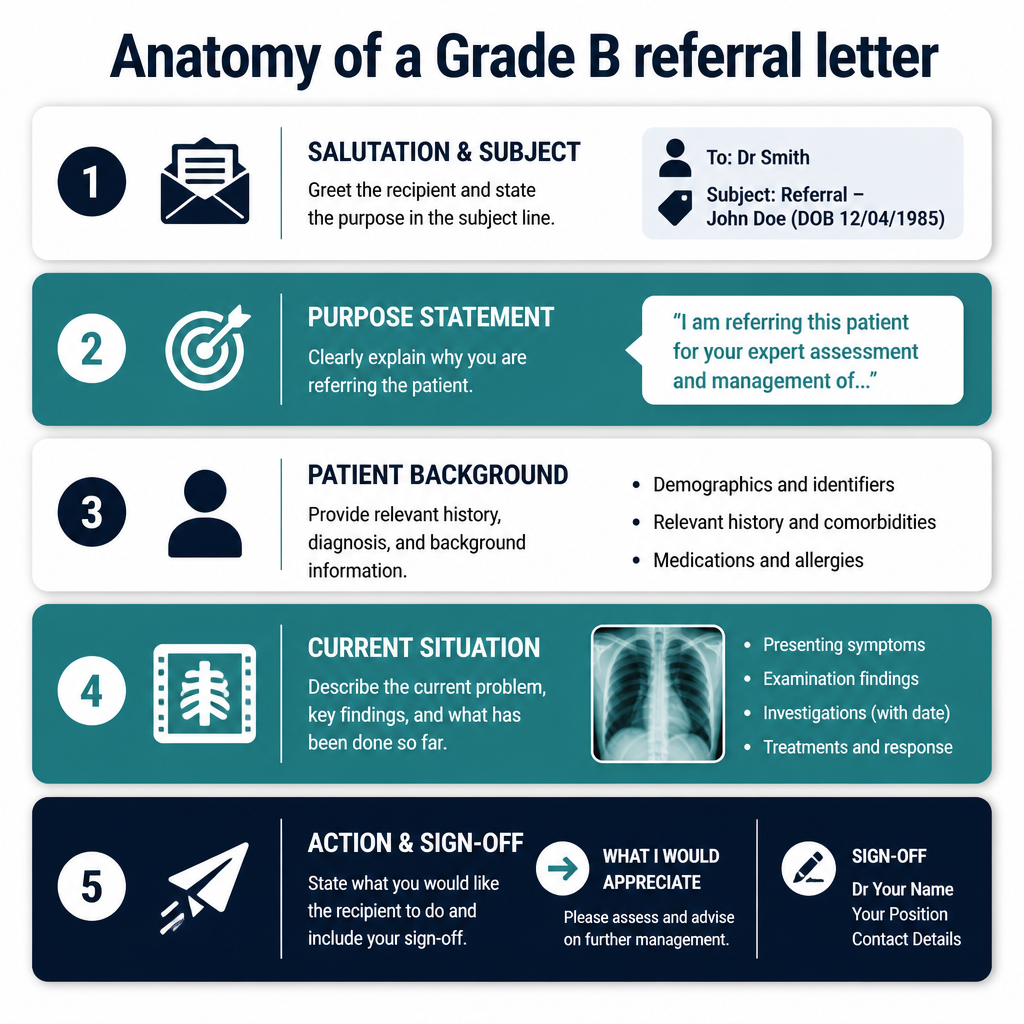
The Grade B sample letter
A complete worked example written to score Grade B (350+) against all six criteria.
Dr Smith
Consultant Physician
16/05/2026
Subject: Urgent radiographer referral — chest x-ray for Mr J Brown (ward 6A)
Dear Dr Smith,
I am writing to request urgent review of chest radiographs for Mr J Brown (DOB 04/03/1954, hospital no. 458723) taken on 12/05/2026 after increased breathlessness on ward 6A. The request was made by ward staff; the portable AP film was performed at 15:30 and images have been uploaded to PACS (Study ID: CHX458723_12052026).
On review I noted a new dense air-space opacity in the left lower zone with associated blunting of the left costophrenic angle consistent with a small pleural effusion. Cardiac silhouette appears within normal size for projection. No pneumothorax was identified. There is limited comparison available in PACS; previous GP chest record shows basal scarring but not the present dense consolidation.
Given the clinical observations (SpO2 90% on 2 L/min O2, RR 24, low-grade fever) I request your urgent review and advice on whether a formal radiology report, lateral or decubitus views, or CT chest are indicated. Ward staff have been informed and can provide further clinical details. Please advise on next steps at your earliest convenience.
Yours sincerely, A. Walker, Radiographer
Why this letter scores Grade B — annotation by annotation
Each highlighted phrase maps to one of the six OET writing criteria.
| Phrase from the letter | Criterion | Examiner comment |
|---|---|---|
| "I am writing to request urgent review of chest radiographs for Mr J Brown" | Purpose | Clearly states the immediate purpose and names the patient; direct and appropriately urgent for the scenario. |
| "The portable AP film was performed at 15:30 and images have been uploaded to PACS" | Content | Provides essential procedural details and where images can be accessed, enabling quick follow-up. |
| "a new dense air-space opacity in the left lower zone with associated blunting of the left costophrenic angle" | Conciseness & Clarity | Specific, clinical description of findings using standard radiographic terms without overinterpretation. |
| "Cardiac silhouette appears within normal size for projection" | Genre & Style | Brief, objective observation appropriate to a diagnostic referral; maintains professional clinical tone. |
| "Given the clinical observations (SpO2 90% on 2 L/min O2, RR 24, low-grade fever) I request your urgent review" | Organisation & Layout | Links imaging findings to current observations and follows with a clear request, showing logical sequencing. |
| "Please advise on next steps at your earliest convenience" | Language | Polite, concise closing request; appropriate formality and clear action prompt. |
| "There is limited comparison available in PACS; previous GP chest record shows basal scarring" | Content | Useful comparative information that supports interpretation, though could include dates for greater precision. |
Criterion-by-criterion score breakdown
| Criterion | Score | Why |
|---|---|---|
| Purpose | 2 / 3 | Purpose is clear and appropriate but could be sharper about the exact action required (e.g. formal report vs clinical decision). |
| Content | 5 / 7 | Includes relevant findings, observations and access details; lacks a few precise comparisons and exact prior dates. |
| Conciseness & Clarity | 5 / 7 | Language is direct with standard clinical terms but one sentence could be shortened for tighter clarity. |
| Genre & Style | 5 / 7 | Maintains an appropriate professional register and objective tone but occasionally borders on implied interpretation. |
| Organisation & Layout | 6 / 7 | Information is logically ordered with a clear request; paragraphs separate purpose, findings and action well. |
| Language | 5 / 7 | Good range of clinical vocabulary with minor lapses in precision (e.g. absence of exact prior imaging date). |
5 Radiographer pitfalls to avoid
1. Overstepping into definitive diagnosis (radiographer offering treatment advice).
Fix: Stick to objective imaging findings and request consultant/radiologist review for diagnosis and management.
2. Omitting where or when images were obtained.
Fix: Always include exam time, projection and PACS/Study ID so the consultant can locate images quickly.
3. Using vague language about findings (e.g. 'looks bad').
Fix: Use specific radiographic terms (location, density, effusion, pneumothorax) and quantify where possible.
4. Including unnecessary patient history or irrelevant details.
Fix: Limit background to items that affect image interpretation or immediate management.
5. Unclear request or next-step action.
Fix: End with a single clear request (urgent review, formal report, further imaging) and availability for discussion.
2026 update
What changed in 2026 for Radiographer letters
From 2026 the OET scoring emphasises sharper purpose and precision in clinical content.
For radiographers this means your referral must state the exact reason for contacting the consultant, provide precise imaging details (projection, time, PACS ID) and avoid diagnostic overreach; request a specific action (formal report, further imaging) and link findings to current observations. Minor vagueness or missing access information is penalised more than before, so be exact and succinct while keeping an objective tone.
Frequently asked questions
Can a radiographer state a diagnosis in a referral letter?
No — radiographers should report objective findings and request consultant or radiologist review; avoid definitive diagnoses or treatment instructions.
What imaging details must I include?
Include patient identifiers, date/time of exam, projection(s) performed, PACS/Study ID and any prior comparison availability.
How do I describe an effusion succinctly?
Use clear terms such as 'blunted left costophrenic angle consistent with small pleural effusion' and avoid speculative language.
Should I mention vital signs in the referral?
Yes — include brief current observations relevant to urgency (SpO2, RR, temperature) to contextualise the imaging findings.
Is it acceptable to request further imaging?
Yes — request specific further views (lateral/decubitus) or CT if you believe additional imaging is needed, but ask the consultant to confirm.
How formal should the tone be?
Maintain a professional, objective clinical register — concise, polite and focussed on action; avoid colloquial language.
Keep learning
Relevant scoring criteria
Related guides
Want Dr Mariam to mark YOUR radiographer letter against all six criteria?
See OET Writing Correction packs →