Podiatrist · Referral letter · Grade B worked sample
Podiatrist Referral to vascular specialist (Grade B Sample)
Worked example showing a Grade B referral letter from a podiatrist requesting vascular assessment for a non-healing foot ulcer.
In short
- →Refer patient urgently due to non-healing plantar ulcer and ABPI 0.55, toe pressure 32 mmHg.
- →Request duplex ultrasound and vascular review to consider revascularisation and optimise limb perfusion.
- →Provide current podiatry treatment, relevant comorbidities, current medications, and contact details for queries.
The case notes
The OET writing task you would receive in this scenario.
Anatomy of this letter
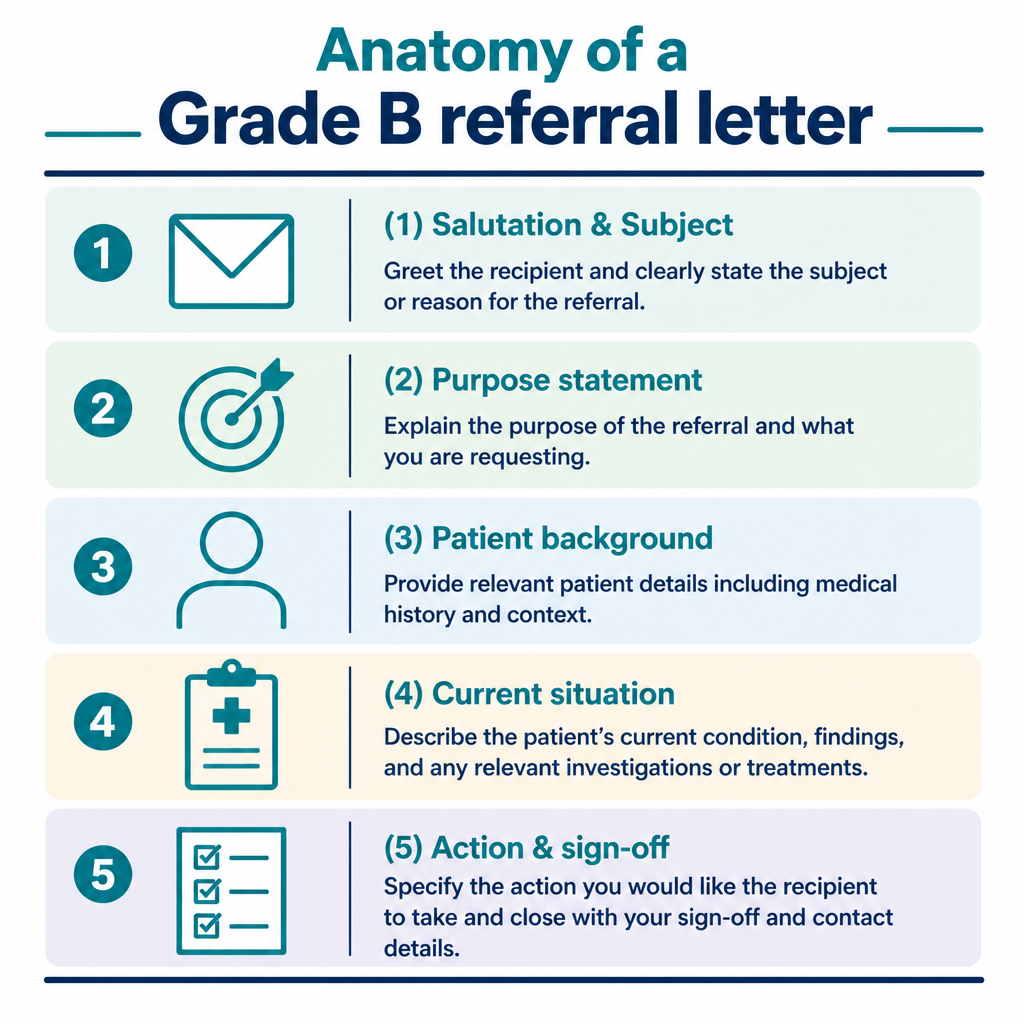
The Grade B sample letter
A complete worked example written to score Grade B (350+) against all six criteria.
Dr Smith
Vascular Consultant
16 May 2026
Re: Mr A. Khan — right plantar ulcer; ABPI 0.55, toe pressure 32 mmHg
Dear Dr Smith,
I am referring Mr A. Khan (DOB 02/03/1958) for urgent vascular assessment due to a non-healing right plantar ulcer and abnormal vascular studies that suggest significant peripheral arterial disease. ABPI measured 0.55 and toe pressure 32 mmHg on 10 May 2026.
Mr Khan has type 2 diabetes (HbA1c 64 mmol/mol March 2026), peripheral neuropathy and is an active smoker. The plantar ulcer has been present six weeks, currently 2.2 cm diameter with slough but no exposed bone. He commenced oral amoxicillin/clavulanate 875/125 mg twice daily on 9 May for surrounding cellulitis. Podiatry management has included debridement and twice-weekly dressings with off-loading footwear; progress has been minimal.
Could you please arrange duplex arterial ultrasound and urgent vascular review to determine suitability for revascularisation? If revascularisation is not feasible, please advise on vascular optimisation and an estimated timeframe for intervention to guide ongoing wound care planning.
I can provide wound photographs and full clinic notes on request. Please contact me via the clinic on 020 7X0 XXXX or email clinic@podiatryservice.example for any additional information.
Yours sincerely, A. Walker, Podiatrist
Why this letter scores Grade B — annotation by annotation
Each highlighted phrase maps to one of the six OET writing criteria.
| Phrase from the letter | Criterion | Examiner comment |
|---|---|---|
| "urgent vascular assessment due to a non-healing right plantar ulcer and abnormal vascular studies" | Purpose | Clearly states the referral reason and urgency, fulfilling the Purpose criterion though could specify triage category. |
| "ABPI measured 0.55 and toe pressure 32 mmHg on 10 May 2026" | Content | Provides key objective vascular test results and date, which are essential clinical details for the specialist. |
| "The plantar ulcer has been present six weeks, currently 2.2 cm diameter with slough but no exposed bone" | Conciseness & Clarity | Concise description of wound history and status; could be improved by adding wound depth classification if available. |
| "He commenced oral amoxicillin/clavulanate 875/125 mg twice daily on 9 May for surrounding cellulitis" | Language | Appropriate medication detail and dosing; clear clinical language and correct terminology aid understanding. |
| "Could you please arrange duplex arterial ultrasound and urgent vascular review to determine suitability for revascularisation?" | Genre & Style | Polite, professional request that states the desired actions, aligning with the referral genre and collaborative tone. |
| "If revascularisation is not feasible, please advise on vascular optimisation and an estimated timeframe for intervention" | Content | Asks for alternative management and timeframe, helping with care planning; specific timeframe request strengthens the referral. |
| "I can provide wound photographs and full clinic notes on request" | Organisation & Layout | Offers supporting information and a clear contact pathway, improving the letter's usefulness and structure. |
Criterion-by-criterion score breakdown
| Criterion | Score | Why |
|---|---|---|
| Purpose | 3 / 3 | Purpose is explicit and urgent, clearly addressed to the vascular consultant. |
| Content | 6 / 7 | Includes relevant history, objective vascular measures and current management but could add limb classification or prior imaging. |
| Conciseness & Clarity | 5 / 7 | Information is mostly concise and clear; a few areas could be tighter or more specific (e.g. wound depth classification). |
| Genre & Style | 5 / 7 | Tone and requests are appropriate for a specialist referral; slight improvement possible in specifying urgency level. |
| Organisation & Layout | 6 / 7 | Logical paragraphing and sign-posted requests make the letter easy to follow; attachments could be referenced more clearly. |
| Language | 5 / 7 | Accurate clinical language with occasional opportunities for more precise terminology or passive-voice reduction. |
5 Podiatrist pitfalls to avoid
1. Omitting objective vascular measurements (ABPI/toe pressures).
Fix: Always include the most recent ABPI/toe pressure values and measurement dates.
2. Using vague urgency terms (e.g. 'soon').
Fix: State specific urgency (e.g. 'urgent' with date tested) or requested timeframe.
3. Failing to list current antibiotics and doses.
Fix: Provide full medication names, doses and start dates for antimicrobial therapy.
4. Overloading with irrelevant past history.
Fix: Include only comorbidities that influence vascular risk and wound healing.
5. Not offering contact details or additional materials.
Fix: Offer clinic phone, email and availability of wound photos or full notes.
2026 update
What changed in 2026 for Podiatrist letters
The 2026 stricter scoring regime places greater emphasis on precise, evidence-based referrals. For podiatrists this means providing up-to-date objective vascular data (ABPI, toe pressures, dates), clear requests (duplex and urgent vascular opinion) and specific clinical context (wound size, infection status, diabetes control).
Be explicit about the action you want and timelines, and avoid vague language. Better organisation and exact terminology now affect banding more than before, so check measurements, medication details and a clear contact pathway before sending referrals.
Frequently asked questions
What key vascular measurements should I include in a referral?
Include the most recent ABPI, toe pressures (with dates), palpable pulses, and any prior duplex or angiography results if available.
How urgent should I label a referral for a non-healing diabetic foot ulcer?
Use 'urgent' when ABPI <0.6, toe pressure <30–40 mmHg, or rapid deterioration; specify clinical reasons to support the urgency.
Should I request a specific vascular procedure in the letter?
Request assessment for suitability for revascularisation rather than specifying a procedure; allow the vascular team to determine feasibility.
How much wound detail is necessary?
Provide size, depth, presence of slough or bone exposure, infection status, and recent treatments such as debridement and antibiotics.
Do I need to attach wound photographs?
Photographs are helpful; state they are available and how to request them, rather than attaching without consent protocols.
How do I improve clarity under the 2026 regime?
Be concise, include objective data and dates, state exact requests and provide contact details; avoid ambiguous language and unnecessary history.
Keep learning
Relevant scoring criteria
Related guides
Want Dr Mariam to mark YOUR podiatrist letter against all six criteria?
See OET Writing Correction packs →