Physiotherapist · Referral letter · Grade B worked sample
Physiotherapist Referral to GP (Grade B Sample)
Worked example of a Grade B physiotherapist referral letter to a GP, showing appropriate clinical content, action requests and clear organisation.
In short
- →Summarises assessment and three physiotherapy sessions with minimal improvement.
- →Requests GP review for analgesia optimisation, knee X-ray and blood tests.
- →Asks GP to consider orthopaedic referral, aspiration or intra‑articular steroid if indicated.
The case notes
The OET writing task you would receive in this scenario.
Anatomy of this letter
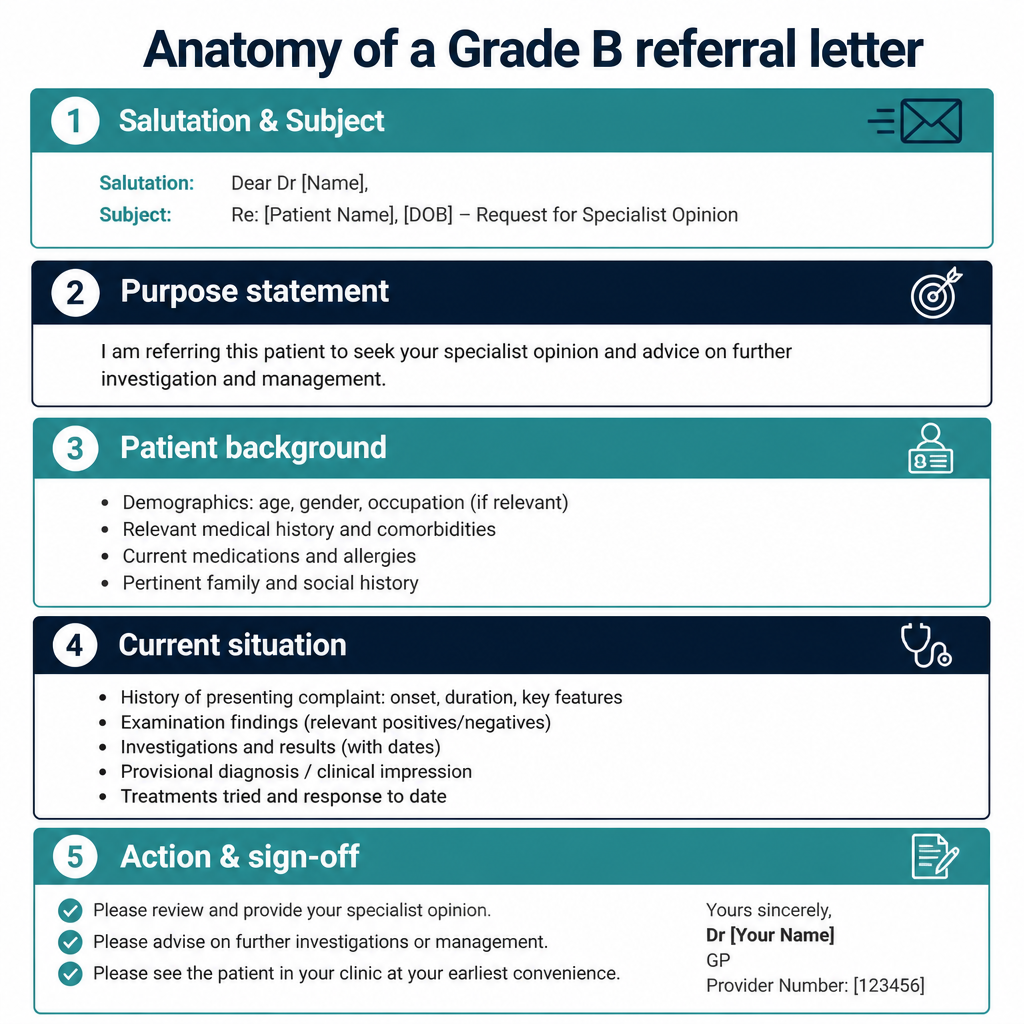
The Grade B sample letter
A complete worked example written to score Grade B (350+) against all six criteria.
Dr Smith
General Practitioner
16 May 2026
Referral: Mr Rajesh Patel — left knee pain; request for imaging and analgesia review
Dear Dr Smith,
I am writing about Mr Rajesh Patel (DOB 04/02/1954), whom I assessed in the outpatient physiotherapy clinic on 10 May 2026 for a six‑week increase in left knee pain and swelling. The purpose of this letter is to summarise treatment to date, objective findings, and to request GP review for analgesic optimisation and investigations.
Mr Patel has established left knee osteoarthritis, type 2 diabetes mellitus and hypertension. He reports nocturnal pain scored 7/10 and increasing difficulty weightbearing; he now uses a single‑point stick. Examination showed reduced left knee flexion to 80°, an effusion with mild warmth, quadriceps weakness (MRC 4/5) and an antalgic gait. Current analgesia: paracetamol 1 g four times daily and naproxen 250 mg twice daily PRN; there are no recent blood results or imaging available to this service.
After three physiotherapy sessions (strengthening, range exercises and gait practice) his pain and function have not improved. Please could you: review and optimise analgesia (consider a short course of opioid or a trial of a neuropathic agent where appropriate), arrange plain radiography of the left knee and bloods (CRP, ESR, FBC, HbA1c), and consider urgent orthopaedic referral or joint aspiration if infection or an inflammatory process is suspected. Please also advise whether intra‑articular steroid would be appropriate.
I will continue the prescribed exercise programme once medical management is clarified. Please forward results and your plan; contact me if you require further clinical information or wish to discuss rehabilitation options.
Yours sincerely, A. Walker, Physiotherapist
Why this letter scores Grade B — annotation by annotation
Each highlighted phrase maps to one of the six OET writing criteria.
| Phrase from the letter | Criterion | Examiner comment |
|---|---|---|
| "The purpose of this letter is to summarise treatment to date, objective findings, and to request GP review for analgesic optimisation and investigations." | Purpose | Clearly states the letter’s intent and the specific action required from the GP; purpose is explicit and focused. |
| "Examination showed reduced left knee flexion to 80°, an effusion with mild warmth, quadriceps weakness (MRC 4/5) and an antalgic gait." | Content | Concise, relevant clinical findings that support the request for imaging and further medical review. |
| "Current analgesia: paracetamol 1 g four times daily and naproxen 250 mg twice daily PRN; there are no recent blood results or imaging available to this service." | Conciseness & Clarity | Medication and absence of investigations are stated succinctly, helping the GP quickly understand gaps in management. |
| "Please could you: review and optimise analgesia (consider a short course of opioid or a trial of a neuropathic agent where appropriate), arrange plain radiography of the left knee and bloods (CRP, ESR, FBC, HbA1c), and consider urgent orthopaedic referral or joint aspiration if infection or an inflammatory process is suspected." | Genre & Style | Polite, professional request with clear, actionable items consistent with a referral letter; could be slightly more prioritised. |
| "After three physiotherapy sessions (strengthening, range exercises and gait practice) his pain and function have not improved." | Organisation & Layout | States intervention and response clearly in a separate paragraph, aiding reader navigation through the letter. |
| "I will continue the prescribed exercise programme once medical management is clarified." | Language | Appropriate register and clear commitment to ongoing care; language is professional with correct tense and vocabulary. |
| "Please forward results and your plan; contact me if you require further clinical information or wish to discuss rehabilitation options." | Content | Includes follow‑up request and offer of collaboration, which strengthens continuity of care. |
Criterion-by-criterion score breakdown
| Criterion | Score | Why |
|---|---|---|
| Purpose | 3 / 3 | Purpose is explicit, relevant and appropriate for a referral letter, clearly directing the GP’s next steps. |
| Content | 6 / 7 | Includes most relevant clinical details, treatment given and clear requests; could add one more objective measure or timeline. |
| Conciseness & Clarity | 5 / 7 | Information is generally concise and clear but one or two sentences could be more tightly prioritised. |
| Genre & Style | 5 / 7 | Tone and formality suit a professional referral letter; action items are polite and appropriate. |
| Organisation & Layout | 6 / 7 | Logical paragraphing and clear signposting make the letter easy to follow; sequencing supports clinical decisions. |
| Language | 5 / 7 | Vocabulary and grammar are accurate overall; occasional phrasing could be more precise for maximum clarity. |
5 Physiotherapist pitfalls to avoid
1. Vague purpose or no clear action requested.
Fix: Begin with a one-line purpose and list specific, numbered actions for the GP.
2. Including irrelevant physiotherapy detail.
Fix: Report only findings and treatments that affect medical decisions.
3. Unclear medication history or dosing.
Fix: State drug names, doses and frequency exactly as prescribed.
4. Long paragraphs that mix history and requests.
Fix: Use separate paragraphs: history, response to therapy, and clear requests.
5. Overly informal language or abbreviations without explanation.
Fix: Use professional register and explain any necessary abbreviations (e.g. MRC).
2026 update
What changed in 2026 for Physiotherapist letters
From 2026 the OET scoring regime places greater emphasis on precision, prioritisation and actionable requests.
As a physiotherapist writing to a GP this means you must state the purpose immediately, include only clinically relevant findings, and make explicit, realistic requests (tests, medication review, referrals). Language must be accurate and professional; avoid hedging and be specific about next steps to meet stricter clarity and content expectations under the new marking standards.
This improves patient safety and interprofessional communication.
Frequently asked questions
How long should an OET physiotherapy referral letter be?
Aim for 180–220 words: enough to state purpose, relevant history, treatment response and clear, specific requests.
What is the most important sentence in the letter?
The purpose statement: it should immediately state why you are writing and what action you need from the GP.
Should I list every physiotherapy exercise provided?
No. Summarise the intervention briefly and focus on patient response and what the GP needs to know for medical decisions.
How specific should medication requests be?
Be specific about current medications and clearly request review or alternatives, but leave prescribing decisions to the GP.
Do I need to offer follow‑up in the letter?
Yes — state that you will continue rehabilitation after medical clarification and ask the GP to forward results or plans.
How formal should language and tone be?
Use professional clinical language, polite requests and avoid colloquialisms; this supports clarity and interprofessional respect.
Keep learning
Relevant scoring criteria
Want Dr Mariam to mark YOUR physiotherapist letter against all six criteria?
See OET Writing Correction packs →