Physiotherapist · Discharge letter · Grade B worked sample
Physiotherapist Discharge to Community Physio (Grade B Sample)
Worked example showing a Grade B discharge letter from an acute physiotherapist to community services. Use this to compare structure, content and tone.
In short
- →Clear request for community physiotherapy after right total knee replacement, with suggested timing and frequency.
- →Provides objective measures (ROM, MRC strength, TUG) and current functional status for handover.
- →Recommends twice-weekly sessions for four weeks, focusing on strength, balance, stairs and graded walking.
The case notes
The OET writing task you would receive in this scenario.
Anatomy of this letter
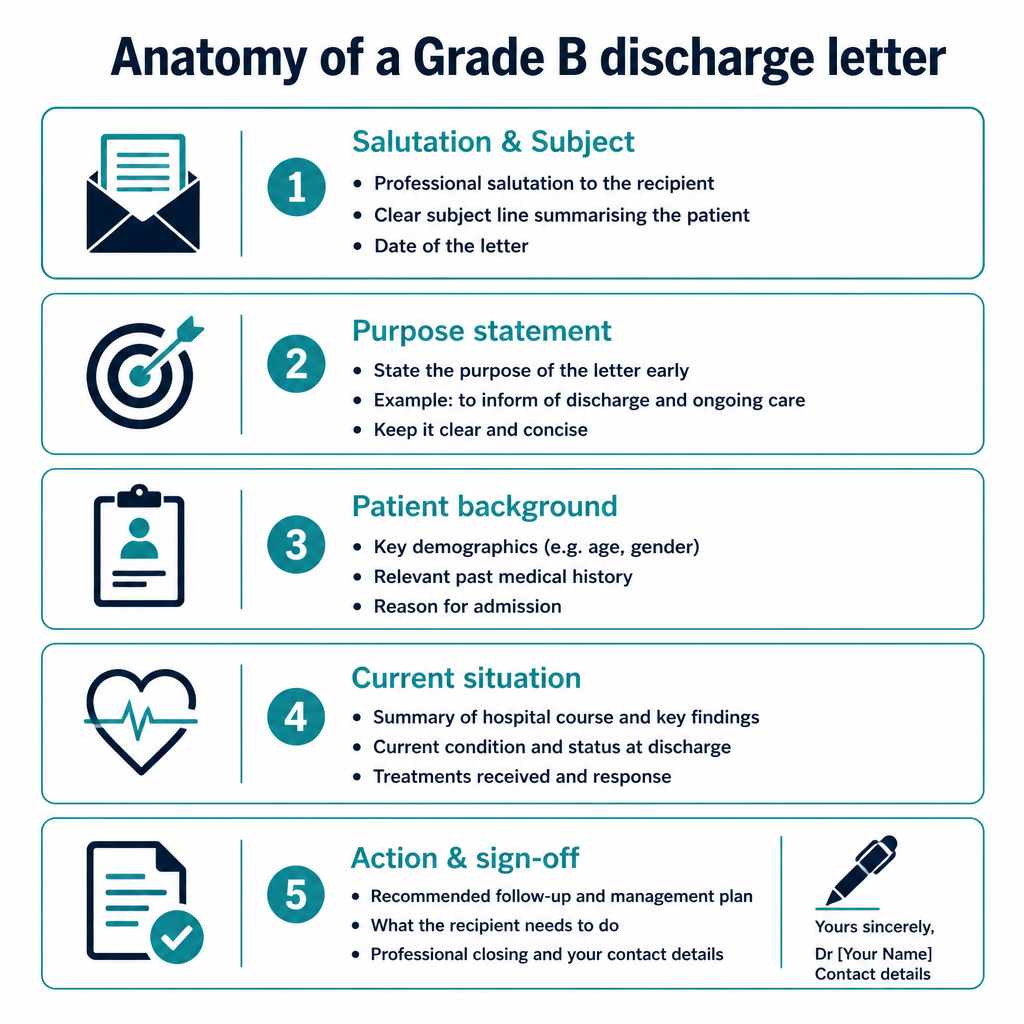
The Grade B sample letter
A complete worked example written to score Grade B (350+) against all six criteria.
Ms Patel
Community Physiotherapist
16/05/2026
Re: Mr John Brown (DOB 14/02/1956) — Discharge to community physiotherapy
Dear Ms Patel,
I am writing to discharge Mr John Brown (DOB 14/02/1956) from the acute physiotherapy service and to request community physiotherapy for ongoing rehabilitation following a right total knee replacement on 05/05/2026. He remains motivated and compliant with exercises but requires further progressive strengthening and gait training to achieve safe community mobility.
Pre-morbid he was independent at home and managed a single flight of stairs. Relevant medical history includes Type 2 diabetes and hypertension. During admission he received daily physiotherapy: mobility retraining, progressive resistance exercises and education regarding pacing. Objective measures at discharge: knee ROM 0–100° flexion, quadriceps MRC 3/5, Timed Up and Go 20 seconds, walking 10 m with single stick at approximately 0.8 m/s.
At discharge he is independent with transfers and level walking indoors using a stick, but requires supervision on stairs and for longer outdoor walks. Wound is healed. Analgesia: paracetamol 1 g four times daily and codeine 30 mg as required; pain currently limits single-leg practice to 10–15 minutes.
I recommend twice-weekly community sessions for four weeks focusing on quadriceps strengthening, progressive balance retraining, stair negotiation and graded walking distance. Please arrange the first visit within 48–72 hours. Enclosed: inpatient exercise sheet and objective scores; contact me for further information.
Yours sincerely, A. Walker, Physiotherapist
Why this letter scores Grade B — annotation by annotation
Each highlighted phrase maps to one of the six OET writing criteria.
| Phrase from the letter | Criterion | Examiner comment |
|---|---|---|
| "I am writing to discharge Mr John Brown (DOB 14/02/1956) from the acute physiotherapy service and to request community physiotherapy for ongoing rehabilitation following a right total knee replacement on 05/05/2026." | Purpose | Clearly states the reason for writing and the clinical context; could be marginally shorter but purpose is explicit. |
| "Objective measures at discharge: knee ROM 0–100° flexion, quadriceps MRC 3/5, Timed Up and Go 20 seconds, walking 10 m with single stick at approximately 0.8 m/s." | Content | Provides relevant, measurable clinical data for handover, supporting prioritisation of community goals. |
| "At discharge he is independent with transfers and level walking indoors using a stick, but requires supervision on stairs and for longer outdoor walks." | Conciseness & Clarity | Succinct functional summary; could specify 'supervision' level (e.g. standby or arm's length) to improve clarity. |
| "I recommend twice-weekly community sessions for four weeks focusing on quadriceps strengthening, progressive balance retraining, stair negotiation and graded walking distance." | Organisation & Layout | Action plan is clearly signposted with frequency and duration, aiding planning; would improve with SMART targets. |
| "Analgesia: paracetamol 1 g four times daily and codeine 30 mg as required; pain currently limits single-leg practice to 10–15 minutes." | Language | Clinical phrasing and doses are appropriate; the long sentence could be split for readability. |
| "Please arrange the first visit within 48–72 hours." | Genre & Style | Appropriate professional request that sets a clear expected timeframe for handover. |
| "Enclosed: inpatient exercise sheet and objective scores; contact me for further information." | Content | Indicates supporting documents are provided, which is helpful for continuity; specifying where the documents are attached would be clearer. |
Criterion-by-criterion score breakdown
| Criterion | Score | Why |
|---|---|---|
| Purpose | 2 / 3 | Purpose is explicit and appropriate but could be slightly more concise. |
| Content | 5 / 7 | Relevant clinical details and objective data are included but some pre-morbid baselines and risk details are limited. |
| Conciseness & Clarity | 5 / 7 | Information is generally concise and clear; a few sentences could be tightened or split for readability. |
| Genre & Style | 5 / 7 | Professional clinical tone is maintained though some phrasing is slightly informal for handover. |
| Organisation & Layout | 6 / 7 | Letter is well-structured with a clear request and plan; SMART targets and explicit supervision detail would strengthen it. |
| Language | 6 / 7 | Accurate clinical language and appropriate terminology are used; minor grammatical tightening would improve flow. |
5 Physiotherapist pitfalls to avoid
1. Vague functional descriptions (e.g. 'improved mobility')
Fix: Use specific measures (ROM, MRC grade, TUG) and clear functional examples.
2. No recommended frequency or timing for community visits
Fix: State suggested first visit timeframe and session frequency/duration.
3. Omitting pain or analgesia information
Fix: Include current pain limits and relevant analgesia affecting participation.
4. Unclear supervision needs on stairs or outdoors
Fix: Specify level of supervision required (standby, contact guard, supervision).
5. No attached exercise sheet or objective scores
Fix: Mention and attach inpatient exercise programme and baseline/outcome measures.
2026 update
What changed in 2026 for Physiotherapist letters
The 2026 stricter scoring regime requires physiotherapists to be precise and directive in discharge letters.
For physiotherapy handovers that means clear, measurable objectives, explicit recommended actions (timing, frequency, duration), and concise documentation of objective outcomes and safety needs. Vague phrasing or missing objective data will be penalised, so include numerical measures, supervision level and any factors limiting rehabilitation (for example pain or wound status). This improves safe, efficient transfer to community services.
Frequently asked questions
How soon should community physio visit after discharge?
Ideally within 48–72 hours to reinforce initial exercises, review mobility and manage pain-related barriers to rehab.
What objective measures are most useful in handover?
Common useful measures: ROM (degrees), MRC strength grades, Timed Up and Go (seconds), and walking speed or distance.
How detailed should the exercise prescription be?
Provide a clear programme with sets/reps, progression guidance and time limits on painful exercises; attach the inpatient sheet.
Should I mention analgesia in a physiotherapy discharge letter?
Yes. State current analgesics and any pain-related limits to participation as this affects therapy planning.
What to include about home environment?
Note relevant details: stairs, living alone, need for aids, and any planned equipment or adaptations.
How to request a specific number of community sessions?
Make a clear recommendation (e.g. twice weekly for four weeks) and justify it with current deficits and goals.
Keep learning
Relevant scoring criteria
Want Dr Mariam to mark YOUR physiotherapist letter against all six criteria?
See OET Writing Correction packs →