Pharmacist · Referral letter · Grade B worked sample
Pharmacist Referral for medication review (Grade B Sample)
Worked example showing a Grade B referral letter from a community pharmacist to a GP requesting a medication review for an older patient with CKD and polypharmacy.
In short
- →Clear purpose statement requesting medication review focused on renal risk and polypharmacy.
- →Summarises relevant history, current medicines, objective data and adherence concerns.
- →Requests specific actions: stop OTC NSAID, check renal function, review metformin and BP.
The case notes
The OET writing task you would receive in this scenario.
Anatomy of this letter
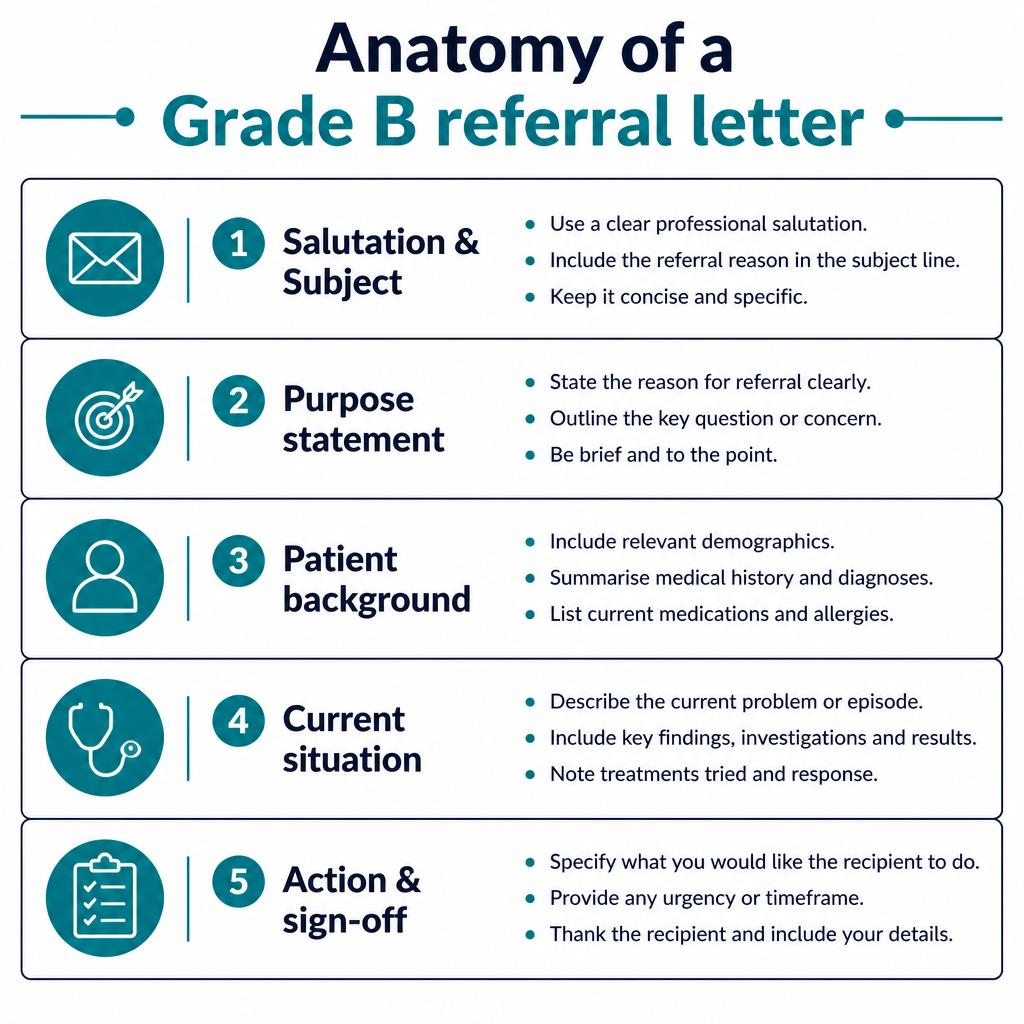
The Grade B sample letter
A complete worked example written to score Grade B (350+) against all six criteria.
Dr Smith
GP
16 May 2026
Medication review request for Mrs S Patel (D.O.B. 12/03/1948)
Dear Dr Smith,
I am writing to request a medication review for Mrs S Patel, a 78‑year‑old patient registered at your practice, following a pharmacy clinical check on 10 May 2026. The purpose is to review renal‑related risk and polypharmacy and to suggest specific monitoring and changes to reduce potential harm.
Relevant history: Type 2 diabetes, hypertension, osteoarthritis and known CKD stage 3a. Current medicines are ramipril 5 mg once daily, metformin 500 mg twice daily, simvastatin 20 mg nocte, and ibuprofen 400 mg PRN (purchased OTC, approximately three times weekly). Latest blood results show creatinine 130 µmol/L with eGFR 42 mL/min/1.73m2 (02/05/2026). The patient reports missing metformin twice weekly.
Concerns: regular NSAID use may be contributing to reduced renal function and increases risk of hyperkalaemia with an ACE inhibitor. Metformin dose is borderline for the current eGFR. Blood pressure remains above target and adherence to diabetes therapy is inconsistent.
Please consider stopping ibuprofen and arrange serum creatinine and electrolyte checks within 2 weeks, with review of metformin continuation/dose if eGFR declines further. I can provide an MUR and adherence support if helpful. Please advise your preferred plan or any changes you make.
Yours sincerely, A. Walker, MPharm
Why this letter scores Grade B — annotation by annotation
Each highlighted phrase maps to one of the six OET writing criteria.
| Phrase from the letter | Criterion | Examiner comment |
|---|---|---|
| "I am writing to request a medication review for Mrs S Patel" | Purpose | Explicit, concise purpose statement at the start; clearly identifies the patient and reason for contact. |
| "CKD stage 3a... creatinine 130 µmol/L with eGFR 42 mL/min/1.73m2" | Content | Provides relevant clinical data and objective values needed for informed decision-making. |
| "ibuprofen 400 mg PRN (purchased OTC, approximately three times weekly)" | Conciseness & Clarity | Specifies frequency and OTC source succinctly, making the concern about NSAID exposure clear. |
| "regular NSAID use may be contributing to reduced renal function" | Genre & Style | Clinical explanation links medication to suspected harm in a professional, non-prescriptive tone. |
| "Please consider stopping ibuprofen and arrange serum creatinine and electrolyte checks within 2 weeks" | Organisation & Layout | Direct request with clear timeframe and actionable monitoring steps, placed in the closing paragraph. |
| "I can provide an MUR and adherence support if helpful" | Language | Offers collaboration using conditional phrasing; polite and professionally worded. |
| "metformin dose is borderline for the current eGFR" | Content | Identifies a specific therapeutic concern that supports the requested review. |
| "Blood pressure remains above target and adherence to diabetes therapy is inconsistent" | Conciseness & Clarity | Summarises two separate issues in a single clear sentence to guide the GP's priorities. |
Criterion-by-criterion score breakdown
| Criterion | Score | Why |
|---|---|---|
| Purpose | 3 / 3 | Purpose is explicit and immediate, identifying the patient and reason for review. |
| Content | 6 / 7 | Includes relevant history, meds, objective results and a clear request, but could add more precise thresholds. |
| Conciseness & Clarity | 5 / 7 | Information is mostly succinct and clear though one or two phrases could be tightened for greater precision. |
| Genre & Style | 6 / 7 | Appropriate professional tone and clinical reasoning; collaborative language is used effectively. |
| Organisation & Layout | 5 / 7 | Logical paragraph structure with requests at the end, minor improvements possible in signposting. |
| Language | 6 / 7 | Accurate vocabulary and grammar with occasional simplification that could improve precision. |
5 Pharmacist pitfalls to avoid
1. Omitting objective renal function data
Fix: Include latest creatinine/eGFR values and dates.
2. Not stating OTC or self‑medication use
Fix: Specify drug, strength, frequency and that it was bought OTC.
3. Vague requests without timeframe
Fix: Give explicit actions and a clear timeframe (e.g. within 2 weeks).
4. Failing to offer collaborative support
Fix: Offer MUR or follow-up and state willingness to help implement changes.
5. Unclear adherence information
Fix: Note reported missed doses and impact on control to guide priority.
2026 update
What changed in 2026 for Pharmacist letters
From 2026 the scoring emphasises clinical precision and actionable requests. For pharmacists this means accurately reporting doses, recent lab values and sources of OTC medicines, and linking these facts to a clear clinical concern.
Markers will expect explicit monitoring plans and timeframes, succinct reasoning for each suggested change, and collaborative offers (for example an MUR). Avoid vague statements; give measurable thresholds and safety actions to meet the stricter criteria for a higher band score.
Frequently asked questions
What is the most important line in a pharmacist referral?
The purpose statement: it should state who the patient is and why you are contacting the GP in one clear sentence.
How much clinical detail should I include?
Include only relevant history, current medicines with doses, recent objective tests (dates/values) and adherence issues to support your request.
Should I recommend specific medication changes?
Yes—suggest actions if appropriate (e.g. stop NSAID, check electrolytes) but use collaborative language so the GP retains clinical responsibility.
How do I show clinical reasoning concisely?
Link a clinical fact to a risk and then a recommended action in two short sentences (e.g. eGFR low → metformin risk → suggest review).
What timeframe is best for requested monitoring?
Give a specific, realistic timeframe, typically within 1–2 weeks for renal checks when acute risk is suspected.
Can I offer pharmacy services in the letter?
Yes. Briefly state available services (MUR, adherence support) and your willingness to help implement changes.
Keep learning
Relevant scoring criteria
Related guides
Want Dr Mariam to mark YOUR pharmacist letter against all six criteria?
See OET Writing Correction packs →