Pharmacist · Advice letter · Grade B worked sample
Pharmacist Advice Letter to GP — Medication Interaction (Grade B Sample)
Worked example of a Grade B pharmacist advice letter to a GP focusing on a clinically important drug interaction and recommended action.
In short
- →Patient on simvastatin started clarithromycin; risk of severe myopathy.
- →Recommend stopping simvastatin immediately and for 7 days after antibiotic course.
- →Request GP to confirm action, consider alternative statin and monitor CK if symptomatic.
The case notes
The OET writing task you would receive in this scenario.
Anatomy of this letter
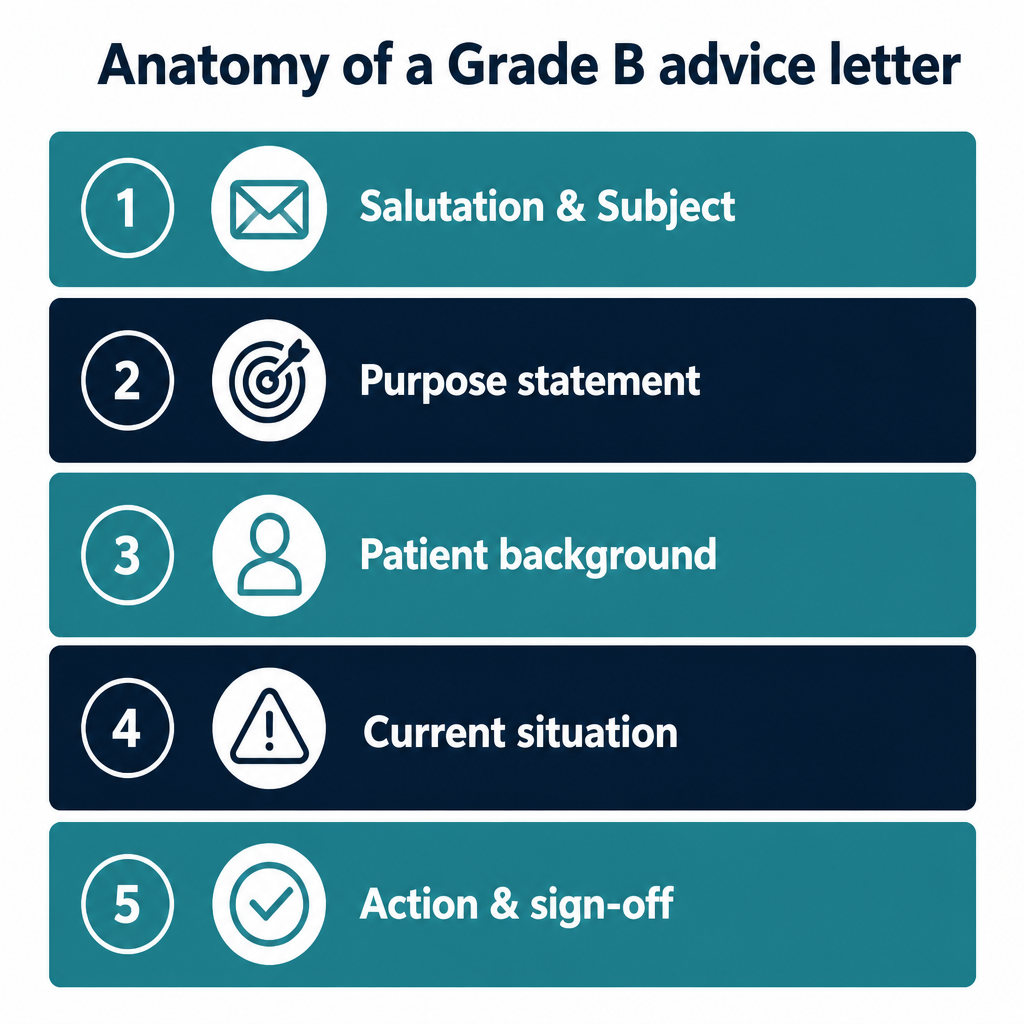
The Grade B sample letter
A complete worked example written to score Grade B (350+) against all six criteria.
Dr Smith
General Practitioner
16 May 2026
Drug interaction: simvastatin and clarithromycin — Mr R Khan (DOB 12/03/1954)
Dear Dr Smith,
I am writing to advise you about a potentially serious drug interaction affecting our mutual patient, Mr R Khan (DOB 12/03/1954). He presented at the pharmacy with an out-of-hours prescription for clarithromycin 500 mg twice daily issued 10 May 2026 while taking simvastatin 40 mg nocte.
Mr Khan is a 72-year-old with hypercholesterolaemia, hypertension and type 2 diabetes. His current medicines are simvastatin 40 mg nocte, lisinopril 10 mg once daily and metformin 1 g twice daily. No drug allergies are recorded and there are no available CK results in his electronic record.
Clarithromycin is a potent CYP3A4 inhibitor and substantially increases simvastatin exposure, raising the risk of myopathy and rhabdomyolysis. I recommend you advise Mr Khan to stop simvastatin immediately and to remain off it for 7 days after completing the 7-day clarithromycin course. If ongoing lipid-lowering is required, please consider restarting simvastatin after review or switching to pravastatin/rosuvastatin which have lower interaction risk. Check CK and review if he reports muscle pain or weakness.
Please confirm your preferred course of action and whether you would like the pharmacy to follow up with the patient. I am available to discuss this further via your practice contact details.
Yours sincerely, A. Walker, MPharm
Why this letter scores Grade B — annotation by annotation
Each highlighted phrase maps to one of the six OET writing criteria.
| Phrase from the letter | Criterion | Examiner comment |
|---|---|---|
| "I am writing to advise you about a potentially serious drug interaction affecting our mutual patient" | Purpose | Clearly states the purpose and identifies the patient, establishing immediate relevance to the GP. |
| "clarithromycin 500 mg twice daily issued 10 May 2026 while taking simvastatin 40 mg nocte" | Content | Provides specific medicines, dosages and date—essential details for clinical decision-making. |
| "No drug allergies are recorded and there are no available CK results in his electronic record." | Conciseness & Clarity | Concise summary of relevant background; flags missing information that affects risk assessment. |
| "I recommend you advise Mr Khan to stop simvastatin immediately and to remain off it for 7 days after completing the 7-day clarithromycin course." | Genre & Style | Direct clinical recommendation phrased professionally and suited to a request for GP action. |
| "If ongoing lipid-lowering is required, please consider restarting simvastatin after review or switching to pravastatin/rosuvastatin" | Content | Offers practical alternatives, demonstrating appropriate pharmacist-led clinical advice. |
| "Check CK and review if he reports muscle pain or weakness." | Conciseness & Clarity | Clear follow-up instructions for monitoring, short and actionable. |
| "Please confirm your preferred course of action and whether you would like the pharmacy to follow up with the patient." | Organisation & Layout | Polite request for confirmation and defined next steps, improving coordination of care. |
| "I am available to discuss this further via your practice contact details." | Language | Professional closing that offers further communication; polite and appropriately formal. |
Criterion-by-criterion score breakdown
| Criterion | Score | Why |
|---|---|---|
| Purpose | 3 / 3 | Purpose is explicit and immediately clear; patient identified and issue signposted. |
| Content | 6 / 7 | Includes most relevant clinical details, dosages and a clear recommendation; minor gaps (no CK baseline). |
| Conciseness & Clarity | 5 / 7 | Information is mostly concise and actionable, though a few sentences could be tightened for greater precision. |
| Genre & Style | 5 / 7 | Appropriate professional tone and directive language; could be slightly more assertive in request for GP action. |
| Organisation & Layout | 6 / 7 | Logical paragraph structure with clear purpose, background, recommendation and request for follow-up. |
| Language | 6 / 7 | Accurate clinical vocabulary and mostly error-free grammar; occasional phrasing could be more concise. |
5 Pharmacist pitfalls to avoid
1. Vague or missing recommendation (e.g. 'consider changes').
Fix: Give a clear, time-limited action the GP can take (stop, hold, review by date).
2. Omitting exact drug names, doses or dates.
Fix: Include full medicine names, strengths, dosing regimen and date prescribed.
3. Overly technical language or unnecessary detail.
Fix: Be precise but concise; only include clinically relevant information for the GP.
4. No request for GP confirmation or follow-up.
Fix: End with a clear request for action and ask the GP to confirm their decision.
5. Failing to flag monitoring needs (e.g. CK checks).
Fix: State specific monitoring actions and symptoms that require urgent review.
2026 update
What changed in 2026 for Pharmacist letters
From 2026 the scoring is stricter: you must demonstrate an explicit purpose, specific clinical details and unambiguous recommendations.
As a pharmacist writing to a GP, this means naming drugs, doses and dates; stating a clear, time-bound action (for example, 'stop simvastatin immediately and for 7 days after'); and requesting confirmation. Concise, clinically focused language and defined monitoring advice (when to check CK, what symptoms warrant review) carry more weight under the new regime and reduce the risk of marks lost for vagueness.
Frequently asked questions
How long should my advice letter be?
Aim for one page; 150–220 words is typical. Include a clear purpose, key clinical details, a recommendation and a request for confirmation.
Do I need to include full medication details?
Yes. Always state the drug name, strength, route, dosing regimen and the date it was prescribed to allow accurate assessment.
How direct should my recommendation be?
Be direct and time-bound: use phrases like 'recommend you advise the patient to stop...' and specify duration or review timeframe.
Should I suggest alternative medications?
If relevant, suggest safe alternatives or options for review; keep suggestions brief and evidence-based (e.g. pravastatin or rosuvastatin).
What monitoring should I include?
State specific monitoring actions such as 'check CK if muscle symptoms occur' and indicate urgency where appropriate.
How do I close the letter?
Request confirmation of action, offer to follow up, and end with a professional sign-off including your name and qualification.
Keep learning
Relevant scoring criteria
Related guides
Want Dr Mariam to mark YOUR pharmacist letter against all six criteria?
See OET Writing Correction packs →