Occupational Therapist · Discharge letter · Grade B worked sample
Occupational Therapist — Discharge to community OT (Grade B Sample)
Worked example showing a Grade B occupational therapy discharge letter requesting community OT follow-up after inpatient rehabilitation.
In short
- →Concise summary and clear request for community OT review within 7 working days.
- →Summarises ADL status, equipment provided, ongoing risks and short-term goals.
- →Requests reassessment for long-term equipment, transfer training and reablement input.
The case notes
The OET writing task you would receive in this scenario.
Anatomy of this letter
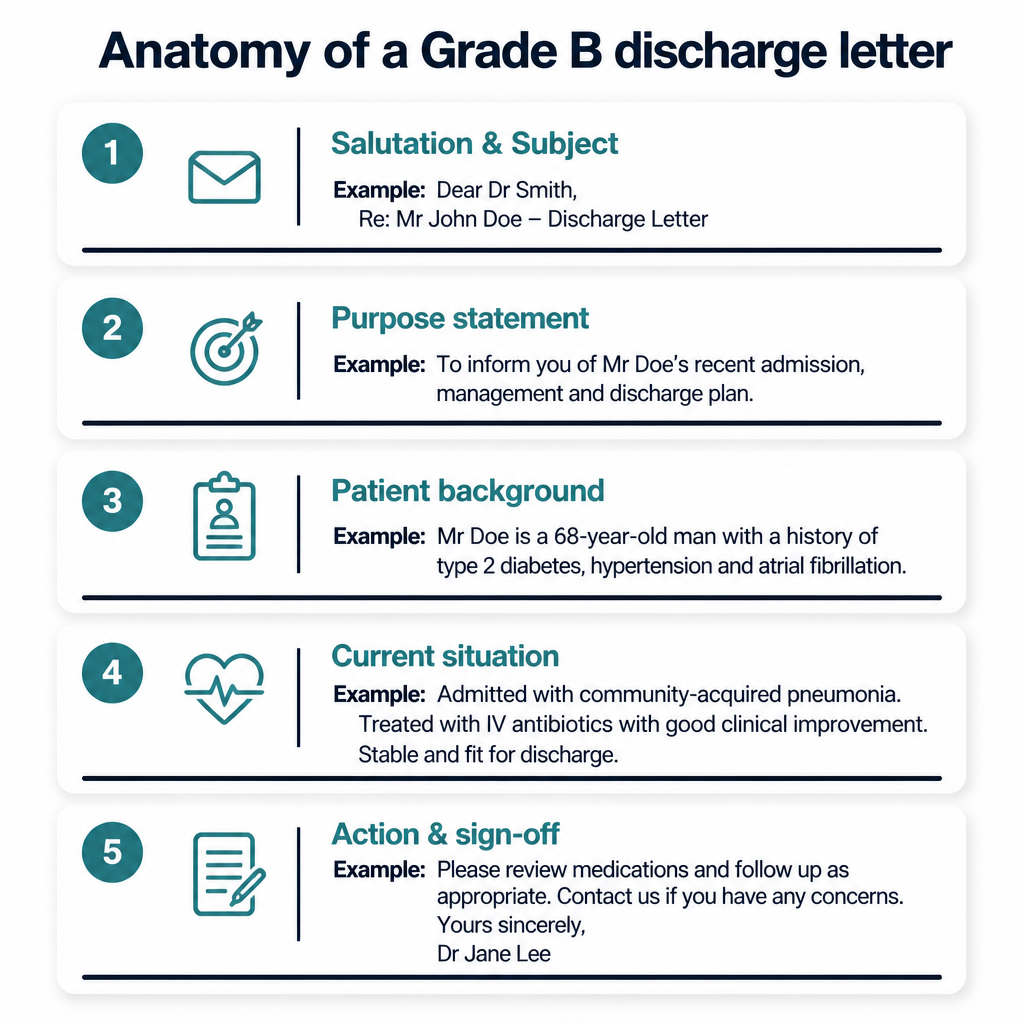
The Grade B sample letter
A complete worked example written to score Grade B (350+) against all six criteria.
Ms S Patel
Community Occupational Therapist
16 May 2026
Subject: Discharge of Mr J Harris — request for community OT reassessment
Dear Ms Patel,
I am writing to request community occupational therapy follow-up for Mr J Harris, discharged home today following inpatient rehabilitation after a left hip fracture and hemiarthroplasty.
During his admission he has progressed to weight-bearing-as-tolerated with a walking frame for short distances and requires a single-person assist for sit-to-stand. He can perform seated washing and upper‑body dressing with supervision but requires assistance for toileting transfers. Pain is controlled with paracetamol and cognition remains intact, though he reports anxiety about falling.
We have provided interim equipment: raised toilet seat, bedside commode, perching stool and two grab rails (fitted). Reablement visits are arranged daily for two weeks; spouse available for supervision but is not able to perform transfers. Ongoing goals are independence with toileting and safe transfers, and assessment for a long-term mobility aid if needed.
Please arrange a home reassessment within 7 working days to review equipment, assess for a long-term walking aid or hoist needs, and provide transfer training or onward referrals as required.
Yours sincerely, A. Walker, Occupational Therapist
Why this letter scores Grade B — annotation by annotation
Each highlighted phrase maps to one of the six OET writing criteria.
| Phrase from the letter | Criterion | Examiner comment |
|---|---|---|
| "I am writing to request community occupational therapy follow-up for Mr J Harris, discharged home today following inpatient rehabilitation after a left hip fracture and hemiarthroplasty." | Purpose | Clear opening sentence that states purpose, patient, and reason for referral; could be slightly shorter to improve conciseness. |
| "He can perform seated washing and upper‑body dressing with supervision but requires assistance for toileting transfers." | Content | Concise summary of ADL status highlighting specific needs relevant to community OT assessment. |
| "We have provided interim equipment: raised toilet seat, bedside commode, perching stool and two grab rails (fitted)." | Content | Lists equipment supplied which helps the receiving therapist plan follow-up; could include sizes or fitting notes for added clarity. |
| "Please arrange a home reassessment within 7 working days to review equipment, assess for a long-term walking aid or hoist needs, and provide transfer training or onward referrals as required." | Organisation & Layout | Clear action request with timeframe and specific tasks, placed at end for emphasis; timeframe is appropriate for continuity of care. |
| "Reablement visits are arranged daily for two weeks; spouse available for supervision but is not able to perform transfers." | Conciseness & Clarity | Provides essential social support information succinctly; balances brevity with necessary detail. |
| "Pain is controlled with paracetamol and cognition remains intact, though he reports anxiety about falling." | Language | Uses precise clinical language and appropriate tone; 'anxiety about falling' flags a psychosocial issue for the community team. |
| "Ongoing goals are independence with toileting and safe transfers, and assessment for a long-term mobility aid if needed." | Genre & Style | States rehabilitation goals relevant to occupational therapy practice, matching professional register and expectations. |
Criterion-by-criterion score breakdown
| Criterion | Score | Why |
|---|---|---|
| Purpose | 2 / 3 | Purpose is clear and timely but the opening could be more concise and directly targeted. |
| Content | 6 / 7 | Includes relevant clinical details, equipment and risks; minor omissions (e.g. exact measurements) limit a top score. |
| Conciseness & Clarity | 6 / 7 | Information is succinct and unambiguous, with only brief opportunities to reduce redundancy. |
| Genre & Style | 6 / 7 | Professional OT tone and appropriate clinical terminology are used throughout. |
| Organisation & Layout | 6 / 7 | Logical paragraphing and clear action request help the reader locate key information quickly. |
| Language | 6 / 7 | Accurate grammar and vocabulary with occasional phrasing that could be more precise for full marks. |
5 Occupational Therapist pitfalls to avoid
1. Being too vague about equipment already provided.
Fix: List items supplied and note whether fittings were completed.
2. Failing to state a clear timeframe for community follow-up.
Fix: Specify number of days or working-day target for reassessment.
3. Overloading the letter with irrelevant medical detail.
Fix: Include only information that affects OT planning and safety.
4. Not stating the patient’s social support or who can assist.
Fix: Briefly describe carer availability and physical capability.
5. Using ambiguous verbs (e.g. 'may need').
Fix: Use definitive requests (e.g. 'assess for long-term walking aid').
2026 update
What changed in 2026 for Occupational Therapist letters
From 2026 the scoring emphasises precision and actionable requests. Occupational therapists must give clear timeframes, list equipment and describe functional limitations that directly inform community care.
Letters should avoid non-essential medical detail and use unambiguous clinical language. A specific request (for example, 'home reassessment within 7 working days') and measurable goals improve reliability under the stricter regime and support safer handover to community services.
(Strict marking penalises vague or missing action points.)
Frequently asked questions
How long should a Grade B OT discharge letter be?
Aim for 160–220 words: enough detail for safe handover but concise. Focus on function, equipment, risks and clear actions.
What timeframe should I request for community follow-up?
Request within 5–10 working days for post-orthopaedic patients; specify sooner if high falls risk or complex equipment is needed.
Do I need to include medication details?
Only include medications that affect function or cognition (e.g. sedatives, strong analgesics). Routine drugs can be summarised briefly.
How specific should equipment descriptions be?
List items and note if fitted. Include measurements or model only if relevant; otherwise request reassessment for long-term provision.
Should I describe social support in detail?
Provide concise information on who is available, their ability to assist with transfers, and any practical limitations.
How to show clinical urgency without being emotive?
Use factual timeframes and risk statements (e.g. 'immediate reassessment within 7 working days due to transfer dependency').
Keep learning
Relevant scoring criteria
Related guides
Want Dr Mariam to mark YOUR occupational therapist letter against all six criteria?
See OET Writing Correction packs →