Optometrist · Referral letter · Grade B worked sample
Optometrist Referral to ophthalmologist (Grade B Sample)
Worked example showing a Grade B optometrist referral to a consultant ophthalmologist for suspected angle‑closure risk. Use this to compare structure, content and tone.
In short
- →Urgent referral for suspected primary angle‑closure risk in a 67‑year‑old man with raised IOP and shallow anterior chamber.
- →Include clear clinical findings, recent tests (IOP, C:D ratio, OCT), and a specific request for gonioscopy and consideration of PI.
- →Keep tone professional, request assessment within two weeks, attach test printouts, and provide contact details for queries.
The case notes
The OET writing task you would receive in this scenario.
Anatomy of this letter
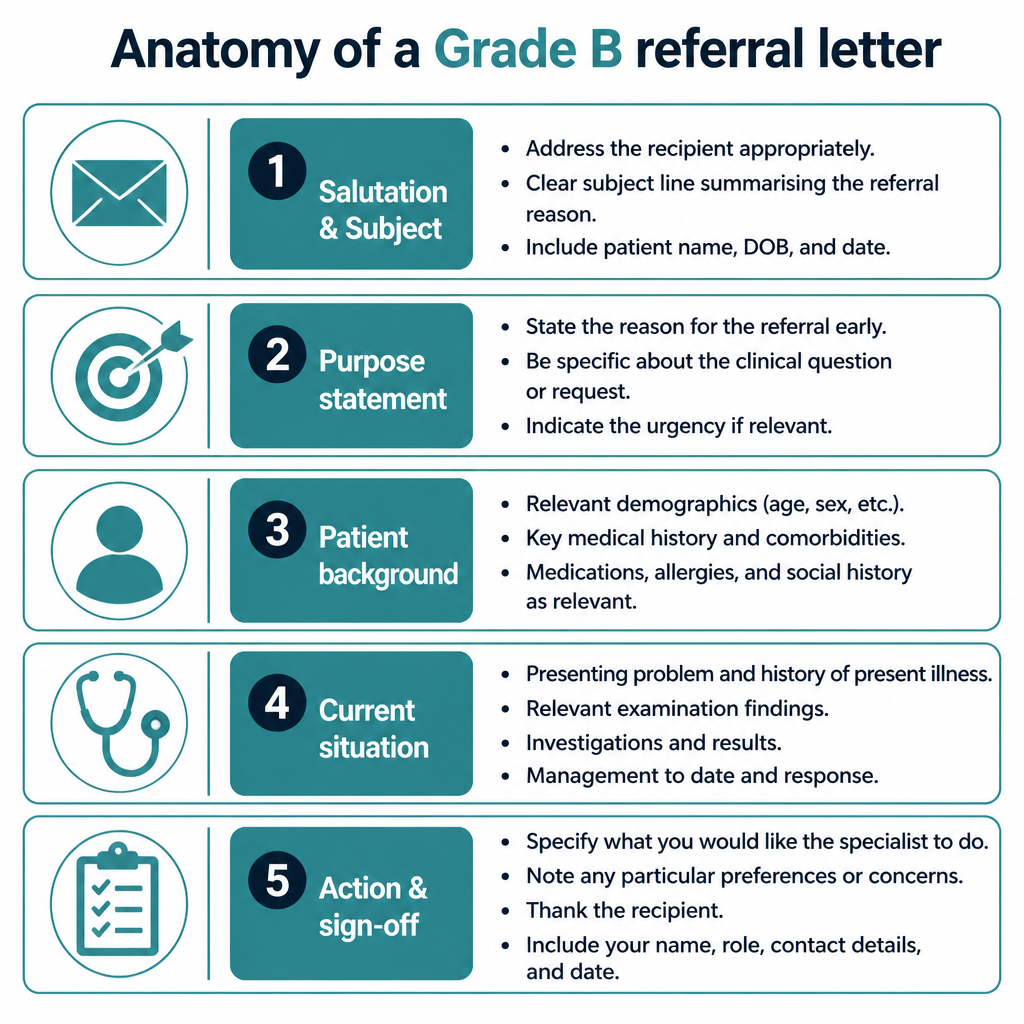
The Grade B sample letter
A complete worked example written to score Grade B (350+) against all six criteria.
Dr Sarah Smith
Consultant Ophthalmologist
16 May 2026
Urgent referral: suspected angle‑closure risk — Mr J. Brown (DOB 12/03/1959)
Dear Dr Smith,
I am writing to refer Mr J. Brown, a 67‑year‑old man, for urgent ophthalmology assessment for suspected primary angle‑closure risk in the left eye. He attended our clinic today with intermittent blurred vision and coloured halos in dim light, and I obtained raised intraocular pressure and a shallow anterior chamber on examination.
Clinical findings today: RE VA 6/6, LE VA 6/12 (pinhole 6/9); NCT IOP RE 16 mmHg, LE 28 mmHg (09:40). Slit‑lamp examination showed a shallow anterior chamber in the left eye (Van Herick grade 1–2) and vertical cup:disc ratio 0.6 LE (0.4 RE). OCT RNFL indicates superior thinning in the left eye. We do not perform gonioscopy in practice and have not started topical pressure‑lowering therapy.
Please could you see Mr Brown within two weeks for gonioscopy, formal IOP measurement, optic nerve assessment and consideration of peripheral iridotomy if indicated. I have attached printouts of the IOP readings and OCT scans. Mr Brown has been advised to avoid dim environments and to contact the practice if vision acutely worsens.
Please contact me on the number below if you require further information or earlier review; I am happy to discuss findings prior to clinic review.
Yours sincerely, A. Walker, Optometrist
Why this letter scores Grade B — annotation by annotation
Each highlighted phrase maps to one of the six OET writing criteria.
| Phrase from the letter | Criterion | Examiner comment |
|---|---|---|
| "I am writing to refer Mr J. Brown, a 67‑year‑old man, for urgent ophthalmology assessment for suspected primary angle‑closure risk in the left eye." | Purpose | Clearly states the purpose, patient ID, urgency and suspected diagnosis — meets Purpose requirements but could specify timeframe immediately. |
| "Clinical findings today: RE VA 6/6, LE VA 6/12 (pinhole 6/9); NCT IOP RE 16 mmHg, LE 28 mmHg (09:40)." | Content | Provides essential, quantitative clinical data (VA, IOP with time) that supports the referral decision. |
| "Slit‑lamp examination showed a shallow anterior chamber in the left eye (Van Herick grade 1–2) and vertical cup:disc ratio 0.6 LE (0.4 RE)." | Conciseness & Clarity | Concise signposting of key findings; use of standard measurements keeps the description clear and brief. |
| "Please could you see Mr Brown within two weeks for gonioscopy, formal IOP measurement, optic nerve assessment and consideration of peripheral iridotomy if indicated." | Genre & Style | Polite, professional request specifying actions and timeframe; fits the clinical referral genre though 'if indicated' is slightly hedged. |
| "I have attached printouts of the IOP readings and OCT scans." | Organisation & Layout | Signposts attachments and supports the letter’s recommendations, aiding the receiving clinician’s review. |
| "Please contact me on the number below if you require further information or earlier review; I am happy to discuss findings prior to clinic review." | Language | Offers continued communication using professional register; grammar and tone are appropriate, though the sentence is slightly long. |
Criterion-by-criterion score breakdown
| Criterion | Score | Why |
|---|---|---|
| Purpose | 3 / 3 | Purpose is explicit, urgent and includes suspected diagnosis and patient identifiers. |
| Content | 6 / 7 | Includes relevant clinical data, tests and a clear request, but could include full past ocular history or medications detail. |
| Conciseness & Clarity | 5 / 7 | Information is concise and mostly clear; one or two sentences are slightly long and could be tightened. |
| Genre & Style | 5 / 7 | Tone is professional and appropriately formal; mild hedging reduces directness of the referral request. |
| Organisation & Layout | 6 / 7 | Logical paragraphing and signposting of attachments support quick clinician review. |
| Language | 5 / 7 | Accurate clinical language and registers are used; occasional long sentences affect fluency. |
5 Optometrist pitfalls to avoid
1. Omitting exact IOP values and times
Fix: Record and include numeric IOPs with the time of measurement.
2. Failing to request specific investigations (eg gonioscopy)
Fix: State the tests and actions you want the ophthalmologist to perform.
3. Using vague urgency (e.g. 'soon')
Fix: Specify a timeframe, for example 'within two weeks' or 'urgent same‑day'.
4. Not attaching objective test printouts
Fix: Attach OCT, IOP, visual fields and mention these attachments in the letter.
5. Overuse of abbreviations without explanation
Fix: Write full terms at first mention (eg intraocular pressure (IOP)).
2026 update
What changed in 2026 for Optometrist letters
From 2026 the marking emphasises precise, clinically useful referrals. You must state a clear purpose, provide concise objective data (IOP with time, VA, OCT), and identify the specific action you want the ophthalmologist to take.
Write in a professional register, avoid unnecessary background, and attach test results. Examiners expect less hedging and more measurable detail; vague requests or missing figures will lose marks under the stricter regime, particularly for candidates in clinical roles such as optometry.
Frequently asked questions
How do I show urgency in a referral?
Use explicit wording such as 'urgent' and give a timeframe (eg 'please see within two weeks' or 'same‑day if acute deterioration').
What clinical data is essential for ophthalmology referrals?
Include VA, IOP (with time), slit‑lamp findings, cup:disc ratio, OCT or visual field results, and recent medication or systemic history.
Should I attach test printouts?
Yes. Attach OCT scans, IOP printouts and any imaging; mention the attachments in the letter so the consultant knows to review them.
How formal should the tone be?
Use a professional, concise clinical register. Be polite but direct; avoid colloquialisms and excessive hedging.
Can I use abbreviations?
Use standard abbreviations but write the full term at first mention (eg intraocular pressure (IOP)). Keep abbreviations minimal to avoid ambiguity.
How long should the referral letter be?
Aim for a brief letter that fits one page: clear purpose, essential clinical findings, requested actions and contact details.
Keep learning
Relevant scoring criteria
Related guides
Want Dr Mariam to mark YOUR optometrist letter against all six criteria?
See OET Writing Correction packs →