Nurse · Transfer letter · Grade B worked sample
Nurse Transfer to specialist unit (Grade B Sample)
Worked example of a Grade B transfer letter from a nurse to a specialist unit charge nurse. Shows realistic clinical detail and common Grade B strengths and weaknesses.
In short
- →Clear transfer request for COPD exacerbation with essential observations and recent treatments.
- →Includes medication list with last doses, oxygen needs, mobility and infection risk.
- →Asks for respiratory monitoring, physiotherapy and review for possible NIV; offers contact details.
The case notes
The OET writing task you would receive in this scenario.
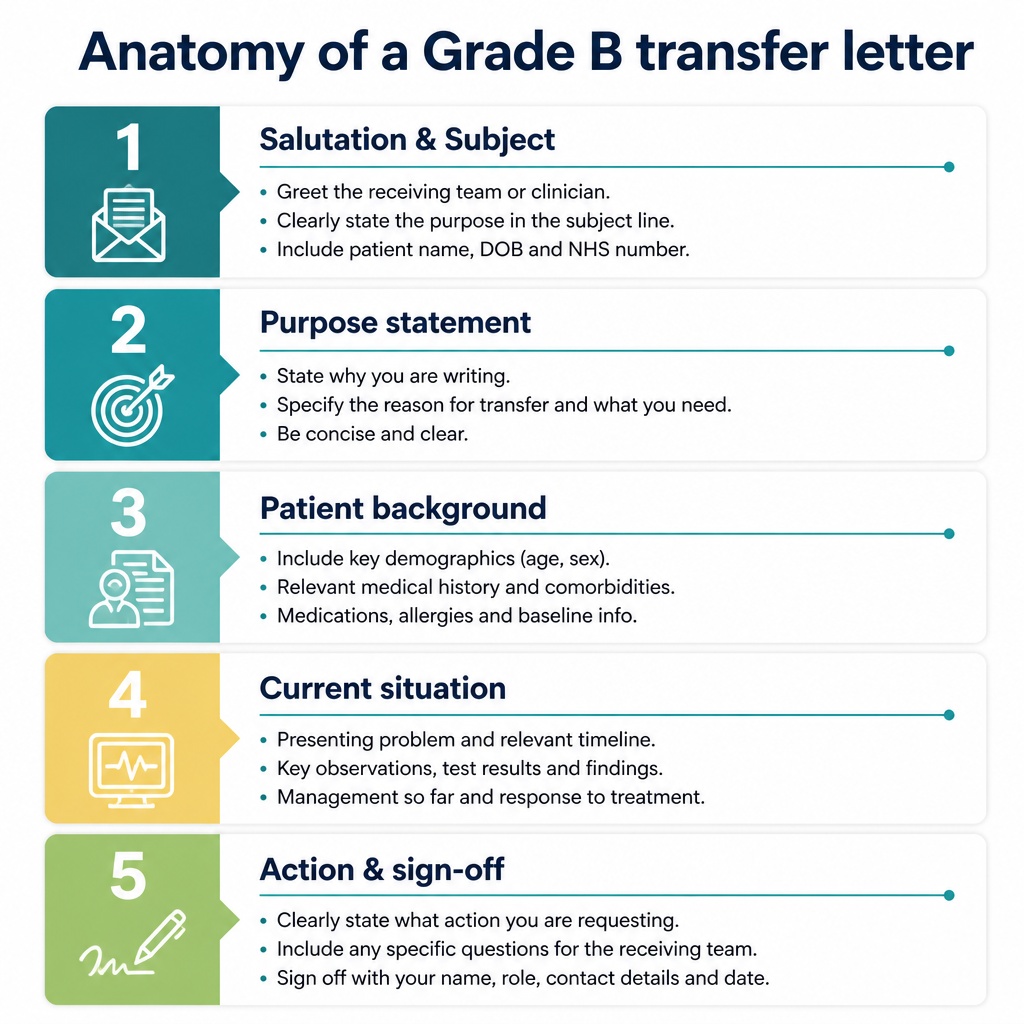
Anatomy of this letter
The Grade B sample letter
A complete worked example written to score Grade B (350+) against all six criteria.
Ms Patel
Charge Nurse, Specialist Unit
16 May 2026
Transfer: Mr John Brown (78) — COPD exacerbation
Dear Ms Patel,
I am transferring Mr John Brown (DOB 02/03/1948; hospital ID 589432) to your unit for specialist respiratory management following a COPD exacerbation with increased sputum production and worsening dyspnoea.
On admission 48 hours ago he was tachypnoeic. Current observations: RR 24/min, HR 98 bpm, BP 132/78 mmHg, Temp 37.8°C. SpO2 is 90% on room air and improves to 94% on 2 L/min O2 via nasal cannula. He is alert and orientated and mobilises with a walking frame; pain score 2/10. A urinary catheter is in situ for fluid monitoring.
Treatments to date: IV co-amoxiclav 1.2 g TDS (first dose 12 hours ago), prednisolone 40 mg PO given 24 hours ago, salbutamol nebuliser 2.5 mg PRN (last given 4 hours ago). No known drug allergies. Chest physiotherapy and chest x-ray are arranged; arterial blood gas will be performed if increased work of breathing.
Please continue IV antibiotics and oral steroids as indicated, provide regular respiratory observations and chest physiotherapy, and consider NIV if there is respiratory fatigue or worsening gas exchange. Contact me on the ward for any queries or further handover information.
Yours sincerely, A. Walker, Nurse
Why this letter scores Grade B — annotation by annotation
Each highlighted phrase maps to one of the six OET writing criteria.
| Phrase from the letter | Criterion | Examiner comment |
|---|---|---|
| "I am transferring Mr John Brown (DOB 02/03/1948; hospital ID 589432) to your unit for specialist respiratory management following a COPD exacerbation with increased sputum production and worsening dyspnoea." | Purpose | Clear, explicit purpose statement with patient ID and reason for transfer — meets Purpose criterion well. |
| "Current observations: RR 24/min, HR 98 bpm, BP 132/78 mmHg, Temp 37.8°C. SpO2 is 90% on room air and improves to 94% on 2 L/min O2 via nasal cannula." | Content | Relevant clinical observations are provided succinctly, giving the receiving team immediate assessment data. |
| "Treatments to date: IV co-amoxiclav 1.2 g TDS (first dose 12 hours ago), prednisolone 40 mg PO given 24 hours ago, salbutamol nebuliser 2.5 mg PRN (last given 4 hours ago)." | Conciseness & Clarity | Medication list is concise and includes dosages and timing, aiding continuity of care; could add route for all items to be clearer. |
| "Chest physiotherapy and chest x-ray are arranged; arterial blood gas will be performed if increased work of breathing." | Organisation & Layout | Shows planned investigations and escalation clearly in a separate sentence, helping the reader identify next steps. |
| "Please continue IV antibiotics and oral steroids as indicated, provide regular respiratory observations and chest physiotherapy, and consider NIV if there is respiratory fatigue or worsening gas exchange." | Genre & Style | Polite, professional action requests with clinical thresholds; fits transfer letter conventions but could be more specific on monitoring frequency. |
| "Contact me on the ward for any queries or further handover information." | Language | Appropriate offer of contact; simple language and correct tone, though a direct phone number would improve usefulness. |
Criterion-by-criterion score breakdown
| Criterion | Score | Why |
|---|---|---|
| Purpose | 3 / 3 | Purpose is explicit and immediately obvious with patient ID and reason for transfer. |
| Content | 6 / 7 | Includes relevant background, observations, treatments and planned actions, though minor details (exact monitoring frequency) are omitted. |
| Conciseness & Clarity | 5 / 7 | Information is mostly concise and clear, but a few sentences could be tightened and some routes/timings clarified. |
| Genre & Style | 5 / 7 | Professional tone and appropriate requests, but occasional lack of specificity reduces band potential. |
| Organisation & Layout | 5 / 7 | Logical paragraphing and clear sections, though headings or bulleting could improve rapid scanning. |
| Language | 5 / 7 | Accurate grammar and medical vocabulary with some minor lapses in precision (e.g. monitoring intervals). |
5 Nurse pitfalls to avoid
1. Omitting exact observation values (e.g. SpO2, RR).
Fix: Include numeric observations and oxygen delivery details for immediate assessment.
2. Listing medications without dosages or last dose time.
Fix: Provide drug name, dose, route and time of last administration.
3. Vague escalation instructions (e.g. 'review if worse').
Fix: Specify triggers (e.g. RR>28 or SpO2 <90%) that require action.
4. Failing to mention mobility or support needs.
Fix: Note baseline and current mobility and any aids or assistance required.
5. No contact details for further handover.
Fix: Give a direct ward phone number or named contact for queries.
2026 update
What changed in 2026 for Nurse letters
The 2026 stricter scoring regime emphasises precision, measurable data and explicit action requests in transfer letters.
As a nurse, you must include exact observations, medication doses and timings, and clear escalation criteria; vague phrases or missing monitoring plans are more likely to lower your score under the new standards. Be concise but exact, and state what you want the specialist unit to do and when they should act in measurable terms (e.g. RR>28, SpO2<90%). Avoid ambiguity and supply a contact for clarification.
Frequently asked questions
How long should an OET transfer letter be?
Aim for one short page: a clear purpose, 2–3 concise body paragraphs with essential clinical details, and a brief sign-off.
What observations must I include?
Include numeric vital signs (RR, HR, BP, Temp), SpO2 with oxygen delivery, and any recent relevant trends or ABG results.
How specific should I be about medications?
Give drug name, dose, route and time of last dose; note allergies and any medication changes during admission.
Do I need to state escalation criteria?
Yes — provide measurable triggers for escalation or interventions (for example thresholds for NIV or ICU review).
Is a mobility note important in respiratory transfers?
Yes — state baseline and current mobility, any aids used, and whether the patient requires assistance for transfers.
Should I include contact details?
Always offer a named contact and ward phone number for handover queries to support safe continuity of care.
Keep learning
Relevant scoring criteria
Related guides
Want Dr Mariam to mark YOUR nurse letter against all six criteria?
See OET Writing Correction packs →