Nurse · Referral letter · Grade B worked sample
Nurse Referral to social worker (Grade B Sample)
Worked example showing a Grade B nurse referral to a hospital social worker, with appropriate clinical detail and a clear request for social input.
In short
- →Refer an 82-year-old man post-fall requiring assessment for home support and possible interim placement.
- →Include brief medical history, current function, cognition, family situation, and medicines.
- →Clear, specific request: social needs assessment, capacity check, and arrange continuing care within 48–72 hours.
The case notes
The OET writing task you would receive in this scenario.
Anatomy of this letter
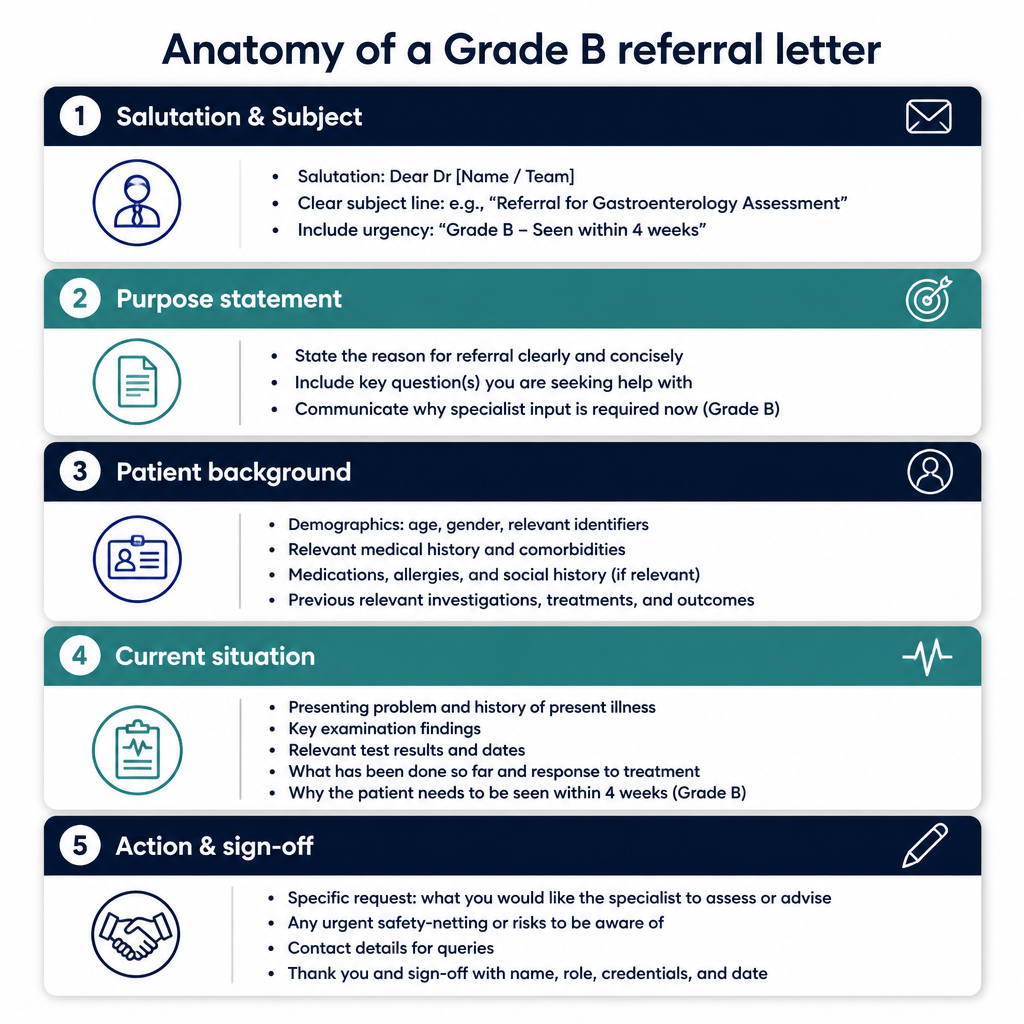
The Grade B sample letter
A complete worked example written to score Grade B (350+) against all six criteria.
Ms Patel
Hospital Social Worker
16 May 2026
Re: Mr J. Carter – social care assessment and discharge planning
Dear Ms Patel,
I am writing to refer Mr J. Carter, an 82-year-old gentleman admitted after a fall resulting in a left neck of femur fracture; he underwent hemiarthroplasty on 07 May. The purpose of this referral is to request a social care assessment to determine his suitability for discharge home and to advise on an interim plan if a care package cannot be arranged promptly.
Mr Carter lived alone prior to admission and was independent with a stick. Medical history includes type 2 diabetes and hypertension. Current medications include paracetamol 1 g four times daily and oxycodone 5 mg PRN. He is mobilising with a frame and requires assistance with transfers and personal care despite physiotherapy input. MMSE 23/30 on 12 May with noticeable short-term memory deficits; he reports anxiety about managing at home.
We request a timely assessment of his social care needs, review of capacity for discharge decisions, and recommendations for either a rapid domiciliary care package or short-term rehabilitation placement. Planned discharge window is 48–72 hours if arrangements can be made. Please contact me on the ward for further information or to discuss family involvement.
Yours sincerely, A. Walker, Nurse
Why this letter scores Grade B — annotation by annotation
Each highlighted phrase maps to one of the six OET writing criteria.
| Phrase from the letter | Criterion | Examiner comment |
|---|---|---|
| "I am writing to refer Mr J. Carter" | Purpose | Clear opening sentence that explicitly states the purpose and identifies the patient, meeting purpose requirements. |
| "The purpose of this referral is to request a social care assessment" | Content | Direct statement of the main request ensures the social worker understands the intended action. |
| "He is mobilising with a frame and requires assistance with transfers and personal care" | Conciseness & Clarity | Concrete functional detail is concise and clinically relevant for discharge planning. |
| "MMSE 23/30 on 12 May with noticeable short-term memory deficits" | Language | Appropriate clinical terminology and date provide precise, evidence-based information. |
| "We request a timely assessment of his social care needs, review of capacity for discharge decisions" | Genre & Style | Polite, professional request phrased as a collaborative action, appropriate for interprofessional correspondence. |
| "Planned discharge window is 48–72 hours if arrangements can be made" | Organisation & Layout | Gives a clear timeframe which helps prioritise the social worker's response and is well placed near the request. |
| "Please contact me on the ward for further information or to discuss family involvement" | Content | Offers a direct follow-up route and acknowledges family role, enhancing completeness of the referral. |
Criterion-by-criterion score breakdown
| Criterion | Score | Why |
|---|---|---|
| Purpose | 3 / 3 | Purpose is explicit and patient is identified immediately, satisfying top marks for intent. |
| Content | 6 / 7 | Includes most relevant clinical, functional and social details, but could include more precise home hazards or ADL checklist. |
| Conciseness & Clarity | 5 / 7 | Information is clear and mostly concise; slight improvement possible by removing minor repetition. |
| Genre & Style | 6 / 7 | Professional tone and appropriate request phrasing; a more explicit prioritisation could strengthen it. |
| Organisation & Layout | 6 / 7 | Well structured into purpose, background, and request with timeframe; could better signpost actions with bullet points. |
| Language | 5 / 7 | Accurate clinical language and dates used; occasional word choice could be more precise for a higher score. |
5 Nurse pitfalls to avoid
1. Vague request (e.g., 'please review')
Fix: State specific actions required: assessment, capacity check, or arrange package within timeframe.
2. Missing contact details for follow-up
Fix: Include ward contact and best times to reach you for rapid coordination.
3. Overloading with irrelevant medical history
Fix: Prioritise information directly relevant to discharge and social needs.
4. Unclear timeframe for discharge
Fix: Provide a realistic window (e.g., 48–72 hours) to guide prioritisation.
5. No mention of family or available support
Fix: Include who is available to help and frequency of their support.
2026 update
What changed in 2026 for Nurse letters
From 2026 the scoring is stricter on clarity and explicit requests in interprofessional letters.
As a nurse referring to a social worker you must state the specific social actions you want (assessment, capacity check, care package or interim placement), include precise functional and cognitive evidence, and give a realistic timeframe. Weak or vague requests now downgrade the score; concise, prioritized information with a clear follow-up route is essential to maintain a Grade B or better under the new regime.
Frequently asked questions
How long should a referral letter to a social worker be?
Aim for 180–220 words: concise but including essential clinical, functional and social details plus a clear request and timeframe.
What is the single most important sentence?
The purpose statement that names the action you want (e.g., 'Please assess social care needs and capacity for discharge').
Should I include medication details?
Yes, include key current medicines if they affect cognition, mobility or discharge planning (name, dose and administration times).
How specific should discharge timeframe be?
Provide a realistic window (for example 48–72 hours) so the social worker can prioritise and plan resources accordingly.
Do I need to mention family involvement?
Yes. State who is available, their proximity and how often they can help — this affects the type and urgency of support needed.
How formal should the tone be?
Maintain a professional, collaborative tone: polite requests, clear actions, and offering a direct contact for follow-up.
Keep learning
Relevant scoring criteria
Related guides
Want Dr Mariam to mark YOUR nurse letter against all six criteria?
See OET Writing Correction packs →