Nurse · Advice letter · Grade B worked sample
Nurse Advice Letter to Patient/Family (Grade B Sample)
Worked example of a Grade B nurse advice letter to a family member following hospital discharge. Use this to see typical language, structure and content for a competent OET response.
In short
- →Clear purpose statement; summarises discharge plan and responsibilities for home care.
- →Includes specific medication, dressing and follow-up instructions with warning signs.
- →Organised into short paragraphs but can improve concision and precise chronology.
The case notes
The OET writing task you would receive in this scenario.
Anatomy of this letter
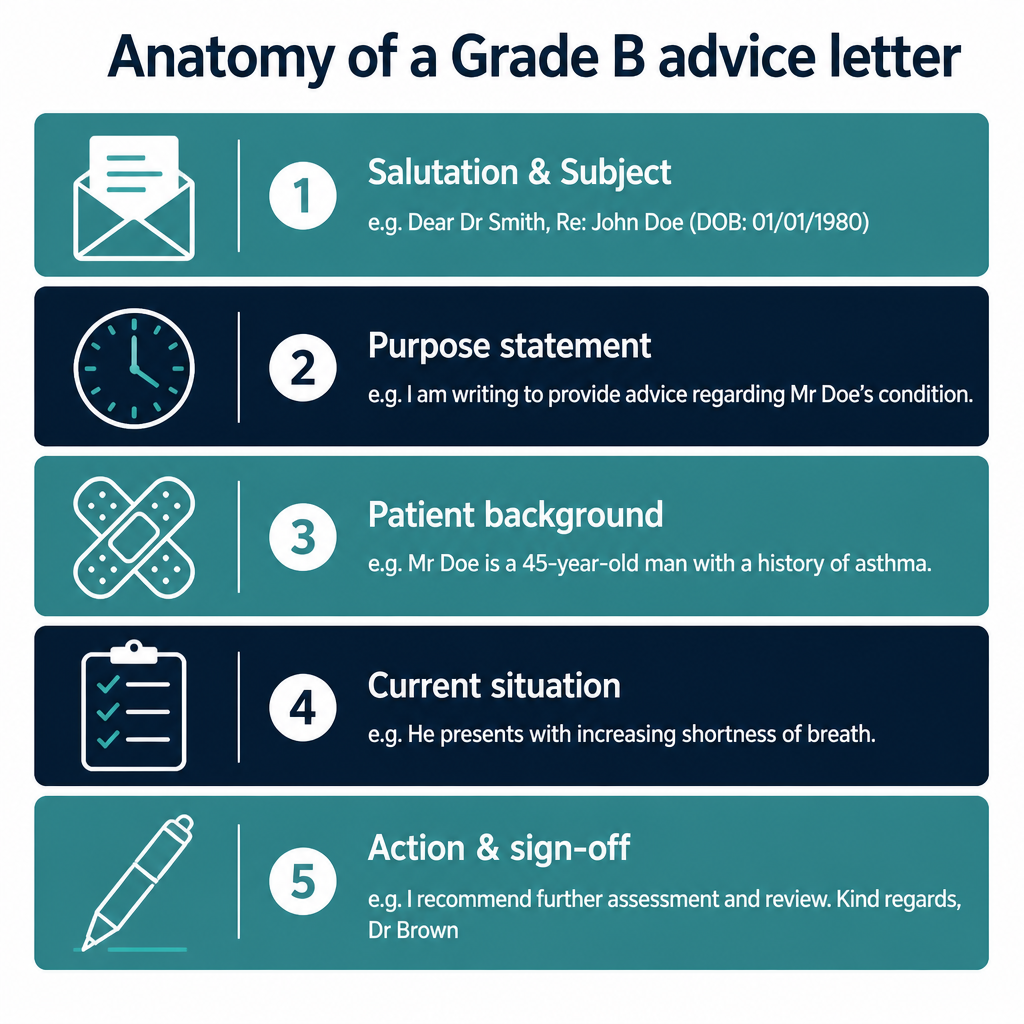
The Grade B sample letter
A complete worked example written to score Grade B (350+) against all six criteria.
Ms Anjali Patel
Daughter of patient
16 May 2026
Discharge and home-care instructions for Mr John Harris
Dear Ms Patel,
I am writing to update you on Mr John Harris's discharge plan and to explain the care he will need at home.
Mr Harris has improved following treatment for left lower leg cellulitis. He will go home today with oral co-amoxiclav 625 mg three times daily for five days and paracetamol 1 g up to four times daily as needed for pain. Please give his regular metformin as prescribed.
The district nursing team will visit daily for the next three days to change the dressing and assess the wound. Keep the area clean and dry between visits. If the dressing becomes soaked or soiled, replace it with a clean dressing and contact the district nurse.
Please monitor for increasing redness, swelling, spreading warmth, new or increased purulent discharge, fever, or a rise in pain. If any of these occur, contact the on-call service or arrange an urgent GP review. If Mr Harris becomes breathless, drowsy or unresponsive, call 999 immediately.
If you have questions about medications or dressing technique, contact the district nursing team or the ward on the number provided before discharge.
Yours sincerely, A. Walker, Nurse
Why this letter scores Grade B — annotation by annotation
Each highlighted phrase maps to one of the six OET writing criteria.
| Phrase from the letter | Criterion | Examiner comment |
|---|---|---|
| "I am writing to update you on Mr John Harris's discharge plan and to explain the care he will need at home." | Purpose | Clear opening sentence states purpose directly and sets reader expectations; effective for meeting the task. |
| "He will go home today with oral co-amoxiclav 625 mg three times daily for five days and paracetamol 1 g up to four times daily as needed for pain." | Content | Provides specific medication names, doses and duration — essential clinical information for family carers. |
| "The district nursing team will visit daily for the next three days to change the dressing and assess the wound." | Organisation & Layout | Presents follow-up actions in a separate paragraph, improving navigability for the reader. |
| "Keep the area clean and dry between visits." | Conciseness & Clarity | Simple, direct instruction that is easy for a non-clinical reader to understand and follow. |
| "Please monitor for increasing redness, swelling, spreading warmth, new or increased purulent discharge, fever, or a rise in pain." | Genre & Style | Uses patient‑centred, safety-focused language and lists signs to watch for; tone is appropriate for family communication. |
| "If Mr Harris becomes breathless, drowsy or unresponsive, call 999 immediately." | Language | Uses clear imperative phrasing for emergency actions; language is unambiguous and appropriately urgent. |
| "If you have questions about medications or dressing technique, contact the district nursing team or the ward on the number provided before discharge." | Content | Gives practical contact options, though could be improved by specifying exact phone numbers and times. |
| "If the dressing becomes soaked or soiled, replace it with a clean dressing and contact the district nurse." | Conciseness & Clarity | Contains actionable steps but could briefly state how to access a replacement dressing for extra clarity. |
Criterion-by-criterion score breakdown
| Criterion | Score | Why |
|---|---|---|
| Purpose | 3 / 3 | Purpose is explicit and appropriate for the recipient, establishing the reason for the letter immediately. |
| Content | 6 / 7 | Most clinical and follow-up details are included with relevant specifics; minor omissions (exact contact numbers) limit completeness. |
| Conciseness & Clarity | 5 / 7 | Instructions are mostly clear and direct but a few sentences could be more concise or better sequenced. |
| Genre & Style | 5 / 7 | Tone is appropriate and patient-centred; some phrasing could be softened for lay readers without losing clarity. |
| Organisation & Layout | 6 / 7 | Logical paragraphing and signposting help the reader locate key information quickly. |
| Language | 5 / 7 | Generally accurate medical language and grammar; occasional opportunity to simplify vocabulary for a lay audience. |
5 Nurse pitfalls to avoid
1. Using medical jargon the family may not understand.
Fix: Replace jargon with simple terms or add brief explanations for technical words.
2. Omitting exact medication doses or duration.
Fix: Always include drug name, dose, frequency and duration in the letter.
3. Failing to state clear escalation steps for deterioration.
Fix: List specific signs and the exact action (phone number, GP review, 999) required.
4. Long dense paragraphs that overwhelm the reader.
Fix: Use short paragraphs and bullet-like sentences to separate key points.
5. Not confirming follow-up arrangements.
Fix: State who will visit, when, and who the family should contact for queries.
2026 update
What changed in 2026 for Nurse letters
From 2026 the OET scoring emphasises precise, actionable communication and clearer organisation in written tasks.
As a nurse writing an advice letter, you must be succinct but include exact medication details, explicit wound-care steps and unambiguous escalation actions. Evidence of audience awareness—simple language for family members and clear sequencing of tasks—will be assessed more strictly, so prioritise clarity over clinical density in every paragraph. Include contact routes and timing to avoid avoidable content penalties.
Frequently asked questions
How long should the OET nurse advice letter be?
Aim for 180–220 words: enough to include purpose, key clinical details, clear instructions and follow-up without excess.
Should I use medical abbreviations?
Avoid uncommon abbreviations. Use full terms for the family and include brief explanations if necessary (e.g., 'paracetamol (pain relief)').
Do I need to list exact drug doses?
Yes. Include drug name, dose, frequency and duration to ensure safe administration at home.
How do I show urgency for red-flag symptoms?
Use direct, unambiguous commands: name the symptom and the exact action (e.g., 'call 999 immediately').
What tone is appropriate for a family member?
Use a professional, compassionate tone: clear and respectful, avoiding overly technical language while staying factual.
Is it necessary to include contact numbers?
Yes — include who to contact and when. If you cannot give a number, state where the family will find it (e.g., 'ward contact provided at discharge').
Keep learning
Relevant scoring criteria
Related guides
Want Dr Mariam to mark YOUR nurse letter against all six criteria?
See OET Writing Correction packs →