Doctor (GP) · Advice letter · Grade B worked sample
Doctor (GP) — Advice letter to patient (Grade B Sample)
Worked example showing a Grade B (band 6/7) GP advice letter to a patient after a consultation for newly identified hypertension.
In short
- →Clear purpose statement about results and treatment started.
- →Practical, time‑bound self-care and monitoring advice with safety netting.
- →Follow‑up appointment and actions if symptoms or high readings occur.
The case notes
The OET writing task you would receive in this scenario.
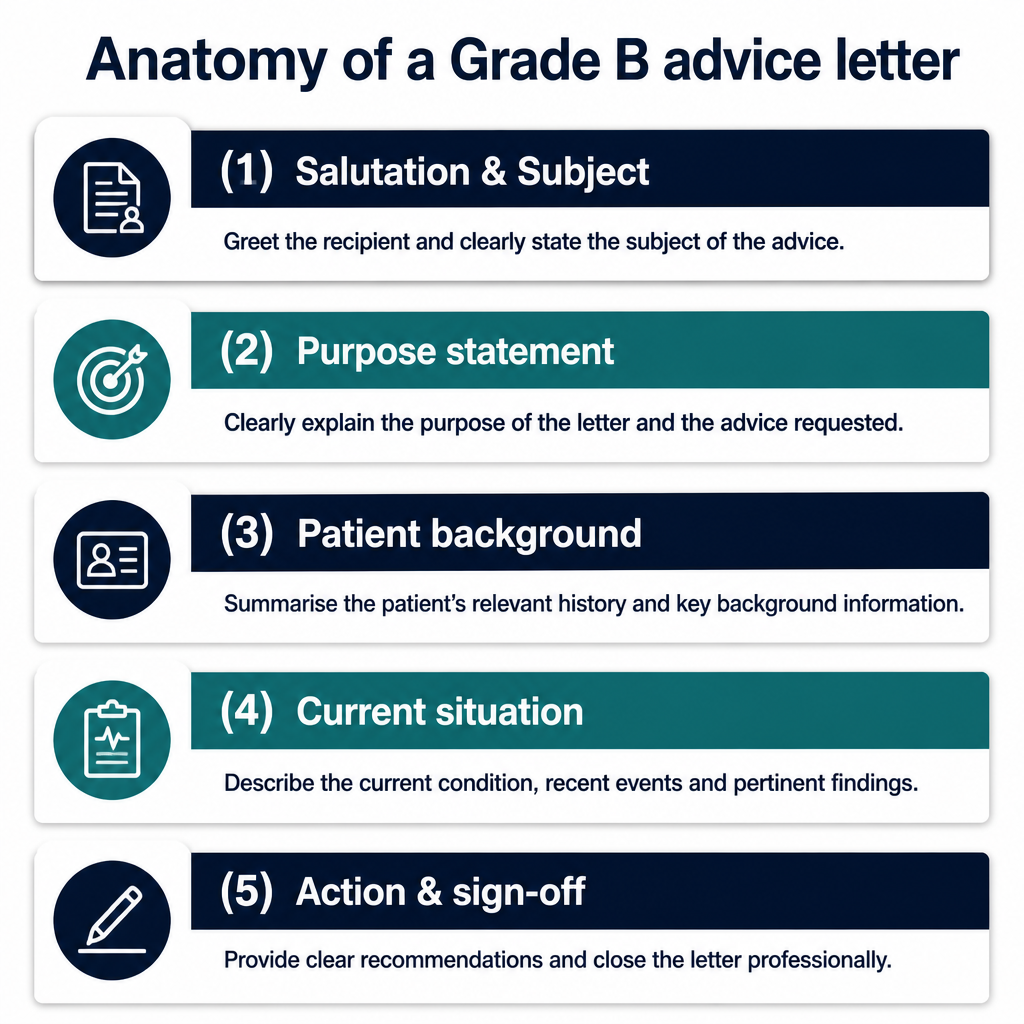
Anatomy of this letter
The Grade B sample letter
A complete worked example written to score Grade B (350+) against all six criteria.
Ms S. Patel
Patient
16 May 2026
Your recent blood pressure results and treatment plan
Dear Ms Patel,
I am writing to explain your recent blood pressure results and to advise you about the treatment and monitoring plan we discussed on 12 May 2026.
Your home readings over the past week average 148–154/88–96 mmHg, which meets the threshold for treatment. I started you on amlodipine 5 mg once daily on 12 May. Take the tablet each morning; the full effect may take up to two weeks.
Please monitor your blood pressure at home twice daily (mornings and evenings) for seven days and note the readings. Aim to reduce salt intake to below 6 g per day, try for 30 minutes of brisk activity on most days, and reduce alcohol. Avoid regular use of NSAIDs such as ibuprofen while on treatment, as these can raise blood pressure.
Contact the practice promptly if you develop pronounced ankle swelling, severe dizziness, chest pain, sudden severe headache or fainting. Bring your blood pressure record to the practice nurse appointment on 02 June 2026; we will review your readings and adjust treatment if needed.
Yours sincerely, Dr A. Walker, MBBS
Why this letter scores Grade B — annotation by annotation
Each highlighted phrase maps to one of the six OET writing criteria.
| Phrase from the letter | Criterion | Examiner comment |
|---|---|---|
| "I am writing to explain your recent blood pressure results and to advise you about the treatment and monitoring plan we discussed on 12 May 2026." | Purpose | Clear, explicit purpose and reference to the consultation date helps the reader immediately understand why the letter was sent. |
| "I started you on amlodipine 5 mg once daily on 12 May." | Content | Provides essential treatment detail (drug, dose, start date) that the patient needs to follow care safely. |
| "Please monitor your blood pressure at home twice daily (mornings and evenings) for seven days and note the readings." | Conciseness & Clarity | Gives a specific, time‑bound monitoring instruction that is easy to follow and record. |
| "Aim to reduce salt intake to below 6 g per day, try for 30 minutes of brisk activity on most days, and reduce alcohol." | Genre & Style | Appropriate, practical lifestyle advice phrased clearly and respectfully for a patient audience. |
| "Avoid regular use of NSAIDs such as ibuprofen while on treatment, as these can raise blood pressure." | Content | Includes a relevant medication safety warning linking common OTC drugs to treatment risks. |
| "Contact the practice promptly if you develop pronounced ankle swelling, severe dizziness, chest pain, sudden severe headache or fainting." | Organisation & Layout | Safety‑netting is grouped and prominent, making urgent signs easy to find. |
| "Bring your blood pressure record to the practice nurse appointment on 02 June 2026; we will review your readings and adjust treatment if needed." | Language | Uses simple future tense and concrete next steps; language is accurate and appropriate for the patient. |
Criterion-by-criterion score breakdown
| Criterion | Score | Why |
|---|---|---|
| Purpose | 2 / 3 | Purpose is explicit and appropriate but could be slightly more personalised to increase rapport. |
| Content | 5 / 7 | Includes key clinical details, medication and safety advice, but omits brief rationale for the chosen drug class. |
| Conciseness & Clarity | 5 / 7 | Instructions are specific and mostly concise, though a small amount of repetition reduces crispness. |
| Genre & Style | 5 / 7 | Tone is appropriate and professional for a patient letter but could be slightly warmer to aid adherence. |
| Organisation & Layout | 6 / 7 | Information is well sequenced with clear sections for action and safety‑netting, aiding quick navigation. |
| Language | 5 / 7 | Generally accurate grammar and vocabulary with occasional simplification that slightly reduces medical precision. |
5 Doctor (GP) pitfalls to avoid
1. Vague monitoring instructions.
Fix: Give specific frequency, duration and what to record (e.g., twice daily for 7 days).
2. Omitting medication dose or start date.
Fix: Always state drug name, dose, route and date started.
3. Lack of safety‑netting for urgent symptoms.
Fix: List clear red flags and when to contact the practice or emergency services.
4. Overly technical language.
Fix: Use plain words for patients; explain necessary medical terms briefly.
5. No follow‑up plan.
Fix: Include a specific review date or appointment and next steps if targets not met.
2026 update
What changed in 2026 for Doctor (GP) letters
From 2026, OET scoring places more weight on explicit purpose, measurable actions and clear safety‑netting in advice letters.
As a GP writing to a patient, you must state the reason for the letter immediately, give time‑bound self‑care and monitoring instructions, include medication specifics, and clearly list when the patient should seek help; vague or implied advice is less likely to reach a Grade A under the stricter regime. Accurate, concise language and clear sequencing remain essential for higher marks.
Frequently asked questions
How long should an advice letter to a patient be?
Aim for 180–220 words: enough to state purpose, give clear actions, safety‑netting and follow‑up without unnecessary detail.
What is the most important sentence to include first?
A one‑line purpose statement that explains why you are writing and references the consultation or test date.
How specific must medication instructions be?
Include drug name, dose, route, when to start, expected onset, and common side effects or warnings.
How should safety‑netting be presented?
List urgent symptoms clearly and concisely and state what the patient should do (contact practice, go to A&E or call 999).
Can I use medical terms in a patient letter?
Use plain English where possible; if you use medical terms, add a brief, simple explanation for the patient.
How do I show follow‑up arrangements?
Give a specific appointment date/time or timeframe and state what will be reviewed or adjusted at that visit.
Keep learning
Relevant scoring criteria
Related guides
Want Dr Mariam to mark YOUR doctor (gp) letter against all six criteria?
See OET Writing Correction packs →