Dietitian · Advice letter · Grade B worked sample
Dietitian Advice letter to GP: Nutritional management (Grade B Sample)
Worked example showing a Grade B dietitian advice letter to a GP about ongoing nutrition care after hospital discharge.
In short
- →Request continuation of oral nutritional supplements (Fortisip Compact 125 ml, twice daily) for 4 weeks.
- →Ask GP to review metformin for possible GI side effects and consider dose adjustment.
- →Recommend blood tests (B12, vitamin D, full blood count) and community dietetic follow-up in 1 month.
The case notes
The OET writing task you would receive in this scenario.
Anatomy of this letter
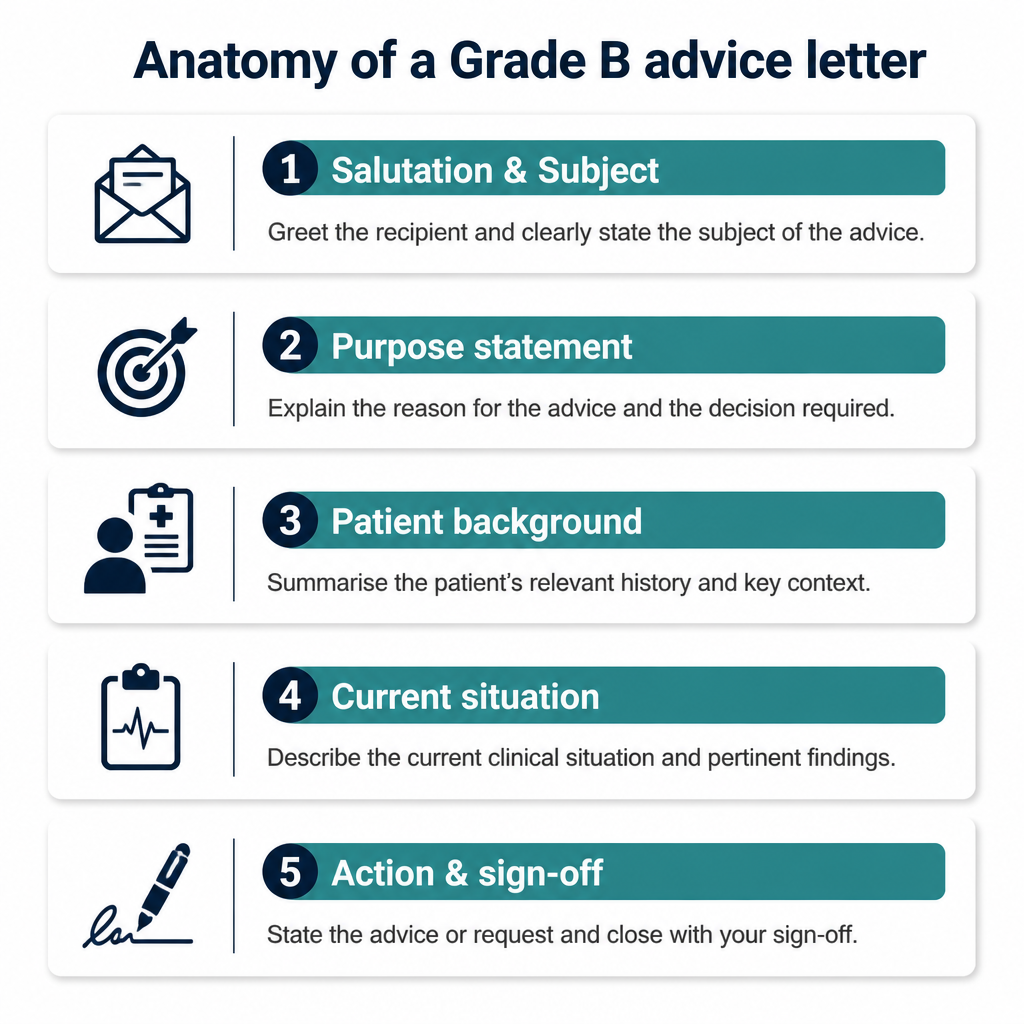
The Grade B sample letter
A complete worked example written to score Grade B (350+) against all six criteria.
Dr Smith
General Practitioner
16 May 2026
Re: Nutritional management — Mr J Brown (DOB 12/03/1954)
Dear Dr Smith,
I am writing to advise regarding the nutritional management of Mr J Brown, recently discharged after a 5‑day admission for urinary sepsis. The purpose of this letter is to request ongoing support in the community to address recent unintentional weight loss and reduced oral intake.
Mr Brown has lost approximately 6 kg over 8 weeks and his BMI is 19 kg/m2. In hospital he accepted Fortisip Compact 125 ml twice daily with a modest improvement in intake. He reports reduced appetite and nausea which he associates with metformin 1 g twice daily. Recent bloods show eGFR 48 mL/min/1.73 m2 and HbA1c 62 mmol/mol.
Please continue Fortisip Compact 125 ml twice daily for 4 weeks and prescribe accordingly. I would be grateful if you could review his metformin for possible gastrointestinal side effects and consider dose reduction or alternative therapy as appropriate. Please arrange blood tests for vitamin B12 and vitamin D, and a full blood count.
We have requested a community dietetic review in 2–4 weeks; our target is a gradual weight gain of 1–2 kg over 4 weeks by adding 300–500 kcal/day (small, energy-dense meals and ONS between meals). Please contact me for further discussion.
Yours sincerely, A. Walker, Dietitian
Why this letter scores Grade B — annotation by annotation
Each highlighted phrase maps to one of the six OET writing criteria.
| Phrase from the letter | Criterion | Examiner comment |
|---|---|---|
| "I am writing to advise regarding the nutritional management of Mr J Brown, recently discharged after a 5‑day admission for urinary sepsis." | Purpose | Clear opening sentence stating purpose and patient identity; could be slightly more specific about the main request to reach full marks. |
| "Mr Brown has lost approximately 6 kg over 8 weeks and his BMI is 19 kg/m2." | Content | Gives relevant clinical facts concisely—weight change and BMI are key data for nutritional decisions. |
| "Please continue Fortisip Compact 125 ml twice daily for 4 weeks and prescribe accordingly." | Content | Specific, actionable recommendation with dose and duration; strengthens usability for the GP. |
| "I would be grateful if you could review his metformin for possible gastrointestinal side effects and consider dose reduction or alternative therapy as appropriate." | Conciseness & Clarity | Clear request to review medication but could be more prescriptive about thresholds for change to improve clarity. |
| "Please arrange blood tests for vitamin B12 and vitamin D, and a full blood count." | Organisation & Layout | Actions are grouped into a single sentence, making responsibilities to the GP easy to identify. |
| "our target is a gradual weight gain of 1–2 kg over 4 weeks by adding 300–500 kcal/day" | Genre & Style | Provides a realistic, measurable goal and practical dietary aim, matching professional clinical tone. |
| "We have requested a community dietetic review in 2–4 weeks; our target is a gradual weight gain" | Language | Appropriate use of past and present tense; professional tone and suitable register for correspondence. |
Criterion-by-criterion score breakdown
| Criterion | Score | Why |
|---|---|---|
| Purpose | 2 / 3 | Purpose is stated clearly but could be more specifically framed as an explicit request at the opening. |
| Content | 5 / 7 | Key data and relevant recommendations are included, though some clinical justification and alternatives are limited. |
| Conciseness & Clarity | 5 / 7 | Mostly clear and succinct; one or two sentences could be tightened or made more directive. |
| Genre & Style | 5 / 7 | Professional clinical tone maintained; occasional phrasing is slightly tentative rather than decisive. |
| Organisation & Layout | 5 / 7 | Information organised logically with requests grouped, but purpose could be highlighted earlier. |
| Language | 6 / 7 | Accurate grammar and vocabulary with clinical terminology used correctly and appropriately. |
5 Dietitian pitfalls to avoid
1. Vague requests for medication review
Fix: State which medication, suspected effect, and suggested action (e.g. reduce dose or consider alternative).
2. Omitting specific ONS dose or duration
Fix: Include brand, volume, frequency and recommended prescription length.
3. Too much non-essential background detail
Fix: Prioritise current nutritional status and immediate actions for the GP.
4. Unclear monitoring plan
Fix: Give explicit follow-up timing and measurable targets (weight, intake goals).
5. Using overly tentative language
Fix: Use professional, direct phrasing for requests while noting clinical judgement remains with GP.
2026 update
What changed in 2026 for Dietitian letters
The 2026 stricter scoring regime expects dietitians to be more precise and action‑oriented in advice letters.
You must open with a clear purpose, give measurable nutrition goals, state exact supplements and doses, and assign responsibilities (who will arrange tests, prescriptions, follow-up). Ambiguity about next steps or doses now reduces marks; concise, evidence-aligned requests score higher under the updated criteria. Be specific about monitoring and thresholds for medication changes to meet new expectations.
Frequently asked questions
How specific must ONS prescriptions be?
Include brand, volume, frequency and duration — for example, Fortisip Compact 125 ml, twice daily for 4 weeks — so the GP can prescribe without further clarification.
Should I suggest medication changes?
You may recommend review and possible actions (e.g. reduce metformin dose) but leave final prescribing decisions to the GP, stating clinical rationale.
What monitoring should I request?
Ask for measurable checks such as weekly weights, blood tests (B12, vitamin D, FBC) and a community dietetic review within 2–4 weeks.
How long should the letter be?
Aim for one page with a clear purpose, brief patient summary, specific actions for the GP, and an offer to discuss — usually 180–220 words in exam conditions.
How to balance tone and assertiveness?
Use professional, direct language for requests while acknowledging the GP’s clinical responsibility; avoid aggressive or overly tentative phrasing.
Can I request specific lab tests?
Yes — request relevant tests (e.g. B12, vitamin D) and explain briefly why they are needed for nutritional management.
Keep learning
Relevant scoring criteria
Related guides
Want Dr Mariam to mark YOUR dietitian letter against all six criteria?
See OET Writing Correction packs →