Dentist · Discharge letter · Grade B worked sample
Dentist Discharge to GP — Post-extraction Care (Grade B Sample)
Worked example showing a Grade B discharge letter from a dentist to a GP following an extraction and concerns about anticoagulation and infection. Use this to model clarity and essential requests.
In short
- →Concise summary of treatment, meds and wound status for Mrs S. Brown, DOB 12/02/1958.
- →Requests: INR check within 48 hours, warfarin review if INR >3.0 or bleeding persists.
- →Continue antibiotics and analgesia; advise GP glycaemic review and urgent review if systemic signs.
The case notes
The OET writing task you would receive in this scenario.
Anatomy of this letter
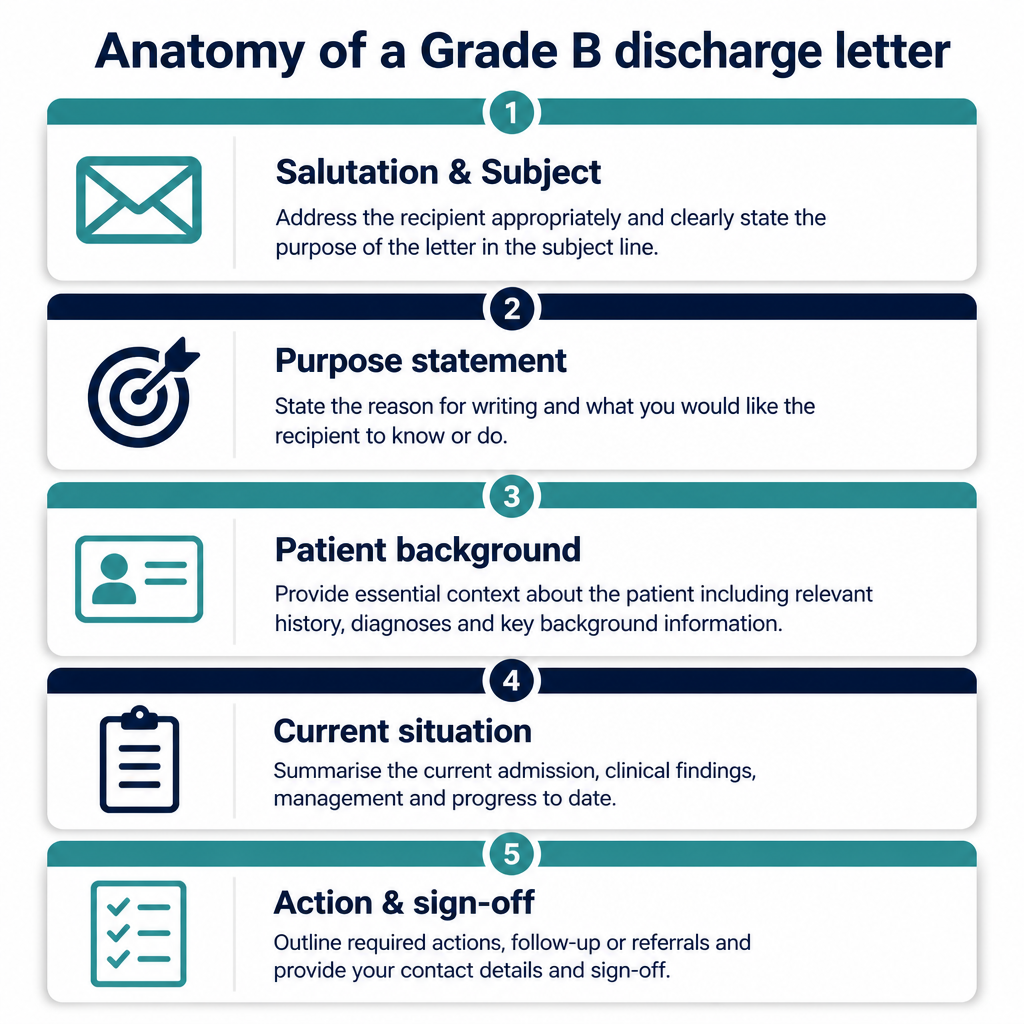
The Grade B sample letter
A complete worked example written to score Grade B (350+) against all six criteria.
Dr Smith
GP
16 May 2026
Subject: Extraction LL7 and request for INR review — Mrs S. Brown (DOB 12/02/1958)
Dear Dr Smith,
I am writing to inform you that I treated Mrs S. Brown (DOB 12/02/1958) on 12 May 2026 for an acute apical abscess of the lower left second molar (LL7) and to request a medical review regarding her anticoagulation and general health prior to further dental care.
Mrs Brown is a 68-year-old woman with atrial fibrillation on warfarin, type 2 diabetes and hypertension. She presented with 48 hours of increasing pain and swelling and underwent extraction of LL7 under local anaesthesia on 12 May 2026. INR at presentation was 3.2. Local haemostasis was achieved and there were no immediate complications.
I commenced amoxicillin 500 mg three times daily for five days and advised analgesia with ibuprofen 400 mg three times daily and paracetamol as required. She was given chlorhexidine 0.12% mouthwash twice daily and standard post-extraction wound-care advice. At 48-hour review there is satisfactory healing with mild oozing only.
Please arrange an INR check within 48 hours and consider warfarin dose adjustment if INR remains >3.0 or if bleeding continues. I would also be grateful if you could review her glycaemic control (HbA1c overdue) and advise any medical action. Please contact our unit if you require further information or if the wound deteriorates.
Yours sincerely, A. Walker, Dentist
Why this letter scores Grade B — annotation by annotation
Each highlighted phrase maps to one of the six OET writing criteria.
| Phrase from the letter | Criterion | Examiner comment |
|---|---|---|
| "I am writing to inform you that I treated Mrs S. Brown (DOB 12/02/1958) on 12 May 2026 for an acute apical abscess of the lower left second molar (LL7) and to request a medical review regarding her anticoagulation and general health prior to further dental care." | Purpose | Clear single-sentence purpose that states the reason for writing and the specific requests; concise and appropriate for a discharge letter. |
| "Mrs Brown is a 68-year-old woman with atrial fibrillation on warfarin, type 2 diabetes and hypertension." | Content | Key medical background provided succinctly so the GP understands comorbidities that affect dental management. |
| "Extraction of LL7 under local anaesthesia on 12 May 2026. INR at presentation was 3.2." | Content | Important clinical details (procedure, date and INR) are included to justify the request for medical review. |
| "I commenced amoxicillin 500 mg three times daily for five days and advised analgesia with ibuprofen 400 mg three times daily and paracetamol as required." | Language | Medication names, dosages and durations are specific and use standard professional phrasing; avoids ambiguous abbreviations. |
| "Please arrange an INR check within 48 hours and consider warfarin dose adjustment if INR remains >3.0 or if bleeding continues." | Conciseness & Clarity | Direct, actionable request with a clear timeframe and threshold value for the GP to act on. |
| "She was given chlorhexidine 0.12% mouthwash twice daily and standard post-extraction wound-care advice." | Organisation & Layout | Treatment and post-op advice grouped logically, making it easier for the recipient to locate practical instructions. |
| "At 48-hour review there is satisfactory healing with mild oozing only." | Genre & Style | Concise clinical status update in objective tone appropriate for professional correspondence. |
Criterion-by-criterion score breakdown
| Criterion | Score | Why |
|---|---|---|
| Purpose | 3 / 3 | Purpose is explicit and prioritised at the start, meeting expectations for a Grade B. |
| Content | 6 / 7 | Includes relevant history, treatment, medications and clear requests, though a lab value or previous INR trend could strengthen it. |
| Conciseness & Clarity | 5 / 7 | Information is clear and mostly concise; some sentences could be tightened to improve flow. |
| Genre & Style | 5 / 7 | Professional and appropriately formal; occasional phrasing is slightly wordy for a discharge letter. |
| Organisation & Layout | 5 / 7 | Logical paragraphing and grouping of actions, but could label actions more explicitly for quick reading. |
| Language | 6 / 7 | Accurate clinical vocabulary and correct grammar with specific dosages; minor improvements in sentence variety possible. |
5 Dentist pitfalls to avoid
1. Failing to state the specific medical action required (e.g., INR check).
Fix: Include a clear, time-bound request with thresholds (e.g., INR within 48 hours; adjust if >3.0).
2. Omitting drug names, dosages or durations.
Fix: List medications with full name, dose, frequency and duration to avoid ambiguity.
3. Overloading the letter with unnecessary dental detail.
Fix: Focus on clinically relevant information for the GP and keep technical dental steps brief.
4. Using informal language or unexplained abbreviations.
Fix: Use formal clinical register and write out less common abbreviations at first mention.
5. Not assigning responsibility for follow-up.
Fix: State explicitly what you ask the GP to do and when, and who to contact for queries.
2026 update
What changed in 2026 for Dentist letters
The 2026 stricter scoring regime emphasises crystal-clear purpose and clinically complete requests. As a dentist writing to a GP you must state the exact medical action you require (for example: INR check within 48 hours and adjustment threshold) and include relevant meds, doses and dates.
Organisation and concision are now weighted more heavily: present background, current status and required actions in distinct paragraphs and avoid unnecessary dental procedural detail so the GP can act quickly.
Frequently asked questions
How specific should medication details be in a discharge letter?
Give full drug name, dose, frequency and duration (for example: amoxicillin 500 mg TDS for five days). This prevents errors and meets OET content expectations.
When should I request GP review for anticoagulation after an extraction?
Request an INR check within 24–72 hours when INR is borderline or >3.0, and ask the GP to consider dose adjustment if bleeding persists.
Do I need to include diabetes review in a dental discharge letter?
Yes if diabetes affects healing or if routine monitoring (HbA1c) is overdue; request review to optimise wound healing and reduce infection risk.
How long should a Grade B discharge letter be?
Aim for a concise letter: 180–220 words typically suffices to include purpose, brief history, current treatment and clear requests.
Should I use medical abbreviations in the letter?
Use common abbreviations (e.g., INR) but spell out less common ones on first use to ensure clarity for all readers.
What makes a request 'actionable' for the GP?
Specify the action, timeframe and any thresholds (e.g., check INR within 48 hours; adjust warfarin if INR >3.0) so the GP knows exactly what to do.
Keep learning
Relevant scoring criteria
Related guides
Want Dr Mariam to mark YOUR dentist letter against all six criteria?
See OET Writing Correction packs →