Dentist · Referral to oral surgeon · 3 bands compared
OET Dentist: Grade A vs B vs C Letters Compared (Referral to oral surgeon)
Three referral letters responding to the same dental case notes are presented at Grade A, B and C. Each letter shows how differences in content, clarity and professionalism affect the band.
In short
- →All three letters refer the same patient to an oral surgeon with differing clarity and safety.
- →Grade A is concise, clinically complete and clearly requests anticoagulation advice and urgency.
- →Grade C omits key medical details, gives unclear requests and uses informal tone and poor organisation.
The shared case notes
48-year-old patient presents with persistent pain and swelling around lower right first molar (LR6). Tooth previously root-filled two years ago, now mobile with recurrent episodic swelling and localised tenderness. Panoramic radiograph shows periapical radiolucency and possible root fracture. Medical history: atrial fibrillation on warfarin, type 2 diabetes controlled with metformin. Allergies: nil known. Current medication list provided. Patient reports poor response to two courses of oral antibiotics and analgesia. Referring GDP requests specialist opinion for extraction versus further endodontic management, urgent assessment advised because of ongoing infection and anticoagulation.
The three letters at a glance
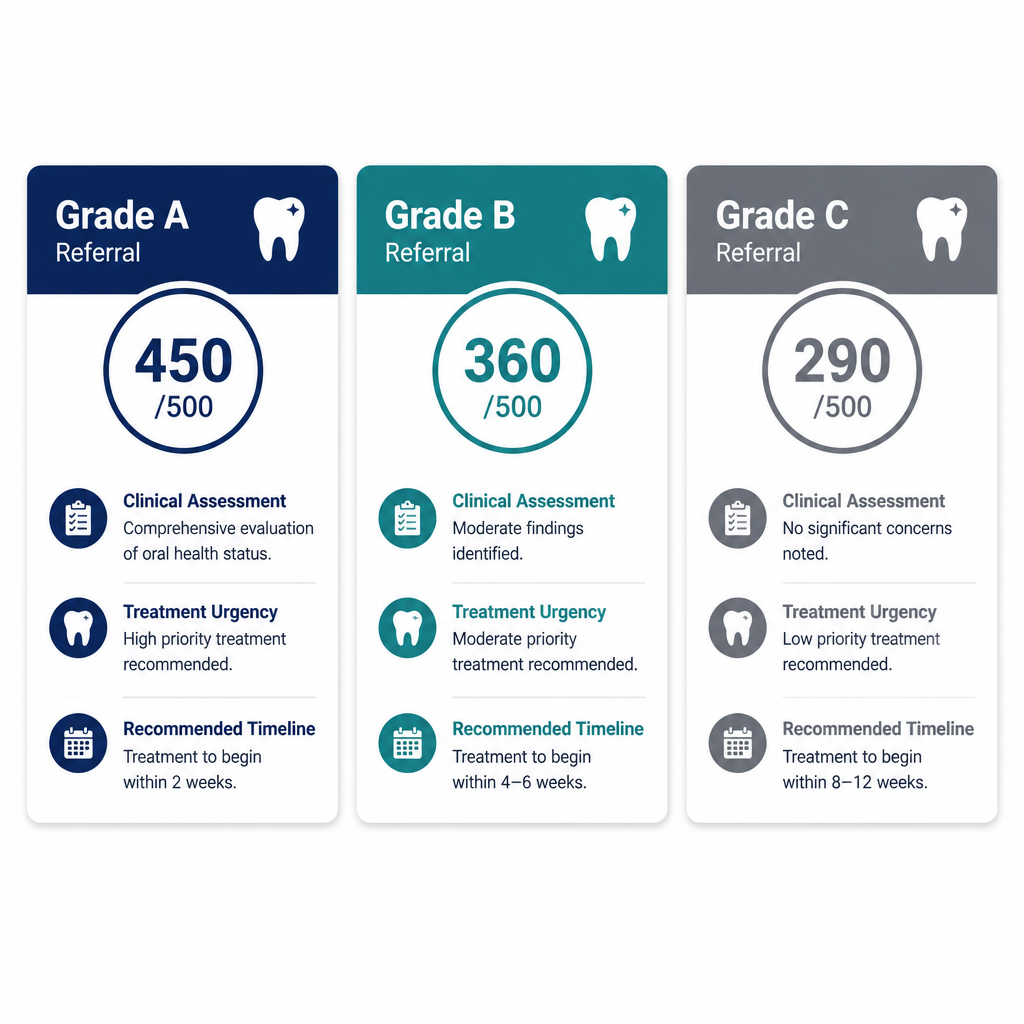
The three letters — same case, different bands
Grade A
450/500Dear Colleague,
I am referring a 48-year-old patient with persistent pain, intermittent swelling and mobility of the lower right first molar (LR6). The tooth was root‑filled two years ago. Recent panoramic imaging shows a periapical radiolucency and possible root fracture. The patient has had two courses of antibiotics with only temporary relief. Medical history: atrial fibrillation on warfarin and type 2 diabetes on metformin. No known drug allergies. Current medication list enclosed.
Please assess urgently for specialist extraction and advise whether further endodontic treatment is appropriate. As the patient is anticoagulated, please advise on perioperative warfarin management and any need for INR check prior to procedure. I would be grateful for guidance on timeframe for intervention, recommended anaesthesia or inpatient care, and any preoperative investigations. Please contact me if you require further information or radiographs; copies of recent images are attached. Many thanks for your prompt attention.
Verdict: This letter meets Grade A criteria: succinct purpose, complete clinical details and clear, safe requests including anticoagulation management. Tone and structure are professional, with relevant attachments and an explicit urgency statement.
Grade B
360/500Dear Colleague,
I refer a 48-year-old patient with ongoing pain and occasional swelling at the lower right first molar (LR6). The tooth had root canal treatment two years ago. A radiograph shows a radiolucency around the apex and there may be a root fracture. The patient has atrial fibrillation and takes warfarin; also has type 2 diabetes on metformin. Antibiotics were tried twice with limited benefit. Medication list included.
Please assess for extraction versus retreatment and advise on management. Because the patient is on warfarin, please advise if adjustment is needed before surgery. I would appreciate an estimated waiting time and any required investigations. Please let me know if you need further details or copies of the radiograph. Thank you.
Verdict: Band B: appropriate purpose and mostly complete content but less precise and slightly wordy. Key requests are present but lack explicit urgency and some organisation; anticoagulation query is vague rather than instruction-seeking.
Grade C
290/500Hello,
I am sending a patient with pain from a lower right molar (LR6). Root filled in the past. There is a dark area on the x‑ray and the tooth moves. Patient on warfarin and takes tablets for diabetes. Antibiotics did not fix the problem.
Can you see them to remove the tooth or fix it? Also tell me about the blood thinner. I can send the x‑ray if needed. Please get back when you can. Thanks,
Yours faithfully, Dentist X (contact details attached). The radiograph may be useful and the patient is worried about pain and swelling continuing, so sooner is better if possible.
Verdict: Band C: insufficient clinical detail and unprofessional tone. The letter is informal, poorly organised and leaves key questions vague. Safety issues (precise anticoagulation plan, urgency, attachments) are not handled appropriately.
Criterion-by-criterion: Grade A vs B vs C
| Criterion | Grade A | Grade B | Grade C |
|---|---|---|---|
| Purpose | Clear urgent referral with specific clinical goal and requested actions. | Purpose present but lacks explicit urgency and detailed action requests. | Purpose vague; referral intent and urgency are unclear. |
| Content | Complete medical, dental details and explicit anticoagulation information. | Mostly complete but omits some precise clinical or safety details. | Key medical or dental facts missing; unsafe omissions. |
| Conciseness & Clarity | Concise, well‑phrased sentences; minimal irrelevant detail. | Generally clear but some redundancy and less precision. | Wordy or fragmented; ideas unclear and repetitive. |
| Genre & Style | Professional, formal tone consistent with clinical correspondence. | Mostly professional but occasional informal phrasing or brevity. | Informal tone and sign‑off; not appropriate for clinical referral. |
| Organisation & Layout | Logical paragraphs, requested actions highlighted, attachments noted. | Acceptable structure but transitions and priorities less explicit. | Poor organisation; no clear sequence of information or requests. |
| Language | Accurate medical language and varied vocabulary, error‑free. | Generally accurate but some imprecise wording and minor errors. | Frequent imprecision and occasional non‑standard phrasing. |
How to lift this letter one band
To move a Grade C letter to Grade B: include all relevant clinical facts (exact tooth notation, prior treatment, radiographic findings), add a clear request (assessment for extraction vs retreatment), and state patient medications with anticoagulation explicitly. Use a formal salutation and sign‑off. Remove informal phrases and organise information into short paragraphs: presenting complaint, medical history, clinical findings, and clear requests.
To progress a Grade B letter to Grade A: tighten wording to prioritise safety actions and specify what you want the specialist to do (e.g. advise perioperative INR check, recommend timeframe, state whether inpatient anaesthesia may be required). Attach or clearly reference radiographs, state urgency explicitly, and ensure tone is concise and professional with precise clinical vocabulary.
2026 update
What changed in 2026 for Dentist band scoring
The 2026 scoring update emphasises clearer task fulfilment and clinical safety across professions, including dentistry. Examiners now weigh explicit requests and safety queries more heavily — for example, clear anticoagulation management, urgency and attachment references. Language precision and professional tone are also scored more strictly, so concise, unambiguous clinical instructions and accurate terminology improve band outcomes.
For dental referrals this means examiners expect precise tooth notation, up‑to‑date medication details and explicit perioperative questions rather than vague statements.
Frequently asked questions
How long should an OET dental referral letter be?
Aim for 160–200 words. Be concise but include all relevant clinical and medication details.
Should I mention anticoagulation in every dental referral?
Yes. If the patient is anticoagulated state the drug and request specific perioperative advice.
Do I need to attach radiographs to the letter?
Yes, attach or clearly reference radiographs; they are essential for specialist decision‑making.
What causes loss of marks from B to C?
Omissions of key facts, informal tone, poor organisation and unclear requests reduce the band.
Can I use abbreviations like 'LR6' in the letter?
Use standard dental notation if widely recognised, but ensure clarity for the recipient.
How do I show urgency effectively?
State the clinical reason for urgency and request an 'urgent' or 'priority' assessment with timeframe.
Keep learning
Scoring criteria
See if your dentist letter is at Grade C, B, or A.
See OET Writing Correction packs →