Physiotherapist · Criterion focus: Purpose
Purpose Statement Failures: Why Physiotherapists Lose Marks in the First Line
A focused clinic for physiotherapists who routinely lose marks on the Purpose criterion. Practical fixes drawn from thousands of marked OET letters.
In short
- →State the action requested before describing assessment findings.
- →Be specific: name exercises, functional goals or equipment, not "continue treatment".
- →Match purpose to reader — community physio wants exercises; GP wants functional status.
Why physiotherapists lose marks on Purpose
Physiotherapy notes are structured around assessment first, then treatment plan, then progress. That structure is appropriate for clinical handover but works against the OET Purpose criterion, which expects the action to come first. In over 11,000 letters I have personally marked as lead corrector at WCS, the most common physiotherapy Purpose failure is opening with subjective assessment ("Mrs Lee presents with a six-week history of…") rather than the discharge or referral request.
Purpose is a 0–3 criterion under the August 2018 OET writing rubric. For physiotherapists, fixing the opening sentence reliably moves Purpose from a 1 to a 2, and combined with a specific closing action, from a 2 to a 3. The pattern repeats across professions but is especially fixable for physios because the structural change is small.
Mistake → fix at a glance
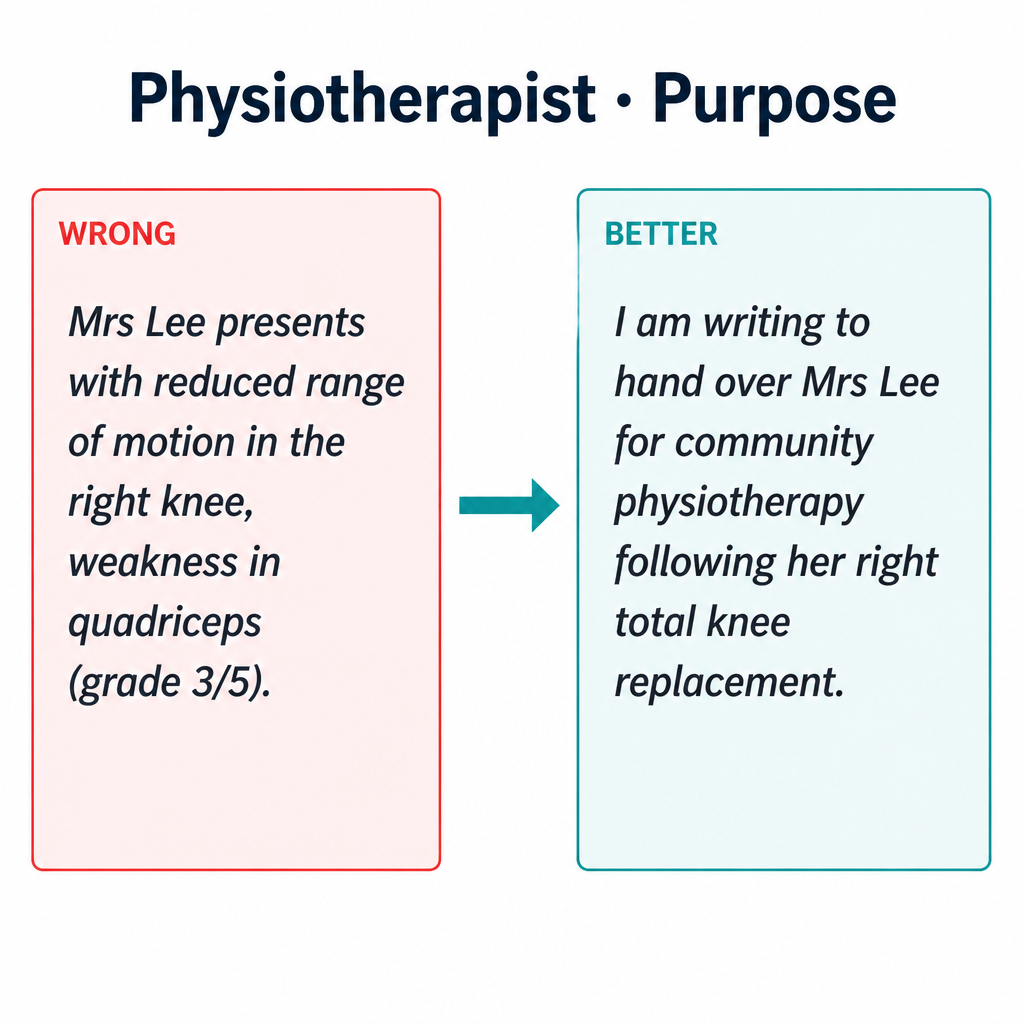
7 physiotherapist Purpose mistakes — wrong vs right
1. Opening with assessment findings instead of purpose
Impacts: Purpose
Wrong
"Mrs Lee presents with reduced range of motion in the right knee, weakness in quadriceps (grade 3/5) and antalgic gait following total knee replacement."
Better
"I am writing to hand over Mrs Lee for community physiotherapy following her right total knee replacement, with a focus on regaining independent gait and stair climbing."
Why it loses marks: Opening with assessment delays the purpose. The reader cannot tell whether this is a referral, discharge or update until the next paragraph.
2. Vague "please continue treatment" closing
Impacts: Purpose
Wrong
"Please continue physiotherapy treatment as needed."
Better
"Please continue strengthening exercises (quadriceps, gluteals) twice daily and gait re-education with the four-wheeled walker, aiming for independent transfers within four weeks."
Why it loses marks: The vague closing does not commit the reader to specific action. Purpose marking rewards a defined, measurable next step.
3. Mismatching purpose to reader role
Impacts: Purpose
Wrong
"I am referring Mr Patel for diagnosis of his persistent lower back pain." (Addressed to a community physiotherapist.)
Better
"I am referring Mr Patel for community physiotherapy to address persistent lower back pain with core stability and manual therapy."
Why it loses marks: Community physiotherapists deliver treatment, not diagnosis. Mismatching the purpose to the reader role signals weak reader analysis.
4. Stacking multiple purposes in one opening
Impacts: Purpose
Wrong
"I am writing to discharge Mrs Khan, refer her for occupational therapy, request a walking aid and update you on her progress."
Better
"I am writing to hand over Mrs Khan's ongoing physiotherapy following discharge, with a recommendation for occupational therapy review for home safety."
Why it loses marks: Stacked purposes show that the candidate has not prioritised reader need. One letter, one primary purpose — supporting actions belong in the body.
5. Using assessment chronology instead of purpose
Impacts: Purpose
Wrong
"Mr Wong was admitted three weeks ago following a fall. Initial assessment showed reduced range of motion. Treatment commenced on day two."
Better
"I am writing to hand over Mr Wong's ongoing rehabilitation following a hip fracture, with the goal of returning to independent community walking."
Why it loses marks: Treatment-chronology openings position the writer as historian rather than handover author. The reader needs the purpose first.
6. Omitting the functional goal from the purpose
Impacts: Purpose
Wrong
"I am referring Mrs Davis for community physiotherapy following her stroke."
Better
"I am referring Mrs Davis for community physiotherapy following her left hemispheric stroke, with the goal of improving right upper-limb function and independent transfers."
Why it loses marks: Purpose without a functional goal leaves the community physio uncertain about target outcomes. Adding the goal sharpens the reader's action.
7. Using "as you know" as the opening
Impacts: Purpose
Wrong
"As you know, Mrs Brown has been under our physiotherapy care since her admission."
Better
"I am writing to hand over Mrs Brown's physiotherapy following discharge today, with continued focus on balance retraining."
Why it loses marks: "As you know" assumes shared context the OET task does not provide. It is courtesy filler, not a purpose statement.
Pre-submission self-check (5 items)
- 1.Does the first sentence name the reason for writing and the action requested?
- 2.Have I identified the reader (community physio, GP, specialist, residential carer)?
- 3.Is the requested action specific — naming exercises, goals or equipment?
- 4.Have I avoided opening with assessment findings or treatment chronology?
- 5.Does the closing reinforce the same purpose with a measurable next step?
2026 update
What changed in 2026 for physiotherapists on Purpose
The 2026 stricter scoring guidance places more weight on clinical relevance to the named recipient. Physiotherapists who write generic functional goals — "improve mobility" — are now marked down more harshly than under earlier marking, because the goals do not specify measurable change.
For physios, the practical implication is that purpose statements must name the functional outcome and the reader's role in delivering it. Generic handover phrasing that worked before now caps achievable Purpose at a 2.
Frequently asked questions
What is a purpose statement in an OET physiotherapy letter?
A single opening sentence telling the reader why you are writing and what action you want them to take.
Why do physios struggle with Purpose more than doctors?
Physiotherapy notes are structured around assessment-treatment-progress, so candidates instinctively open with assessment findings rather than the action.
Should a discharge letter mention rehab goals?
Yes — but as the purpose, not as background. State the goal in the opening sentence.
Is "please continue treatment" acceptable?
No. It is too vague. Specify the exercises, modality and goal.
How do I match purpose to reader role?
Identify the reader first. Community physio readers want specific exercises; GP readers want functional status.
Can I open with "thank you for your continued care"?
No. Courtesies do not count as a purpose statement.
Keep learning
Scoring criteria
Want Dr Mariam to mark your physiotherapy letter against Purpose?
See OET Writing Correction packs →