Physiotherapist · Criterion focus: Content
Content Selection Failures: What Physiotherapists Should Choose and Cut
A focused clinic for physiotherapists who lose marks on the Content criterion. Practical fixes drawn from thousands of marked OET letters.
In short
- →Select objective measurements that shape the recipient's decisions; drop the rest.
- →Prioritise functional status over isolated range-of-motion figures.
- →Include social factors only where they shape rehabilitation planning.
Why physiotherapists lose marks on Content
Physiotherapy training rewards detailed objective assessment. Candidates instinctively transfer every range-of-motion figure, muscle grade and balance score from the case notes into the letter. In over 11,000 letters I have personally marked as lead corrector at WCS, the most common physiotherapy Content failure is over-selecting objective data while under-reporting functional status — which is what the recipient actually needs.
Content is scored 0–7 under the August 2018 OET rubric. For physiotherapists, the highest-yield fix is shifting selection toward reader-relevant function: can the patient transfer, walk, climb stairs, manage at home? Those answers shape community physiotherapy and GP follow-up more than the degree of knee flexion at discharge.
Mistake → fix at a glance
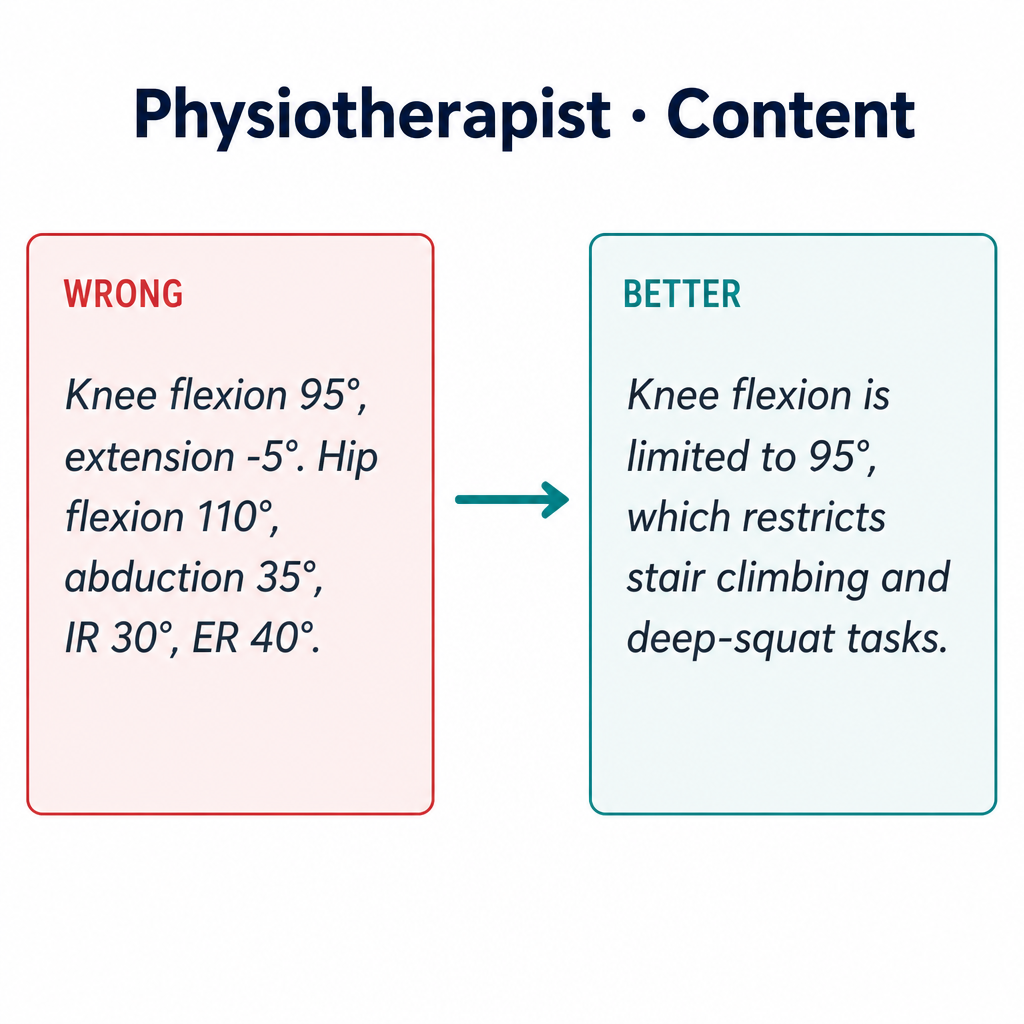
7 physiotherapist Content mistakes — wrong vs right
1. Listing every range-of-motion figure
Impacts: Content
Wrong
"Right knee flexion 95°, extension -5°. Hip flexion 110°, abduction 35°, extension 10°. Ankle dorsiflexion 10°, plantar flexion 40°."
Better
"Right knee flexion is limited to 95°, restricting stair climbing and deep-squat tasks."
Why it loses marks: Numerical lists without functional interpretation force the reader to do the clinical reasoning. Content rewards the interpretation, not the raw data.
2. Session-by-session treatment log
Impacts: Content
Wrong
"Day 1: passive range exercises. Day 2: active assisted. Day 3: gait training with frame. Day 4: stairs practice. Day 5: outdoor mobility."
Better
"Treatment has included progressive mobilisation, gait re-education and stair practice."
Why it loses marks: A session log shows what the writer did, not what the recipient needs. Content rewards summary of intervention with current functional status.
3. Generic social history
Impacts: Content
Wrong
"Mr Khan is retired, married for 40 years, enjoys reading and has two adult children." (Standard hip replacement rehab.)
Better
"Mr Khan lives in a two-storey home with internal stairs and has support from his wife."
Why it loses marks: Generic social facts do not affect rehabilitation. Reader-relevant facts — stairs at home, presence of support — do.
4. Listing all modalities used, not those to continue
Impacts: Content
Wrong
"Treatment included ultrasound, TENS, soft tissue release, joint mobilisation, taping, dry needling, exercise prescription and education."
Better
"Please continue progressive strengthening and balance retraining exercises twice daily."
Why it loses marks: The recipient acts on what should continue, not on what was tried. Content rewards forward-looking selection.
5. Omitting functional outcome measures
Impacts: Content
Wrong
A discharge letter lists ranges of motion but omits that the patient can now transfer independently and walk 50 metres with a stick.
Better
"Mr Wong now transfers independently and walks 50 metres with a stick, up from supervised transfers on admission."
Why it loses marks: Content errors include omission. Leaving out the functional outcome — the single most relevant item — caps the achievable score.
6. Including muscle grades for irrelevant muscles
Impacts: Content
Wrong
"Quadriceps 4/5, hamstrings 4/5, gluteus medius 3+/5, gluteus maximus 4/5, gastrocnemius 4/5, tibialis anterior 4/5." (Standard knee rehab.)
Better
"Quadriceps weakness (grade 4/5) is the main remaining limitation on stair climbing."
Why it loses marks: Comprehensive muscle charts belong in the notes. Content rewards selection of the muscle group that drives the recipient's plan.
7. Pain scores without functional context
Impacts: Content
Wrong
"Pain on admission 8/10. Pain on day 3: 6/10. Pain on day 5: 4/10. Pain at discharge: 3/10."
Better
"Pain has reduced from 8/10 to 3/10, no longer limiting routine transfers."
Why it loses marks: Pain trajectories without functional interpretation give numbers without meaning. Content rewards integration — the score plus the function it now permits.
Pre-submission self-check (5 items)
- 1.Have I selected measurements that affect the recipient's decisions?
- 2.Is treatment history summarised in one to two sentences?
- 3.Have I named exercises to continue, not every modality used?
- 4.Is functional status given precedence over isolated figures?
- 5.Are social factors included only when they affect rehab?
2026 update
What changed in 2026 for physiotherapists on Content
The 2026 stricter scoring guidance places more weight on clinical relevance to the recipient. Comprehensive objective lists, once tolerated, are now penalised when they do not inform the community physio's or GP's plan.
For physios this means the assessment-driven culture of physiotherapy documentation must yield, in OET letters, to a reader-driven selection. Functional outcomes outscore raw measurements.
Frequently asked questions
What does Content measure?
Whether you have selected the right items from the case notes for the receiving clinician.
Include every objective measurement?
No. Include only measurements that shape the recipient's decisions.
How much treatment history?
One to two sentences summarising what was tried.
List exercises by name?
Yes, but selectively — those that should be continued.
Function vs range of motion?
Function is usually more important to the recipient.
Mention home environment?
Only when it affects rehabilitation planning.
Keep learning
Scoring criteria
Want Dr Mariam to mark your physio letter against Content?
See OET Writing Correction packs →