Pharmacist · Criterion focus: Purpose
Purpose Statement Failures: Why Pharmacists Lose Marks Before the Recommendation
A focused clinic for pharmacists who lose marks on the Purpose criterion. Practical fixes drawn from thousands of marked OET letters.
In short
- →State the action — dose change, switch, counselling — before the medication detail.
- →Match register to reader: prescribers expect clinical recommendation; patients expect plain language.
- →One letter, one primary purpose — bundle recommendations under a single reason.
Why pharmacists lose marks on Purpose
Pharmacists approach the OET writing task with a medication-first instinct: list the drug, dose, frequency, then the issue. That ordering inverts what the Purpose criterion rewards. In over 11,000 letters I have personally marked as lead corrector at WCS, the most common pharmacy Purpose error is opening with medication detail before the reader knows why they are being written to or what action is required.
Purpose is scored 0–3 under the August 2018 OET rubric. For pharmacists, the fix is structural: name the action first, then justify with medication-specific evidence. This single change reliably moves Purpose from a 1 to a 2 on letters that already have strong clinical content.
Mistake → fix at a glance
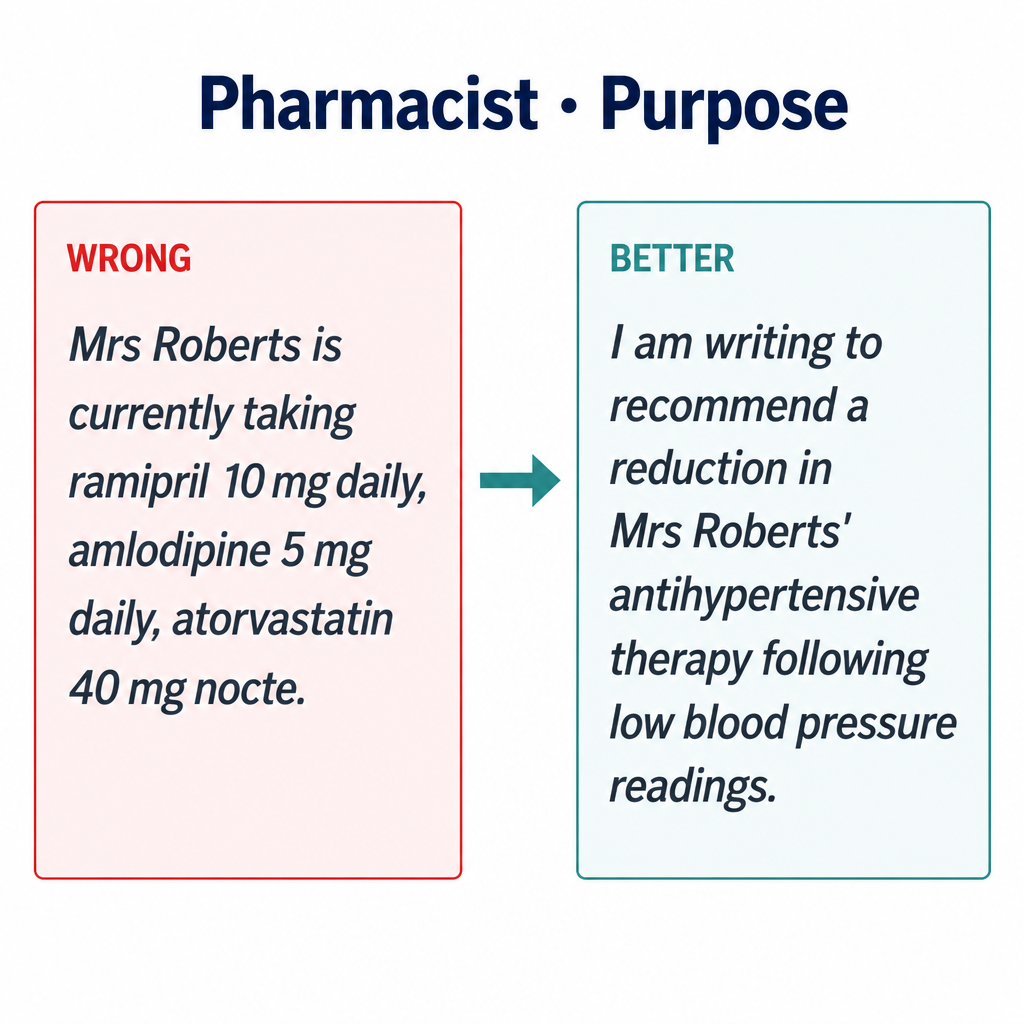
7 pharmacist Purpose mistakes — wrong vs right
1. Opening with the medication list
Impacts: Purpose
Wrong
"Mrs Roberts is currently taking ramipril 10 mg daily, amlodipine 5 mg daily, atorvastatin 40 mg nocte, metformin 1 g twice daily and aspirin 75 mg daily."
Better
"I am writing to recommend a reduction in Mrs Roberts' antihypertensive therapy following persistent low blood pressure readings on her current five-drug regimen."
Why it loses marks: The reader does not know why they are being written to until the medication list ends. Purpose marking penalises buried action statements.
2. Vague "please review medication" closing
Impacts: Purpose
Wrong
"Please review the medication and make changes as appropriate."
Better
"Please consider reducing ramipril to 5 mg daily and reviewing in two weeks with repeat blood pressure measurement."
Why it loses marks: "Review medication" delegates the decision back to the reader. Purpose marking rewards a defined, actionable recommendation.
3. Mismatching register to reader
Impacts: Purpose
Wrong
"I am writing to inform you regarding the pharmacokinetic interaction profile of clarithromycin with your current statin." (Addressed to a patient.)
Better
"I am writing to explain why you should stop your cholesterol tablet during your course of antibiotics."
Why it loses marks: Purpose marking is reader-sensitive. Technical register to a patient reader signals failed audience analysis and caps the achievable Purpose score.
4. Stacking unrelated recommendations
Impacts: Purpose
Wrong
"I am writing to discontinue Mr Chen's NSAID, switch his statin, organise vaccination, and counsel him on inhaler technique."
Better
"I am writing to recommend changes to Mr Chen's regular medication following a polypharmacy review."
Why it loses marks: Listing unrelated recommendations in the opening dilutes purpose. Bundle them under a single rationale; detail them in the body.
5. Stating the problem without the action
Impacts: Purpose
Wrong
"I am writing to inform you that Mrs Khan is at risk of bleeding due to interaction between warfarin and her new antibiotic."
Better
"I am writing to recommend an urgent INR check and dose adjustment for Mrs Khan following a clinically significant warfarin–antibiotic interaction."
Why it loses marks: Naming the problem without the action leaves the reader to deduce what to do. Purpose marking expects both — the issue and the requested response.
6. Treating the advice letter as a referral
Impacts: Purpose
Wrong
"I am referring Mr Singh to you for further management of his asthma." (Addressed to the patient.)
Better
"I am writing to explain how to use your two new inhalers correctly and when to seek further help."
Why it loses marks: Misclassifying letter type relative to reader role is one of the costliest Purpose errors. Patients are not referral recipients.
7. Using "this letter concerns" as the entire purpose
Impacts: Purpose
Wrong
"This letter concerns Mrs Williams and her recent pharmacy review."
Better
"I am writing to recommend deprescribing Mrs Williams' long-term proton pump inhibitor following an indication review."
Why it loses marks: "This letter concerns" names a topic, not a purpose. The opening must commit to a reason for writing and a reader action.
Pre-submission self-check (5 items)
- 1.Does the first sentence name the reason for writing and the action requested?
- 2.Have I matched register to reader (prescriber vs patient)?
- 3.Is the action specific — dose, switch, counselling — not "review medication"?
- 4.Have I avoided opening with the medication list?
- 5.Does the closing reinforce the same purpose with a defined next step?
2026 update
What changed in 2026 for pharmacists on Purpose
The 2026 stricter scoring guidance places more weight on clinical relevance to the named recipient. Pharmacists writing patient advice letters in clinical register, or prescriber letters in lay register, now lose marks they would have retained under earlier marking.
The practical implication: identify reader type before the first sentence is written. Purpose marking now reliably distinguishes letters that demonstrate audience analysis from those that do not.
Frequently asked questions
Where does the purpose statement go?
In the first sentence of the body. The reader must know within five seconds why you are writing.
Why do pharmacists fail Purpose most often?
Pharmacy training emphasises medication detail first. OET expects the action first, with medication detail as evidence.
Is "I am writing to update you" enough?
Only if update is genuinely the purpose with no required reader action. Most pharmacy tasks involve a recommendation — say so.
Should an advice letter to a patient state the purpose?
Yes, in lay language. "I am writing to explain how to take your new blood pressure tablets safely."
Can the purpose include multiple recommendations?
Yes, if bundled under a single reason — for example, polypharmacy review.
Different style for prescribers vs patients?
Yes. Prescribers expect concise clinical recommendation; patients expect plain-language explanation.
Keep learning
Scoring criteria
Want Dr Mariam to mark your pharmacy letter against Purpose?
See OET Writing Correction packs →