Pharmacist · Criterion focus: Genre & Style
Advice Letter Mistakes Pharmacists Make: Genre & Style
A focused clinic for Pharmacists who consistently lose marks on the Genre & Style criterion. Practical, profession-specific fixes drawn from thousands of corrected letters.
In short
- →Use the right register for your recipient: patient, GP or multidisciplinary team.
- →Signpost actions, responsibilities and timelines clearly and politely.
- →Replace unexplained jargon and abbreviations with audience-appropriate phrasing.
Why Pharmacists lose marks on Genre & Style
In my 11,000+ marked OET letters I see Pharmacists repeatedly lose Genre & Style marks because they choose the wrong voice for their audience. They may write to patients with clinical abbreviations, address clinicians in overly simplified language, or alternate between technical and lay terms in the same paragraph. Other common faults are instruction framing that sounds either too blunt or too passive, and poor sequencing of actions. These are not grammar failures but failures of professional tone, audience awareness and communicative purpose — the core of Genre & Style.
Mistake → fix at a glance
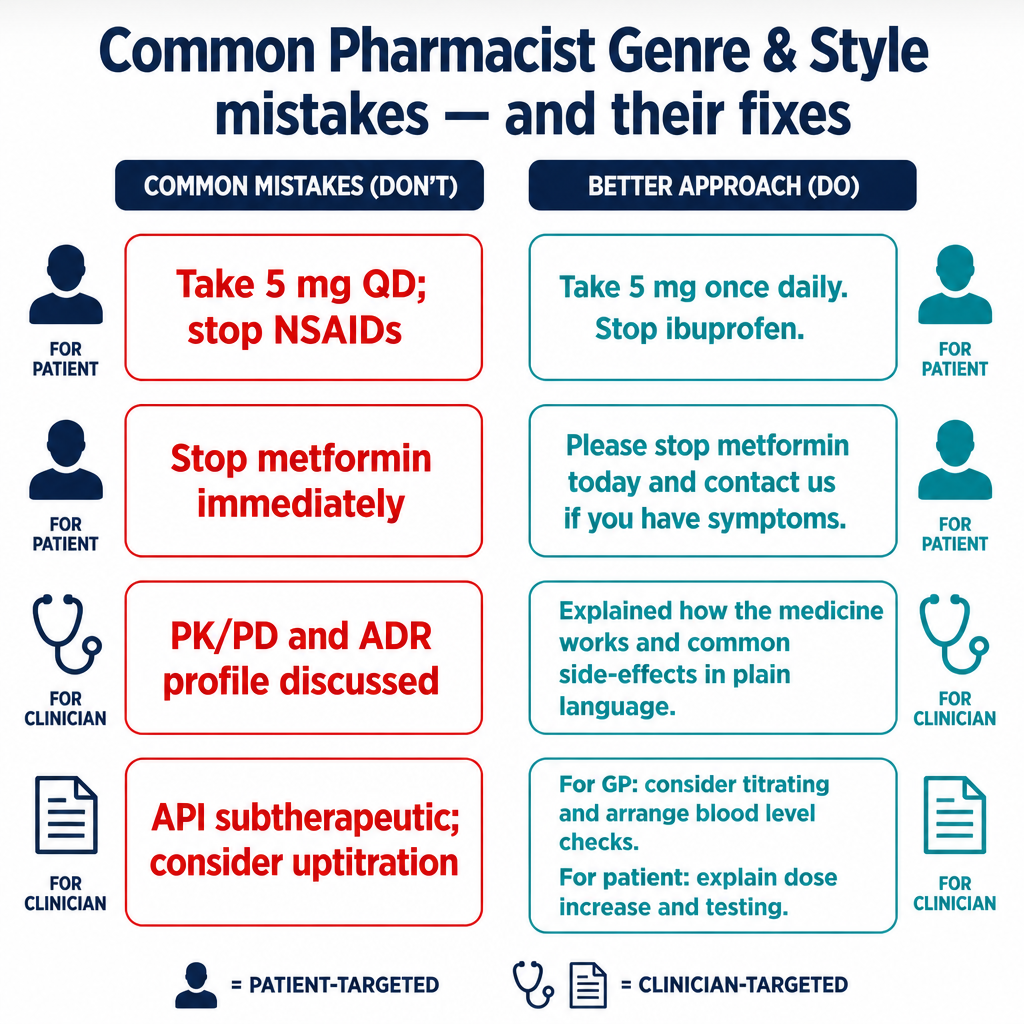
7 Pharmacist mistakes — wrong vs right
1. Using clinical abbreviations when writing to patients
Impacts: Genre & Style
Wrong
"Advise: take 5 mg QD; stop NSAIDs; monitor BP and HbA1c."
Better
"Take 5 mg once daily. Stop ibuprofen and other painkillers. We will check your blood pressure and HbA1c at your next visit."
Why it loses marks: Abbreviations and shorthand create a professional register mismatch and reduce patient comprehension; examiners mark down when the letter fails to meet the patient's communicative needs.
2. Addressing a GP with patient-focused wording
Impacts: Genre & Style
Wrong
"Patient anxious about tablet changes; please reassure and explain why this is fine."
Better
"The patient expressed anxiety about the dose change. Please reassure them and explain the safety monitoring plan during the next review."
Why it loses marks: Letters to colleagues require professional, clinical phrasing that identifies actions and responsibility; overly generic, patient-centred wording weakens the professional tone.
3. Giving blunt, imperative instructions to patients
Impacts: Genre & Style
Wrong
"Stop metformin immediately or you will have lactic acidosis."
Better
"Please stop metformin today and contact the clinic immediately if you have any shortness of breath or severe weakness."
Why it loses marks: A brusque or alarmist tone is inappropriate for patient correspondence; examiners expect a calm, instructive style that supports the reader emotionally and practically.
4. Mixing technical and lay registers in the same paragraph
Impacts: Genre & Style
Wrong
"I discussed PK/PD and the ADR profile; he seemed to get it, so no change."
Better
"I explained how the medicine works and its common side-effects in plain language; the patient understood and agreed to continue treatment."
Why it loses marks: Inconsistent register signals poor audience awareness; examiners penalise letters that confuse the intended reader by switching between specialist and lay language.
5. Failing to signpost actions and responsibilities
Impacts: Genre & Style
Wrong
"Alternative dose suggested and follow-up arranged."
Better
"Please prescribe the alternative 50 mg daily dose and schedule a follow-up in four weeks. I will notify the patient of the change."
Why it loses marks: Vague phrasing leaves responsibilities unclear; Genre & Style expects explicit signposting of who will do what and when, so examiners can see clear professional communication.
6. Overly passive, formal phrasing for direct instructions
Impacts: Genre & Style
Wrong
"It is recommended that the therapy be suspended until further evaluation."
Better
"Please suspend the therapy until you have completed the safety assessment."
Why it loses marks: Excessive passivity weakens clarity and authority; examiners look for confident, appropriately direct requests that fit the professional relationship.
7. Not adapting language to the recipient (patient vs clinician)
Impacts: Genre & Style
Wrong
"API concentration subtherapeutic; consider uptitration and PK sampling."
Better
"To the GP: The active ingredient concentration appears subtherapeutic; please consider titrating and arrange pharmacokinetic sampling. To the patient: Your current dose seems low; the doctor may increase it and we will do a blood test to check levels."
Why it loses marks: Failing to tailor content shows poor audience awareness; examiners expect different registers and detail levels for clinicians and patients.
Pre-submission self-check (7 items)
- 1.Have I identified the recipient (patient, GP, other) and used the appropriate register?
- 2.Did I avoid unexplained abbreviations when writing to patients?
- 3.Are actions, responsibilities and timelines explicitly assigned?
- 4.Is the tone professional, calm and neither overly passive nor blunt?
- 5.Have I used consistent language (technical or lay) throughout?
- 6.Does the opening sentence clearly state purpose and intended outcome?
- 7.Have I closed with my role and a clear contact for follow-up?
2026 update
What changed in 2026 for Pharmacists on this criterion
The 2026 stricter scoring regime tightens what examiners expect from Genre & Style: clear audience awareness, precise allocation of responsibility and an appropriate professional register. Small mismatches that previously passed may now reduce marks because they directly affect the letter's communicative purpose.
As a result, Pharmacists who continue to alternate registers, use unexplained abbreviations with patients, or fail to signpost actions will see larger mark penalties. The updated regime rewards letters that demonstrate deliberate choices about tone, audience and action sequencing — not just correct content.
Frequently asked questions
How do I decide the correct register for a letter?
Identify the recipient first. Use plain, reassuring language for patients; concise clinical language with clear actions for clinicians. Tailor explanations and detail level accordingly.
Are abbreviations allowed in advice letters?
Use standard abbreviations only with clinicians. For patients, write full words and simple phrases; unexplained abbreviations will lower Genre & Style marks.
How should I frame instructions to patients?
Use calm, direct, supportive phrasing that explains the reason and what to watch for. Avoid alarmist or blunt imperatives.
What is an effective opening sentence?
State purpose, recipient and immediate action: e.g. ‘I reviewed X and recommend Y; please do Z by [time].’ This signals professional focus and audience awareness.
How do I show who is responsible for actions?
Use explicit phrasing: ‘Please prescribe…’, ‘I will inform the patient…’, ‘Arrange follow-up in 2 weeks.’ Examiners look for clear ownership.
Can I use technical terms with patients if I explain them?
Yes — introduce the term briefly and immediately explain it in simple language. This shows professional accuracy while maintaining patient comprehension.
Keep learning
Scoring criteria
Want Dr Mariam to mark your pharmacist letter against Genre & Style?
See OET Writing Correction packs →