Pharmacist · Criterion focus: Content
Content Selection Failures: Choosing What Pharmacy Readers Actually Need
A focused clinic for pharmacists who lose marks on the Content criterion. Practical fixes drawn from thousands of marked OET letters.
In short
- →Include drugs relevant to the recommendation, not the full medication list.
- →Pair drug names with lay descriptions when writing to patients.
- →Limit pharmacokinetic detail to what supports the action.
Why pharmacists lose marks on Content
In over 11,000 letters I have personally marked as lead corrector at WCS, pharmacists lose marks on Content for two opposite reasons: over-selection (the full medication list, full pharmacokinetics, every adherence issue) and under-selection (the relevant drug interaction omitted, the lay drug description skipped, the allergy history left implicit). Both signal that the candidate has not analysed what the reader needs to act.
Content is scored 0–7 under the August 2018 rubric. For pharmacists, the high-yield fix is reader-driven selection: prescribers need the clinical recommendation and the evidence that justifies it; patients need the drug name, the action and the rationale in lay terms. Each reader profile drives a different selection.
Mistake → fix at a glance
7 pharmacist Content mistakes — wrong vs right
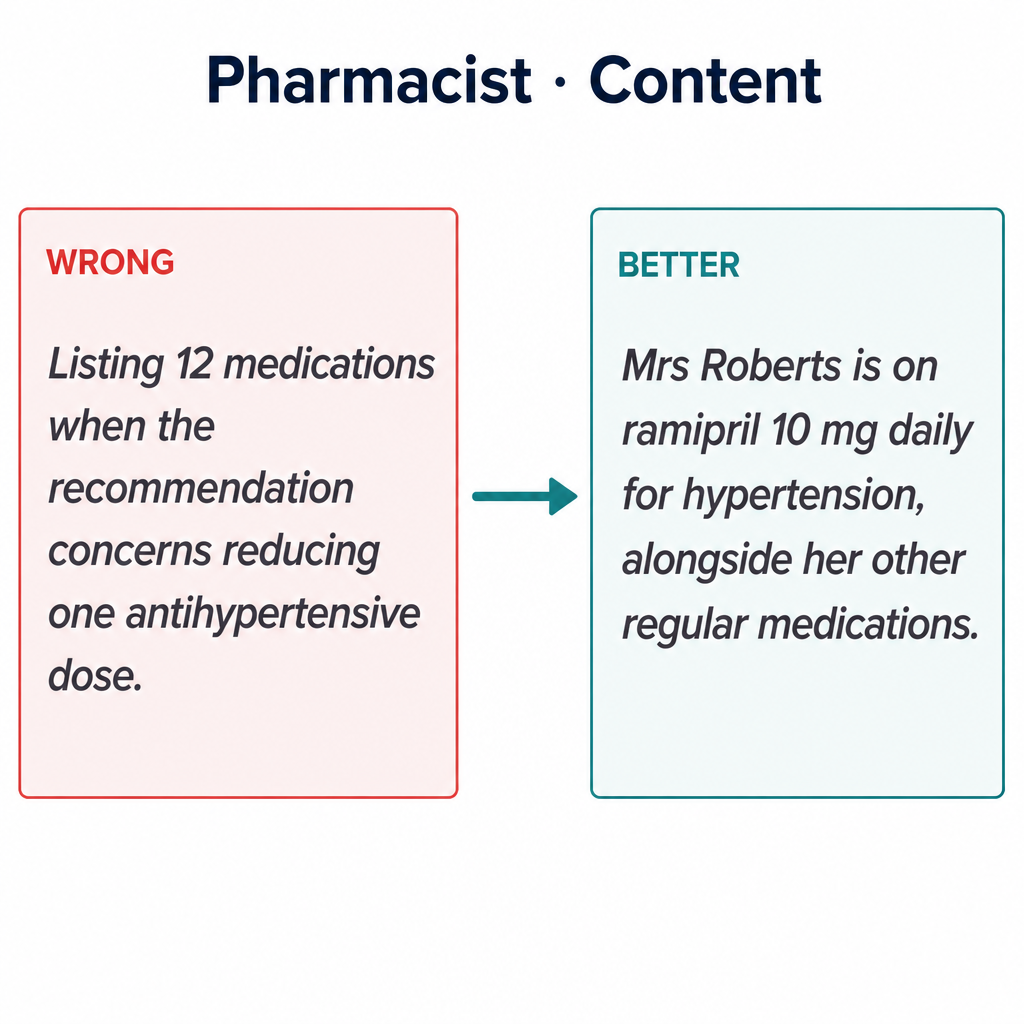
1. Full medication list for a single-drug recommendation
Impacts: Content
Wrong
Listing 12 medications when the recommendation concerns reducing one antihypertensive dose.
Better
"Mrs Roberts is on ramipril 10 mg daily for hypertension, alongside her other regular medications."
Why it loses marks: Listing every drug pads the letter without informing the recipient's decision. Content rewards selection relevant to the recommendation.
2. Pharmacokinetic lecture instead of clinical conclusion
Impacts: Content
Wrong
"Clarithromycin inhibits CYP3A4, which is responsible for the metabolism of simvastatin, increasing plasma concentration by up to 10-fold and increasing the risk of rhabdomyolysis."
Better
"Clarithromycin significantly increases simvastatin levels, raising the risk of muscle injury. Please hold simvastatin during the antibiotic course."
Why it loses marks: Mechanism-heavy detail belongs in a tutorial, not a letter. Content rewards clinical conclusion plus action.
3. Drug names without lay descriptions in patient letters
Impacts: Content
Wrong
"Please continue your ramipril, atorvastatin and tiotropium as prescribed." (To the patient.)
Better
"Please continue your blood pressure tablet (ramipril), your cholesterol tablet (atorvastatin) and your daily breathing inhaler (tiotropium)."
Why it loses marks: Patient letters that use only generic names risk being misunderstood. Lay pairing supports both Content and reader appropriateness.
4. Omitting allergy history when prescribing is recommended
Impacts: Content
Wrong
A letter recommending a new antibiotic with no mention of allergy history.
Better
"No known drug allergies. I recommend amoxicillin 500 mg three times daily for seven days."
Why it loses marks: Omitting allergy status in a prescribing recommendation is a Content omission with safety implications. Examiners mark omission as well as over-inclusion.
5. Adherence history irrelevant to the recommendation
Impacts: Content
Wrong
"Mr Kumar sometimes forgets his evening doses but is generally compliant." (Letter recommending a single morning dose change.)
Better
Omit unless the recommendation explicitly addresses evening dosing.
Why it loses marks: Adherence detail that does not shape the recommendation pads the letter and dilutes the clinical message.
6. Listing every reason a drug exists in the BNF
Impacts: Content
Wrong
"Ramipril is an ACE inhibitor used for hypertension, heart failure, secondary prevention of cardiovascular disease and diabetic nephropathy."
Better
"Mrs Roberts takes ramipril 10 mg daily for hypertension."
Why it loses marks: Drug indication summaries are textbook content, not letter content. The reader knows what ramipril is.
7. Counselling instructions in a referral letter
Impacts: Content
Wrong
"I counselled the patient on inhaler technique, side effects, when to seek help…" (Referral to GP.)
Better
"The patient has been counselled on inhaler technique."
Why it loses marks: A referral letter to a GP does not need full counselling content — that goes in a patient-facing letter. Content selection respects letter type.
Pre-submission self-check (5 items)
- 1.Are drugs included only when relevant to the recommendation?
- 2.Is pharmacokinetic detail limited to what supports the action?
- 3.Are drug names paired with lay descriptions in patient letters?
- 4.Is allergy history included when prescribing is recommended?
- 5.Have I omitted adherence detail irrelevant to the recommendation?
2026 update
What changed in 2026 for pharmacists on Content
The 2026 stricter scoring guidance places more weight on relevance to the named recipient. Mechanism-heavy pharmacokinetic explanations, once tolerated, are now penalised when they do not inform the prescriber's or patient's action.
For pharmacists, this means a final-pass relevance check: would removing this line change the recipient's decision? If not, cut it.
Frequently asked questions
What does Content measure?
Whether you have selected the right items from the case notes for the specific reader.
Include every drug?
Only drugs relevant to the recommendation.
How much PK detail?
Enough to support the recommendation, no more.
Drug names without lay descriptions?
No. Pair each with a short lay description in patient letters.
Allergy history always relevant?
Yes when prescribing is recommended; otherwise optional.
Adherence history?
Only if it affects the recommendation.
Keep learning
Scoring criteria
Want Dr Mariam to mark your pharmacy letter against Content?
See OET Writing Correction packs →