Nurse · Criterion focus: Purpose
Purpose Statement Failures: Why Nurses Lose Marks in the First Sentence
A focused clinic for nurses who routinely lose marks on the Purpose criterion. Practical fixes drawn from thousands of marked OET letters.
In short
- →Open with the reason for writing and the action requested — not patient chronology.
- →Match purpose to reader: a discharge letter informs; a referral requests assessment.
- →Make the closing action specific and time-bound, not "please review".
Why nurses lose marks on Purpose
In over 11,000 letters I have personally marked as lead corrector at WCS, nurses lose marks on Purpose more often than on any other criterion. The cause is consistent: nursing case notes are organised as a clinical handover narrative, which trains candidates to open letters with chronology — "Mrs X was admitted on…" — instead of purpose. The reader, however, does not need to be oriented to a timeline; they need to know what the letter is asking them to do.
Purpose is a 0–3 criterion under the August 2018 OET writing rubric. Losing one band here is mathematically expensive: it represents a third of the available marks on a criterion that examiners assess in the first 15 seconds of reading. Nurses who fix their opening line consistently move from Grade C to Grade B without changing anything else about their writing.
Mistake → fix at a glance
7 nurse Purpose mistakes — wrong vs right
1. Opening with admission chronology instead of purpose
Impacts: Purpose
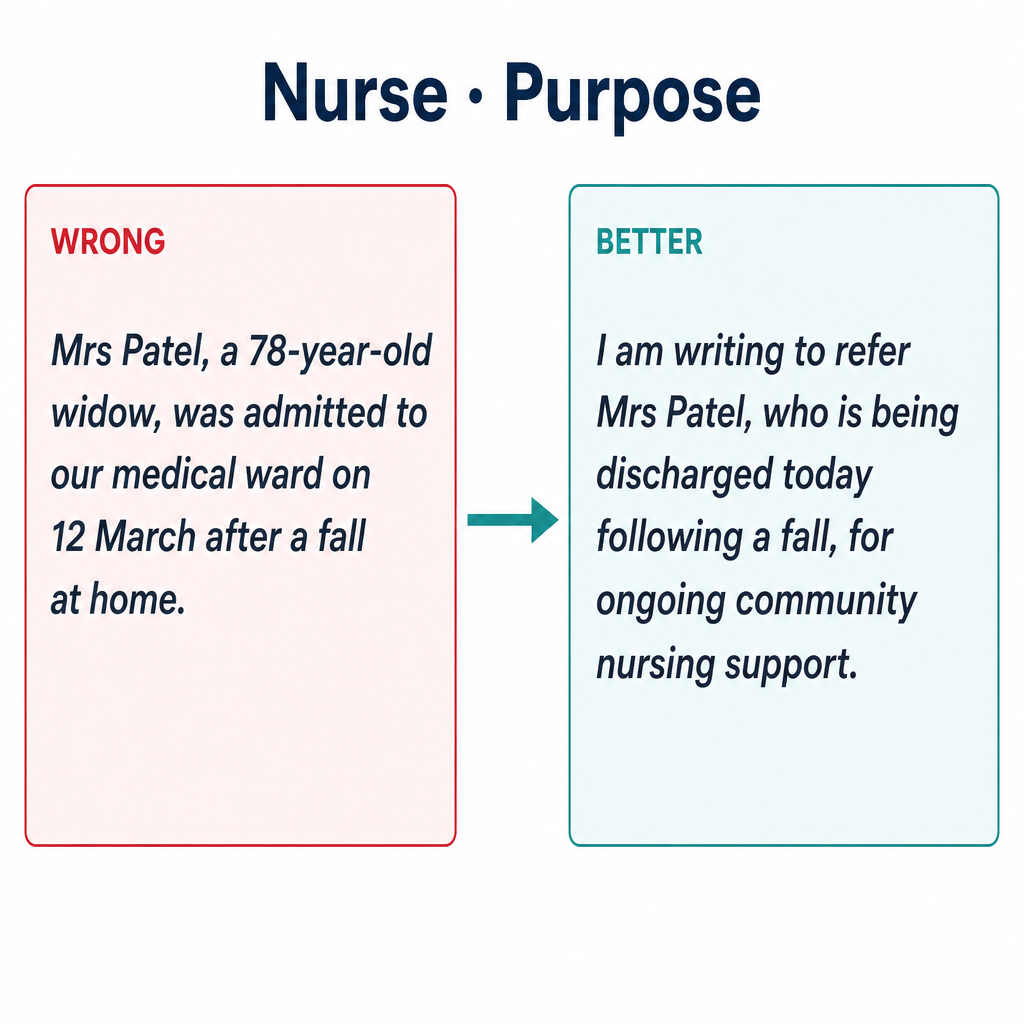
Wrong
"Mrs Patel, a 78-year-old widow, was admitted to our medical ward on 12 March after a fall at home. She has a history of osteoporosis and lives alone in a first-floor flat."
Better
"I am writing to refer Mrs Patel, who is being discharged today following a fall, for ongoing community nursing support with mobility assessment and medication monitoring."
Why it loses marks: The chronology version makes the reader work through three sentences before learning the purpose. Examiners mark Purpose down when the reason for writing is not signalled in the first sentence.
2. Mismatching purpose to reader role
Impacts: Purpose
Wrong
"I am referring Mr Lee to you for diagnosis of his ongoing back pain." (Addressed to the community nurse.)
Better
"I am writing to inform you of Mr Lee's discharge today and to request ongoing pain monitoring and dressing changes in the community."
Why it loses marks: Community nurses do not diagnose. Asking the wrong reader for the wrong action shows the candidate has not analysed reader role — a core Purpose failure.
3. Vague "please review" closing with no specific action
Impacts: Purpose
Wrong
"Please review the patient and provide further care as needed. Thank you."
Better
"Please assess the surgical wound for signs of infection at the first home visit and reinforce sliding-scale insulin teaching with the family."
Why it loses marks: The vague closing fails to specify the action requested. Purpose marking explicitly rewards a defined reader task; "please review" gives the reader nothing to do.
4. Stating multiple competing purposes in one letter
Impacts: Purpose
Wrong
"I am writing to refer Mrs Brown, transfer her care, request social work involvement and update you on her treatment plan."
Better
"I am writing to transfer Mrs Brown's care to your community nursing team following discharge, with a specific focus on wound management and medication adherence."
Why it loses marks: Stacking purposes signals that the candidate has not prioritised reader need. One letter, one primary purpose — supporting actions can sit in the body.
5. Burying the purpose mid-paragraph
Impacts: Purpose
Wrong
"Thank you for your continued care of Mrs Patel. As you know, she has been under our care since her admission, and given the complexity of her case, I would appreciate your ongoing support with wound dressing."
Better
"I am writing to request ongoing wound dressing for Mrs Patel, who is being discharged today following abdominal surgery."
Why it loses marks: Padding the purpose with courtesies pushes the request out of the first sentence, where examiners look for it.
6. Using "for your information" as the entire purpose
Impacts: Purpose
Wrong
"This letter is for your information regarding Mr Singh's stay on our ward."
Better
"I am writing to inform you of Mr Singh's discharge today and to outline the ongoing care needs your team will manage in the community."
Why it loses marks: "For your information" is reader-passive — it does not commit to a reason for writing or a reader action. Purpose marking treats it as an absent purpose statement.
7. Treating the discharge letter as a referral
Impacts: Purpose
Wrong
"I am referring Mr Walters to your community team for assessment of his diabetes management." (The case notes describe a routine discharge home.)
Better
"I am writing to inform you of Mr Walters' discharge home today and to request ongoing diabetes monitoring as part of his routine community care."
Why it loses marks: A discharge letter handing over routine care is not a referral asking for new assessment. Misclassifying the letter type costs Purpose marks because the reader action does not match the case-note scenario.
Pre-submission self-check (5 items)
- 1.Does the first sentence of the body name the reason for writing and the action requested?
- 2.Have I identified who the reader is and matched the purpose to their role?
- 3.Is the requested action specific enough that the reader could act on it without re-reading?
- 4.Have I avoided opening with patient background or chronology?
- 5.Does the closing sentence reinforce the purpose with a clear next step?
2026 update
What changed in 2026 for nurses on Purpose
Under the 2026 stricter scoring guidance, examiners are explicitly directed to look for clinical relevance — does the purpose statement match what a real recipient would need to act on this case? Generic openings that worked under earlier marking now drop a band.
For nurses this means the old habit of opening with patient background is more expensive than ever. A weak Purpose statement now caps overall achievable grade, because a low Purpose score signals to the examiner that subsequent content has not been organised around reader need.
Frequently asked questions
Where should the purpose statement appear in a nursing OET letter?
In the very first sentence of the body, immediately after the salutation. The reader should know within five seconds why the letter has been written and what action is requested.
What is the difference between purpose and content in OET marking?
Purpose is whether the letter has a clear reason for being written and a defined reader action. Content is whether the selected information supports that purpose.
Can a discharge letter have a referral-style purpose?
No. A discharge letter informs the receiving carer about ongoing needs; a referral asks for assessment or treatment. Mixing these confuses the reader and is penalised heavily on Purpose.
Is it acceptable to start with the patient's background?
No. Background belongs in paragraph two. Starting with chronology delays the purpose and signals that the writer has not analysed reader need.
How specific should the requested action be?
Specific enough that the reader could act on it without re-reading the letter. "Please review" is too vague; "Please assess wound for signs of infection" is actionable.
Do nurses lose marks on Purpose more often than other professions?
Yes. Nursing case notes contain more handover chronology than other professions, which encourages timeline openings rather than purpose-first openings.
Keep learning
Scoring criteria
Want Dr Mariam to mark your nursing letter against Purpose?
See OET Writing Correction packs →