Doctor (GP) · Criterion focus: Content
Content Selection Failures: What Doctors Should Leave Out of OET Letters
A focused clinic for doctors who routinely lose marks on the Content criterion. Practical fixes drawn from thousands of marked OET letters.
In short
- →Select case-note items only if the recipient needs them to act on your request.
- →Negative findings belong only where they support the clinical reasoning.
- →Integrate notes into reader-facing language — never copy verbatim.
Why doctors lose marks on Content
Doctors approach OET writing with a clinical-record instinct: be thorough, document everything, leave no gap. That instinct is the wrong one for the Content criterion, which rewards selection rather than inclusion. In over 11,000 letters I have personally marked as lead corrector at WCS, the most common doctor failure is not omitting key information — it is including too much information that the reader does not need.
The Content criterion is scored 0–7 under the August 2018 rubric. Doctors who include three pages of detailed history typically cap at a 4 or 5, not because the writing is wrong but because the selection is unfocused. Reader-driven selection — asking what the recipient needs to act — is the single change that moves doctor letters from mid-band to high-band Content scores.
Mistake → fix at a glance
7 doctor Content mistakes — wrong vs right
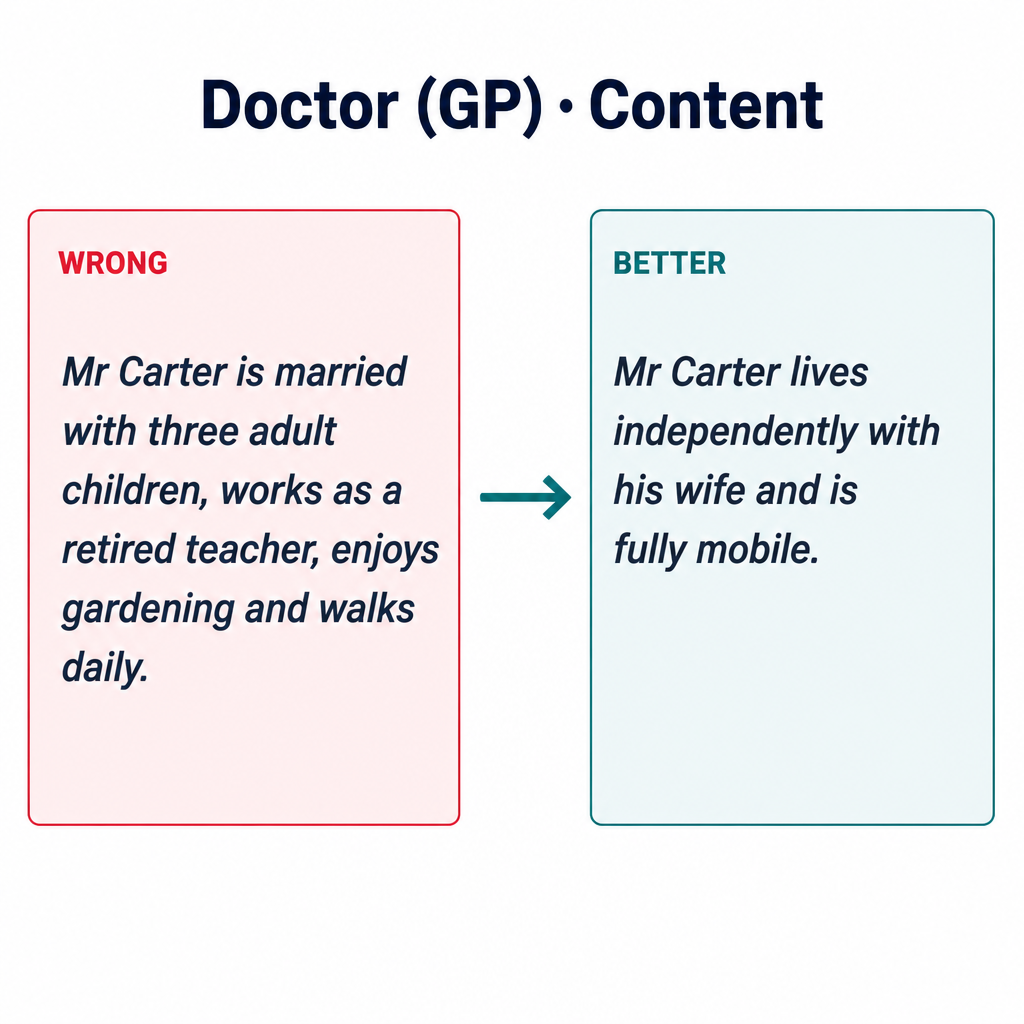
1. Including full social history regardless of relevance
Impacts: Content
Wrong
"Mr Carter is married with three adult children, works as a retired teacher, lives in a two-bedroom house with his wife, enjoys gardening and walks daily." (Referral for suspected colorectal cancer.)
Better
"Mr Carter lives independently with his wife and is fully mobile."
Why it loses marks: Social context only matters where it affects management. For a cancer referral, mobility and home support are relevant; gardening hobbies are not.
2. Listing every negative finding indiscriminately
Impacts: Content
Wrong
"No history of diabetes, asthma, epilepsy, thyroid disease, cancer, depression, dementia, hypertension or stroke."
Better
"No relevant cardiovascular history." (For a chest-pain referral.)
Why it loses marks: Negatives only support clinical reasoning when they narrow differential. A blanket list shows the candidate has not selected for relevance.
3. Including family history unrelated to the referral
Impacts: Content
Wrong
"Family history: father had a hip replacement, mother died of pneumonia, brother has eczema." (Referral for atrial fibrillation.)
Better
"No family history of cardiac disease or arrhythmia."
Why it loses marks: Family history is high-signal only when it bears on the index condition. Including unrelated relatives' conditions wastes reader attention.
4. Copying case notes verbatim instead of integrating them
Impacts: Content
Wrong
"Pt: 64M. HPC: chest pain x 3/52. PMH: HTN, T2DM. Meds: ramipril, metformin."
Better
"Mr Brown, a 64-year-old man with a three-week history of exertional chest pain, has hypertension and type 2 diabetes, treated with ramipril and metformin."
Why it loses marks: Case-note shorthand transferred unchanged into a letter signals that the candidate has not processed the information for a professional reader. Content rewards selection plus integration.
5. Omitting the single piece of information the recipient most needs
Impacts: Content
Wrong
A referral for breathlessness lists past medical history and medications but omits oxygen saturations and exam findings from the case notes.
Better
"On examination today, oxygen saturation was 91% on room air with bilateral basal crepitations on auscultation."
Why it loses marks: Content errors include omission as well as over-inclusion. Selecting irrelevant items while dropping the key clinical finding is a double penalty.
6. Including investigation results with no interpretation
Impacts: Content
Wrong
"FBC 09/03: Hb 9.2, MCV 72, WCC 6.8, plts 320. Ferritin 8."
Better
"Recent blood tests confirm microcytic anaemia (Hb 9.2, MCV 72, ferritin 8), consistent with iron deficiency."
Why it loses marks: Raw numbers without interpretation force the reader to do the clinical reasoning. Content rewards items that are pre-digested for the recipient.
7. Including reassurance and follow-up notes the reader doesn't need
Impacts: Content
Wrong
"I have reassured the patient, advised lifestyle modification, scheduled follow-up in six weeks, given a leaflet, and contacted the family."
Better
"The patient has been counselled and is awaiting your specialist review."
Why it loses marks: Process notes about what the writer has done do not help the recipient act. Content selection should privilege clinical information over administrative narrative.
Pre-submission self-check (5 items)
- 1.For each sentence, does the reader need this to act on my request?
- 2.Are relevant negatives included only where they support clinical reasoning?
- 3.Have I omitted social or family history items unrelated to the referral?
- 4.Are investigation results presented with interpretation, not raw numbers?
- 5.Have I integrated case-note items into reader-facing prose rather than copying verbatim?
2026 update
What changed in 2026 for doctors on Content
The 2026 stricter scoring regime tightened the Content criterion by emphasising clinical relevance to the named recipient. Examiners are now explicitly directed to penalise inclusion of items that do not support the reader's clinical decision-making — even when those items are factually accurate.
For doctors this means the comprehensive-history habit, once forgiven under earlier marking, is now more costly. Letters that include a balanced set of relevant items now score visibly higher than letters that include everything.
Frequently asked questions
What does the Content criterion measure?
Whether you have selected the right information from the case notes for this specific reader and purpose. It is about relevance, not volume.
Why do doctors get Content wrong despite detailed letters?
Clinical training rewards thoroughness; OET Content rewards selection. The two skills pull in opposite directions.
Should I include negative findings?
Only when they materially affect the referral or narrow the differential.
Is it acceptable to copy from the case notes?
Selection is allowed, but verbatim copying without integration is penalised. Examiners look for evidence that you have processed the notes.
How do I decide what to include?
Ask whether the recipient needs the information to act. If they would skip past it, leave it out.
Does Content overlap with Conciseness?
Related but distinct. Content asks whether the right items are present; Conciseness asks whether each item is expressed efficiently.
Keep learning
Scoring criteria
Want Dr Mariam to mark your doctor letter against Content?
See OET Writing Correction packs →