Doctor (GP) · Criterion focus: Conciseness & Clarity
Over-Detailed Letters: Conciseness & Clarity Failures for Doctor (GP)
A focused clinic for Doctor (GP)s who routinely lose marks on the Conciseness & Clarity criterion. Practical fixes drawn from thousands of marked OET letters.
In short
- →Trim full consultation narratives to a one-line presenting-issue summary.
- →Include only medically relevant PMH and current meds for the referral purpose.
- →Use clear, single-line statements for diagnosis and requested action.
Why Doctor (GP)s lose marks on Conciseness & Clarity
In over 11,000 letters I have marked, Doctor (GP)s commonly lose marks on Conciseness & Clarity because they treat the referral like a complete consultation record. GPs naturally include chronology, complete past histories and long medication lists to be thorough; in OET these habits bury key information. Examiners penalise excess detail that obscures purpose and slows reader comprehension. Learning to filter and present only what supports the referral request is the most efficient way for GPs to regain marks without sacrificing clinical accuracy.
Mistake → fix at a glance
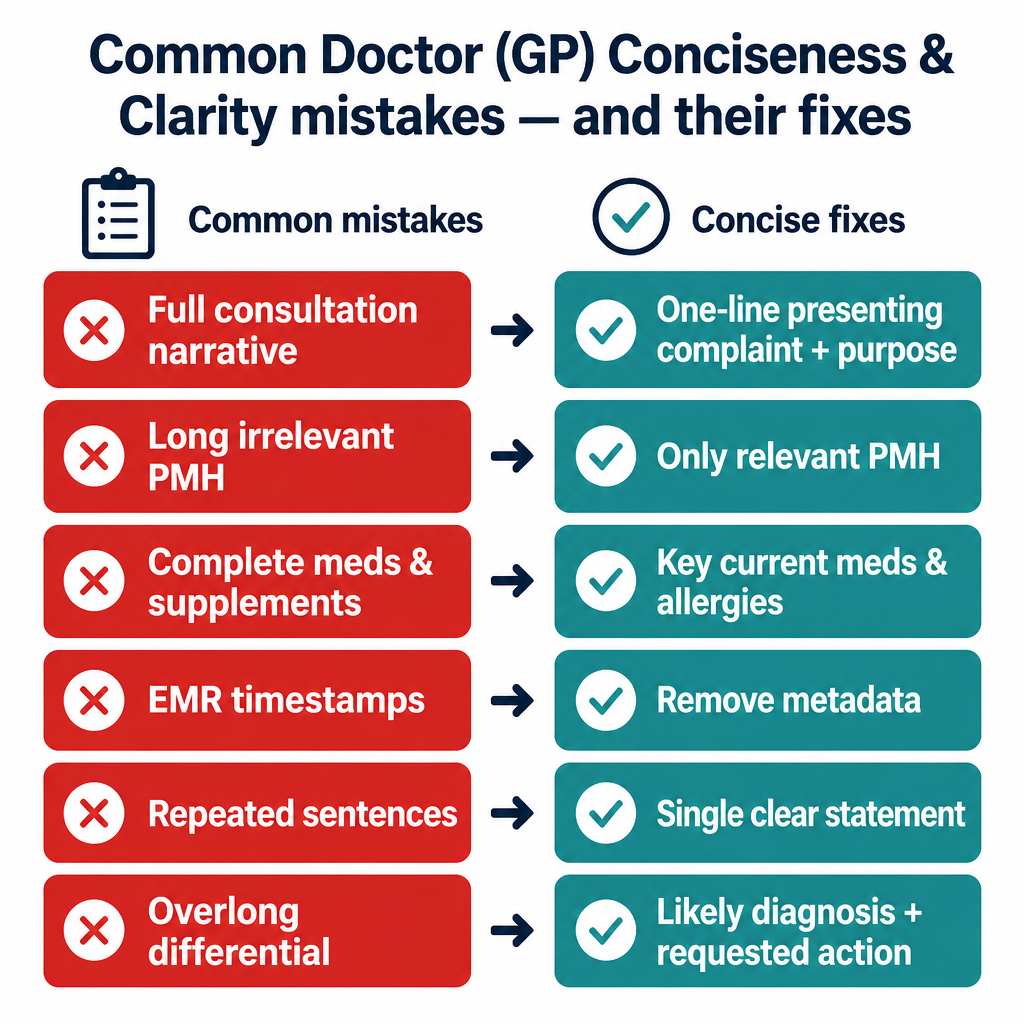
7 Doctor (GP) mistakes — wrong vs right
1. Full consultation narrative instead of a concise reason for referral
Impacts: Conciseness & Clarity
Wrong
"Mrs Jones attended the practice on 12/03 with a two-week history of intermittent chest pain. She first noticed pain after gardening, then again while walking her dog, rated 5/10; she described it as tight then sharp and said it improved with rest."
Better
"Mrs Jones presents with a two-week history of exertional chest pain, intermittent, improving with rest. Please assess for ischaemic heart disease."
Why it loses marks: Long chronological consultation detail buries the presenting complaint and referral request, making the letter hard to scan and lowering perceived clinical focus.
2. Listing remote, irrelevant past medical history
Impacts: Conciseness & Clarity
Wrong
"Past history: childhood asthma, appendicectomy aged 10, treated for gout in 2008, tonsillectomy age 6, and a knee sprain aged 22."
Better
"Relevant past history: asthma (childhood, no recent attacks) and osteoarthritis of the knee."
Why it loses marks: Including irrelevant or remote conditions dilutes clinical relevance and forces the reader to search for what actually matters to the referral.
3. Unnecessary full medication/dose history for routine referrals
Impacts: Conciseness & Clarity
Wrong
"Current medications: amlodipine 5 mg at night, metformin 500 mg twice daily with breakfast and evening, aspirin 75 mg daily, simvastatin 20 mg nocte, salbutamol inhaler as needed (two puffs), zinc 25 mg daily."
Better
"Current medications relevant to this referral: amlodipine 5 mg daily, metformin 500 mg twice daily. No known drug allergies."
Why it loses marks: Long med lists with unrelated supplements add bulk and distract; examiners expect only medications that affect the referral or patient safety to be included.
4. Repeating the same point in multiple sections
Impacts: Conciseness & Clarity
Wrong
"I am referring for investigation of anaemia. The patient has iron deficiency anaemia suspected from blood tests and needs investigation for cause of anaemia."
Better
"Referral for investigation of iron deficiency anaemia following abnormal blood tests."
Why it loses marks: Redundancy increases length without adding information, suggesting poor organisation and reducing clarity of intent.
5. Overlong differential reasoning instead of clear request
Impacts: Conciseness & Clarity
Wrong
"I think the pain could be myocardial, but it might be musculoskeletal or even reflux; alternatively pleuritic causes or panic attacks could explain symptoms, so many tests might be needed."
Better
"Most likely diagnosis: angina. Please arrange ECG and exercise tolerance test (or urgent cardiology review if indicated)."
Why it loses marks: Extensive speculative lists of diagnoses obscure the most likely problem and the specific action requested, making the referral unfocused.
6. Including electronic record metadata and admin notes
Impacts: Conciseness & Clarity
Wrong
"Template: Seen by GP 12/03/2026 09:12 via telephone; note created by user ID 457; referral printed to letterhead."
Better
"Consultation: telephone review 12/03/2026. Referral: urgent ENT assessment requested."
Why it loses marks: EMR metadata and administrative details are irrelevant to clinical decision-making and unnecessarily lengthen the letter.
7. Over-describing normal examination with long lists
Impacts: Conciseness & Clarity
Wrong
"On exam: no clubbing, no cyanosis, no jaundice, pulses equal, chest clear with no crepitations, normal S1 and S2, abdomen soft, no organomegaly, neurological exam normal with intact cranial nerves, normal reflexes, no focal deficits."
Better
"Examination: cardiorespiratory and abdominal examination normal; no focal neurological deficit."
Why it loses marks: Long lists of normal findings add bulk; a focused summary conveys the same clinical message with less cognitive load for the reader.
Pre-submission self-check (7 items)
- 1.Does the opening sentence state the presenting problem and referral purpose in one line?
- 2.Have I removed irrelevant past medical history and remote events?
- 3.Are medications limited to those relevant to the referral or patient safety?
- 4.Have I avoided repeating information in different sections?
- 5.Is the requested action (investigation, opinion, treatment) explicitly stated?
- 6.Have I deleted electronic metadata, templates or internal timestamps?
- 7.Is the examination/findings section a concise summary rather than a long checklist?
2026 update
What changed in 2026 for Doctor (GP)s on this criterion
The 2026 stricter scoring regime applies the 2018 OET writing criteria with tighter expectations for reduction of irrelevant detail. Examiners are explicitly instructed to mark more harshly for verbosity that obscures purpose.
For Doctor (GP)s this means the old habit of including full consultation notes or exhaustive histories now costs more marks: each unnecessary sentence increases cognitive load and can change a band score on Conciseness & Clarity. Candidates must actively edit for purpose and reader.
Frequently asked questions
How long should my opening sentence be?
One clear sentence that names the problem, duration and the referral purpose is ideal — typically 10–18 words.
Do I need to list every medication and dose?
No. Include only medications relevant to the referral or those that affect diagnosis/treatment, plus allergies.
Should I include a detailed timeline of symptoms?
Only include timeline details that affect urgency or diagnosis; otherwise give a concise duration and key changes.
Is it okay to use a short normal-exam summary?
Yes. A focused phrase such as 'examination unremarkable' or 'cardiorespiratory exam normal' is appropriate when no specific findings guide referral.
How do I show clinical reasoning without verbosity?
State the most likely diagnosis briefly, give one clinical sign or test that supports it, then specify the requested action.
Will removing detail make the letter seem less professional?
No. Concise letters that include relevant evidence and a clear request are judged more professional and clinically useful by examiners.
Keep learning
Scoring criteria
Want Dr Mariam to mark your doctor (gp) letter against Conciseness & Clarity?
See OET Writing Correction packs →