Dentist · Criterion focus: Conciseness & Clarity
Conciseness & Clarity Failures: Why Dentist Letters Run Long
A focused clinic for dentists who lose marks on Conciseness & Clarity. Practical fixes drawn from thousands of marked OET letters.
In short
- →Limit dentition detail to teeth relevant to the referral request.
- →Summarise radiograph findings in one clinical phrase, not a paragraph.
- →Use tooth notation consistently to compress descriptions.
Why dentists lose marks on Conciseness & Clarity
Dental training emphasises charting completeness — every tooth, every surface, every restoration. That habit produces OET letters with full-mouth descriptions when the referral concerns one quadrant. In over 11,000 letters I have personally marked as lead corrector at WCS, the most common dental Conciseness failure is including charting detail that does not affect the recipient's clinical decision.
Conciseness & Clarity is scored 0–7 under the August 2018 OET rubric. For dentists, the fix is reader-led pruning: would the oral surgeon, orthodontist or specialist need to know about every existing restoration to manage the referral? Usually not.
Mistake → fix at a glance
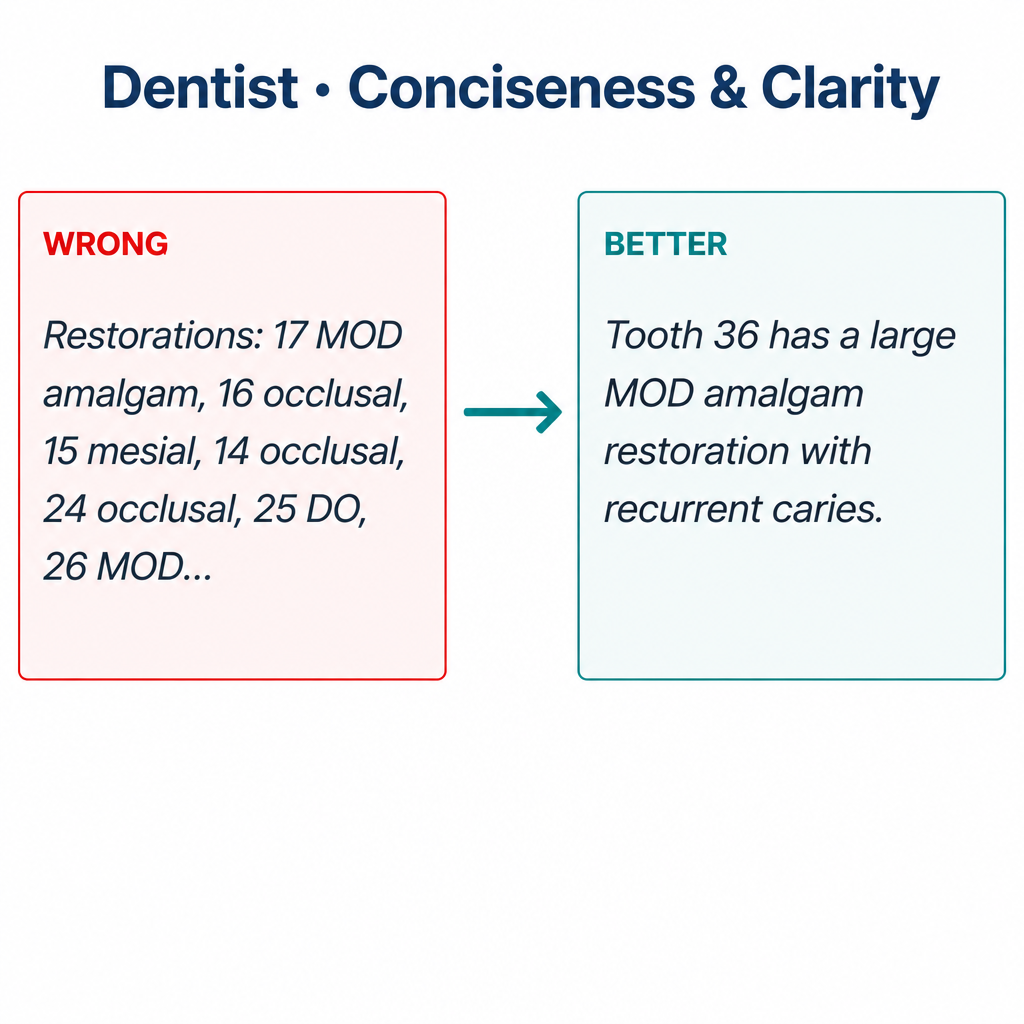
7 dentist Conciseness mistakes — wrong vs right
1. Full-mouth restoration history for a single-tooth referral
Impacts: Conciseness & Clarity
Wrong
"Existing restorations: 17 MOD amalgam, 16 occlusal composite, 15 mesial composite, 14 occlusal, 24 occlusal, 25 distal-occlusal, 26 MOD composite, 27 occlusal..."
Better
"Tooth 36 has a large MOD amalgam restoration with recurrent caries."
Why it loses marks: The recipient needs only the dentition relevant to their assessment. Full charts inflate word count without informing decision-making.
2. Long radiograph narrative
Impacts: Conciseness & Clarity
Wrong
"A periapical radiograph was taken on 10 March. The radiograph showed a radiolucent area at the apex of tooth 36. The radiolucency measures approximately 4 mm. The surrounding bone appears normal."
Better
"A periapical radiograph shows a 4 mm apical radiolucency at tooth 36, consistent with chronic apical periodontitis."
Why it loses marks: One interpretive sentence beats three descriptive ones. Examiners reward integration of findings with clinical meaning.
3. Repeating tooth descriptions in different notations
Impacts: Conciseness & Clarity
Wrong
"The lower left first molar (tooth 36, also referred to as the LL6) presents with..."
Better
"Tooth 36 presents with..."
Why it loses marks: Pick one notation and stay with it. Multiple naming systems inflate word count and signal uncertainty about reader assumptions.
4. Excessive pain descriptors
Impacts: Conciseness & Clarity
Wrong
"The patient describes a sharp, shooting, sometimes throbbing, occasionally dull pain that lasts for varying durations and is triggered by cold and sometimes hot and biting."
Better
"The patient reports cold-sensitive pain in tooth 36, lasting under 30 seconds."
Why it loses marks: Stacked descriptors blur the clinical picture. Pick the diagnostically useful features.
5. Detailed appointment history
Impacts: Conciseness & Clarity
Wrong
"The patient attended for an emergency appointment on 02/03, was reviewed on 09/03, then returned on 12/03 after persistent symptoms, and was seen again on 15/03."
Better
"The patient has been reviewed four times over the past three weeks with persistent symptoms."
Why it loses marks: Date-by-date narrative belongs in the chart, not the letter. A summary statement preserves the clinical signal.
6. Including patient's anxiety where it doesn't affect the referral
Impacts: Conciseness & Clarity
Wrong
"The patient is anxious about dental treatment, dislikes the smell of clinics, finds the light uncomfortable and feels nervous before each visit." (Standard orthodontic referral.)
Better
Omit, unless the referral is specifically for sedation. In that case: "Significant dental anxiety; sedation requested."
Why it loses marks: Anxiety is relevant when it shapes management. Otherwise it pads the letter and dilutes the clinical message.
7. Long courtesy paragraphs at the start and end
Impacts: Conciseness & Clarity
Wrong
"Thank you so much for taking the time to read this letter. I really appreciate your help with this patient and look forward to hearing from you when convenient."
Better
"Thank you for your assistance with this patient."
Why it loses marks: Long courtesy text adds word count without adding clinical information. One short sentence is plenty.
Pre-submission self-check (5 items)
- 1.Is the letter between 180 and 200 words?
- 2.Is dentition detail limited to teeth relevant to the referral?
- 3.Is the radiograph summarised in one clinical phrase?
- 4.Have I removed restoration history irrelevant to the request?
- 5.Have I used tooth notation consistently?
2026 update
What changed in 2026 for dentists on Conciseness & Clarity
The 2026 stricter scoring guidance places more weight on relevance to the recipient. Full-chart descriptions, once tolerated, are now penalised when they do not inform the specialist's decision.
For dentists this means letters need active pruning. Each charting line should be challenged: would the oral surgeon, orthodontist or specialist act differently if this were not included?
Frequently asked questions
How long should an OET dental letter be?
Aim for 180–200 words.
Should I use tooth notation?
Yes, consistently. It compresses descriptions and matches professional register.
List every restoration?
Only if relevant to the referral.
How do I describe pain concisely?
Type, duration, trigger — one phrase.
Omit radiograph findings?
Only if they do not affect the referral. Otherwise summarise in one line.
Include dental anxiety?
Only when it affects management.
Keep learning
Scoring criteria
Want Dr Mariam to mark your dental letter against Conciseness & Clarity?
See OET Writing Correction packs →