Dentist · Criterion focus: Purpose
Specialist Referral Errors — Dentist (Purpose)
A focused clinic for Dentists who are losing marks on the OET Writing Purpose criterion. Practical, profession-specific fixes for clearer referral intent and requested action.
In short
- →State the referral purpose in the opening sentence and repeat the requested action explicitly.
- →Name the receiving service and indicate urgency or timeframe to avoid ambiguity.
- →Say who will do follow-up and whether investigations or prescriptions are needed (be specific).
Why Dentists lose marks on Purpose
Dentists commonly lose Purpose marks because referral letters often bury the actual request beneath dental history and clinical detail. In over 11,000 letters I have marked, Dentists tend to assume the specialist will infer the next steps rather than stating them.
This yields ambiguity: assessors cannot award Purpose points when the action, urgency, recipient, or expected outcome is unclear. Clear, concise opening statements and an explicit 'I request' line transform a borderline referral into a purposeful one under the 2018 criteria (scored under the 2026 stricter regime).
Mistake → fix at a glance
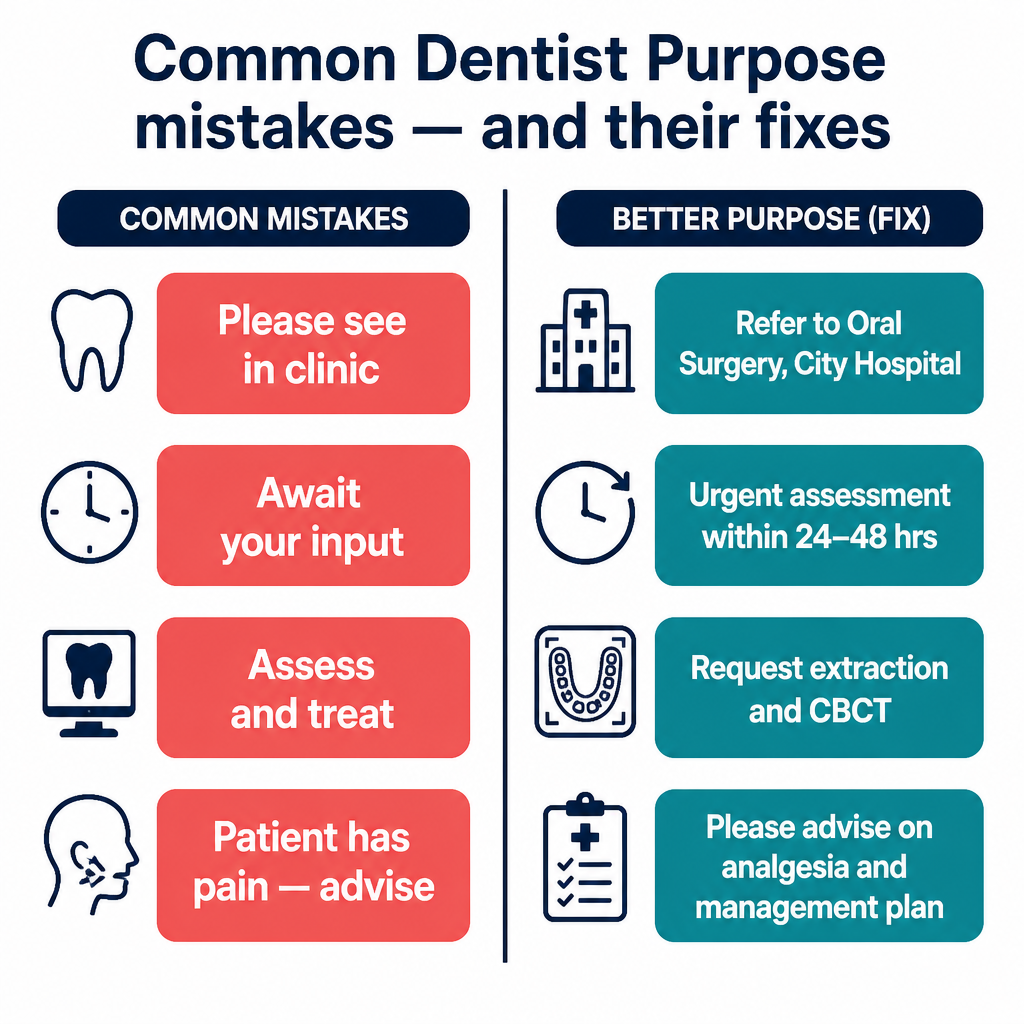
7 Dentist mistakes — wrong vs right
1. Purpose buried in clinical history
Impacts: Purpose
Wrong
"Mrs Jones presents with recurrent pain and a fractured restoration following a root canal two years ago; she has a sinus tract and mobility of the tooth."
Better
"Please assess Mrs Jones for possible extraction and implant planning due to recurrent pain and a fractured restoration following previous root canal treatment."
Why it loses marks: Examiners cannot infer the referral action when history comes first; the explicit request for assessment or treatment must be stated to show clear purpose.
2. Unspecified recipient — 'please see in clinic'
Impacts: Purpose
Wrong
"Please see the patient in clinic for further management of an impacted canine."
Better
"Please refer Mrs Patel to the consultant orthodontist (Orthodontics Department, City Hospital) for assessment and surgical exposure of an impacted upper canine."
Why it loses marks: Vague destination fails Purpose: assessors need to know which service or specialist is expected to receive the referral, not a generic 'clinic'.
3. No urgency or timeframe noted
Impacts: Purpose
Wrong
"The patient has an acute swelling but will await your input when possible."
Better
"The patient has an acute facial swelling; I request urgent assessment within 24–48 hours for possible drainage and intravenous antibiotics."
Why it loses marks: OET Purpose requires clarity on urgency. Without a timeframe, the examiner cannot determine whether the request matches the clinical priority.
4. Missing requested investigations or imaging
Impacts: Purpose
Wrong
"I am referring Mr Li for persistent pain after endodontic treatment."
Better
"I am referring Mr Li for persistent post-endodontic pain and request CBCT imaging and specialist endodontic review to assess for missed canals."
Why it loses marks: If the expected investigations or diagnostic steps are not stated, the letter lacks a clear, actionable purpose; examiners mark down when next steps are ambiguous.
5. Ambiguous follow-up responsibility
Impacts: Purpose
Wrong
"Please advise on further treatment and let us know your plan."
Better
"Please advise on further treatment and indicate whether you will continue active management; if not, please return the patient to my care with recommended plan."
Why it loses marks: Purpose includes who will carry out ongoing care. Examiners penalise letters that do not indicate whether the referrer or specialist will follow up.
6. Mixing several unrelated requests in one sentence
Impacts: Conciseness & Clarity
Wrong
"Please assess for extraction, consider referral to oral surgery or ENT if necessary, and advise on antibiotics if needed."
Better
"I request an oral surgery assessment for extraction of the lower third molar. If you consider ENT input necessary for associated sinus symptoms, please advise and liaise with ENT. Please also advise whether antibiotics are indicated now."
Why it loses marks: Multiple conditional requests in one sentence obscure the primary purpose. Examiners need distinct, single requests presented clearly to award Purpose and Clarity marks.
7. Failing to state expected outcome or question
Impacts: Purpose
Wrong
"Patient has oroantral communication after extraction; please see and treat."
Better
"Patient has an oroantral communication after extraction. Please assess for closure and advise whether surgical closure under local or general anaesthesia is required."
Why it loses marks: Without a clear question about the desired outcome, the referral reads like a notification rather than a purposeful request; examiners require a defined objective to award Purpose marks.
Pre-submission self-check (8 items)
- 1.Have I stated the referral purpose in the first or second sentence?
- 2.Have I named the receiving service or consultant specifically?
- 3.Have I indicated urgency or provided a timeframe (urgent/routine/within X days)?
- 4.Have I requested specific investigations or actions (e.g. CBCT, extraction, biopsy)?
- 5.Have I made clear who will follow up and who is responsible for ongoing care?
- 6.Have I kept the primary request concise and separated from supporting history?
- 7.Have I avoided conditional chains of requests in one sentence?
- 8.Have I restated the requested action in a final closing line?
2026 update
What changed in 2026 for Dentists on this criterion
The 2026 stricter scoring regime places greater emphasis on explicit communicative intent in referrals. Examiners now require an unmistakable statement of purpose, named recipient, and specified action or timeframe before awarding Purpose marks.
For Dentists this means a historical narrative alone will not suffice. Letters that previously passed by implication are now more likely to be downgraded, so precise opening lines and an explicit request are essential under the 2018 criteria evaluated in 2026.
Frequently asked questions
Do I have to name the exact consultant or is the department enough?
Name the consultant if known; if not, name the department and service (e.g. 'Oral Surgery, City Hospital'). This shows clear recipient intent (OET 2018 criteria).
How specific must urgency be?
Give a clear timeframe (urgent/24–48 hours/routine within 2 weeks). Vague phrases like 'soon' are insufficient under the 2026 scoring approach.
Should I include treatment options or leave that to the specialist?
State the action you request (assessment, extraction, imaging). You may suggest options briefly, but the primary request must be explicit (Purpose criterion).
Is it okay to request multiple outcomes in one letter?
Yes, if each request is separated and clear. Avoid packing conditional or competing requests into one sentence to protect clarity and Purpose marks.
Do I need to say who will provide follow-up care?
Yes. Indicate whether you expect the specialist to manage ongoing care or to return the patient to you; this clarifies responsibility and supports Purpose scoring.
How long should a referral letter be?
Keep it concise: state purpose and requested action early, include only essential supporting history, and finish with a clear request. Quality of purpose beats length.
Keep learning
Scoring criteria
Want Dr Mariam to mark your dentist letter against Purpose?
See OET Writing Correction packs →