Physiotherapist · Criterion focus: Genre & Style
Genre & Style Failures: Where Physio Letters Drift Out of Register
A focused clinic for physiotherapists who lose marks on Genre & Style. Practical fixes drawn from thousands of marked OET letters.
In short
- →Match register to reader: clinical terminology for community physio; plain language for carer.
- →Expand AROM/PROM/ROM/MMT in letter prose; no documentation shorthand.
- →Use continuous prose — no SOAP, no labelled sections.
Why physiotherapists lose marks on Genre & Style
In over 11,000 letters I have personally marked as lead corrector at WCS, physiotherapists arrive at OET writing from a documentation culture that values structured templates: SOAP, subjective/objective/assessment/plan, ranged measurements in shorthand. That habit pulls letters out of professional letter genre into clinical-record genre, where examiners cannot award high Genre & Style marks.
Genre & Style is scored 0–7 under the August 2018 rubric. For physios, the highest-yield fix is genre-swap: replace structured documentation conventions with continuous prose appropriate to a doctor-to-doctor or therapist-to-therapist letter. This sits alongside the universal Genre rules — named salutations, matched closings, no contractions.
Mistake → fix at a glance
7 physiotherapist Genre & Style mistakes — wrong vs right
1. SOAP-style structure imported into the letter
Impacts: Genre & Style
Wrong
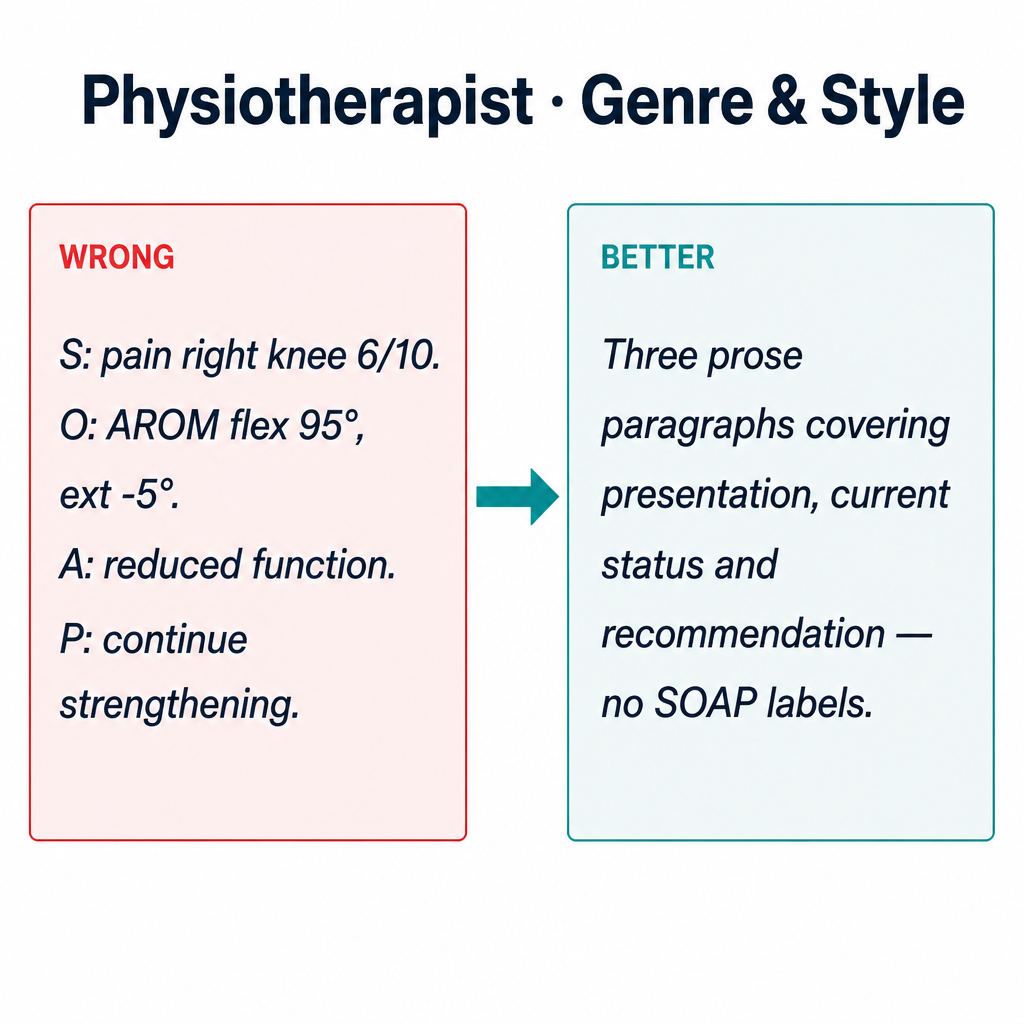
"S: pain right knee 6/10. O: AROM flex 95°, ext -5°. A: reduced function. P: continue strengthening."
Better
Three paragraphs of prose covering presentation, current status and recommendation — no headings, no SOAP labels.
Why it loses marks: SOAP signals clinical-record genre. OET letters require continuous prose.
2. Documentation shorthand in prose
Impacts: Genre & Style
Wrong
"AROM full, PROM WNL, MMT 4/5 quads, TUG 18s, FIM motor 65."
Better
"Active range of motion is full and quadriceps strength is grade 4/5. Timed Up and Go is 18 seconds, suggesting moderate mobility limitation."
Why it loses marks: Shorthand is record register. Genre marking expects expanded prose with appropriate clinical terminology.
3. Register mismatched to reader
Impacts: Genre & Style
Wrong
"Mrs Lee demonstrates reduced AROM of the glenohumeral joint with capsular pattern restriction." (Addressed to the patient's family carer.)
Better
"Mrs Lee has reduced movement of her right shoulder, particularly when raising her arm overhead."
Why it loses marks: Carer readers cannot act on clinician-only terminology. Genre marking penalises mismatched register.
4. Chart-style sentence fragments
Impacts: Genre & Style
Wrong
"72F. ORIF L NOF #. POD 5. Mobilising 4WW. Indep transfers."
Better
"Mrs Khan is a 72-year-old woman, five days post open reduction and internal fixation of a left neck of femur fracture. She is mobilising with a four-wheeled walker and transfers independently."
Why it loses marks: Fragments are handover register. Letter prose uses complete sentences with subject and verb.
5. Mismatched salutation and closing
Impacts: Genre & Style
Wrong
Opening "Dear Community Physiotherapist," closing "Yours sincerely."
Better
Unnamed salutation pairs with "Yours faithfully." Named salutation ("Dear Ms Brown,") pairs with "Yours sincerely."
Why it loses marks: Salutation–closing mismatch is a quick Genre marker examiners check for.
6. Over-personal commentary about the patient
Impacts: Genre & Style
Wrong
"Mrs Lee is a lovely lady who works so hard at her exercises and is a pleasure to treat."
Better
"Mrs Lee has been engaged and adherent with her exercise programme throughout admission."
Why it loses marks: Personal warmth in clinical commentary breaks register. State adherence and engagement factually instead.
7. Contractions in letter prose
Impacts: Genre & Style
Wrong
"She's progressing well and doesn't need supervision anymore."
Better
"She is progressing well and no longer requires supervision."
Why it loses marks: Contractions are too informal for a professional letter. Use full forms throughout.
Pre-submission self-check (5 items)
- 1.Have I matched register to reader?
- 2.Have I expanded AROM/PROM/ROM/MMT?
- 3.Have I avoided SOAP headings?
- 4.Is the tone collegial — neither chart fragments nor over-deferential?
- 5.Does salutation match closing?
2026 update
What changed in 2026 for physiotherapists on Genre & Style
The 2026 stricter scoring guidance treats register slips as more clearly band-marking than before. SOAP imports, shorthand, and chart-style fragments now reliably drop a band.
For physios this means active genre-swapping at proofread: every sentence must read as letter prose, not record prose.
Frequently asked questions
What does Genre & Style measure for physios?
Whether the letter sits within the professional letter genre and matches register to reader.
Clinician vs patient-centred language?
Match register to reader: clinical for community physio; plain for carer.
Are AROM/PROM acceptable?
No. Expand in letter prose.
Is first person OK?
Yes for letter opening and recommendation.
SOAP-style headings?
No. OET letters are continuous prose.
Collegial vs deferential?
Collegial. Treat the recipient as a professional peer.
Keep learning
Scoring criteria
Want Dr Mariam to mark your physio letter against Genre & Style?
See OET Writing Correction packs →