Physiotherapist · Criterion focus: Conciseness & Clarity
Conciseness & Clarity Failures: Where Physio Letters Get Padded
A focused clinic for physiotherapists who lose marks on Conciseness & Clarity. Practical fixes drawn from thousands of marked OET letters.
In short
- →Summarise treatment in one or two sentences, not a session-by-session log.
- →Expand ROM/MMT/AROM/PROM and similar shorthand in letter prose.
- →Name exercise categories with their target — not every set and rep.
Why physiotherapists lose marks on Conciseness & Clarity
In over 11,000 letters I have personally marked as lead corrector at WCS, physiotherapists lose marks on Conciseness because physio documentation rewards precise measurement detail. Every range-of-motion value, every muscle grade, every set-and-rep prescription is recorded — and then transferred unchanged into the OET letter, where it adds words without adding meaning for the recipient.
Conciseness & Clarity is scored 0–7 under the August 2018 rubric. For physios, the highest-yield fix is the treatment-summary swap: replace a session log with one or two interpretive sentences. This single change reliably saves 30–50 words and increases the reader's clinical signal.
Mistake → fix at a glance
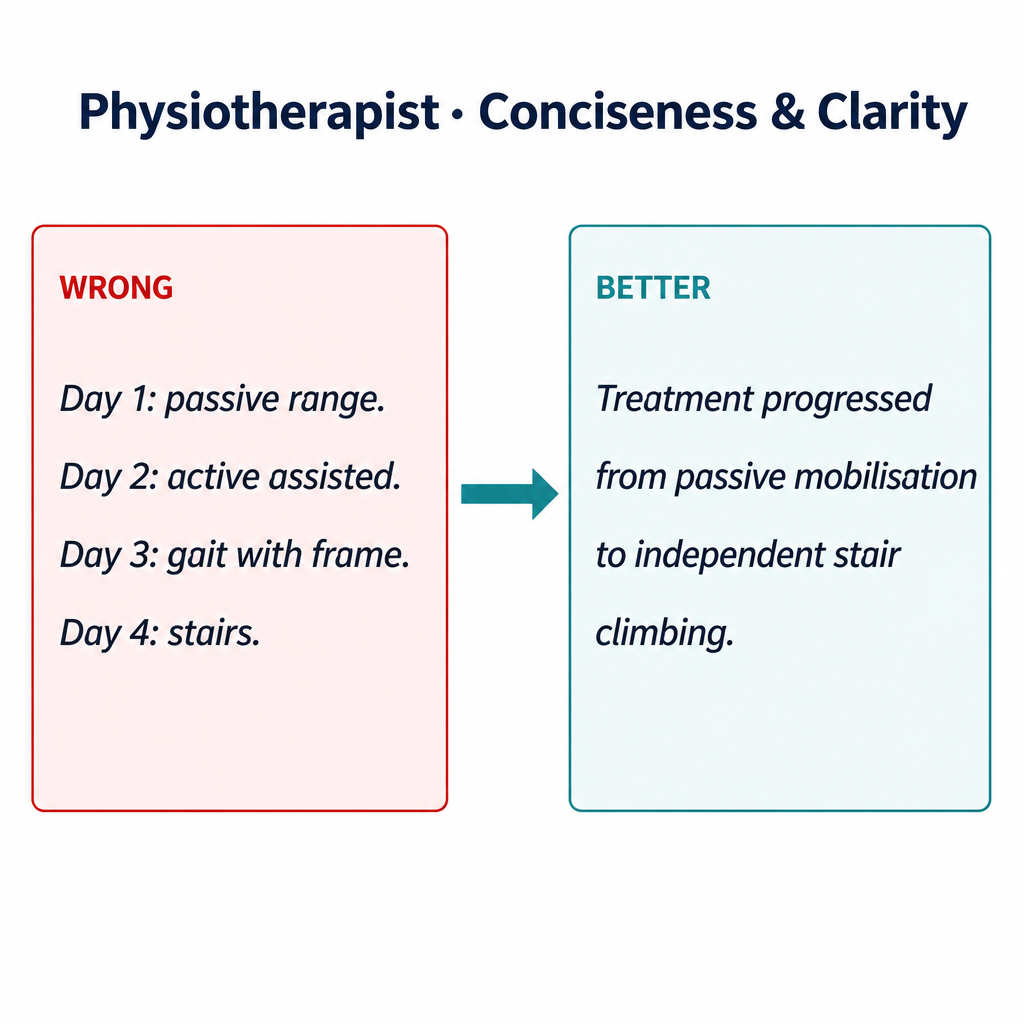
7 physiotherapist Conciseness mistakes — wrong vs right
1. Session-by-session treatment narrative
Impacts: Conciseness & Clarity
Wrong
"Day 1: passive range. Day 2: active assisted. Day 3: gait with frame. Day 4: stairs. Day 5: outdoor mobility. Day 6: progression to stick…"
Better
"Treatment progressed from passive mobilisation to independent stair climbing over the admission."
Why it loses marks: Session-by-session detail pads the letter without informing the recipient. One-sentence summary preserves the clinical signal.
2. Listing every range-of-motion value
Impacts: Conciseness & Clarity
Wrong
"Knee flexion 95°, extension -5°. Hip flexion 110°, abduction 35°, adduction 25°, internal rotation 30°, external rotation 40°…"
Better
"Knee flexion is limited to 95°, which restricts deep-squat tasks."
Why it loses marks: Multi-joint measurement lists pad the letter. The recipient acts on the measurement that constrains function.
3. Unexpanded shorthand (ROM, MMT, AROM, PROM)
Impacts: Conciseness & Clarity
Wrong
"AROM full, PROM WNL bilaterally. MMT 4/5 quads. TUG 18s."
Better
"Active and passive range of motion are within normal limits bilaterally. Quadriceps strength is grade 4/5. Timed Up and Go is 18 seconds."
Why it loses marks: Shorthand is documentation register, not letter register. Both Conciseness and Genre criteria penalise it in prose.
4. Set-and-rep exercise prescriptions in letter prose
Impacts: Conciseness & Clarity
Wrong
"Quadriceps sets 3 × 10 with 10-second hold. Heel slides 3 × 10. Glute bridges 3 × 10. Standing knee bends 3 × 10. Repeat twice daily."
Better
"Please continue progressive lower-limb strengthening and range-of-motion exercises twice daily, per the home programme provided."
Why it loses marks: Full prescriptions belong in the home programme. Letter prose names exercise category and target.
5. Pain scores across multiple time points
Impacts: Conciseness & Clarity
Wrong
"Pain day 1: 8/10. Day 3: 7/10. Day 5: 6/10. Day 7: 5/10. Day 10: 4/10. Day 14: 3/10."
Better
"Pain has reduced from 8/10 to 3/10 and no longer limits transfers."
Why it loses marks: Time-series numbers without interpretation force the reader to do the trend analysis. Two endpoints with function are clearer.
6. Listing every outcome measure administered
Impacts: Conciseness & Clarity
Wrong
"Berg Balance: 42. 6MWT: 200m. TUG: 18s. FIM motor: 65. Oxford knee: 26. KOOS: 40. WOMAC: 28."
Better
"Berg Balance score of 42 indicates moderate fall risk; Timed Up and Go of 18 seconds confirms ongoing mobility limitation."
Why it loses marks: Outcome score lists are documentation. Letter prose selects two or three measures with interpretation.
7. Repeating equipment lists
Impacts: Conciseness & Clarity
Wrong
"Patient mobilises with four-wheel walker. The four-wheel walker is required for community ambulation. Please continue use of the four-wheel walker."
Better
"Mr Wong mobilises with a four-wheeled walker and will require it for community ambulation."
Why it loses marks: Repetition signals poor planning. Each equipment item appears once with its functional context.
Pre-submission self-check (5 items)
- 1.Is the letter between 180 and 200 words?
- 2.Have I summarised treatment in one to two sentences?
- 3.Have I expanded ROM/MMT/AROM/PROM?
- 4.Are pain scores paired with functional interpretation?
- 5.Have I named exercise categories rather than full prescriptions?
2026 update
What changed in 2026 for physiotherapists on Conciseness
The 2026 stricter scoring guidance applies the 2018 criteria with tighter expectations for relevance to the recipient. Outcome-measure lists, full prescriptions, and time-series scores now drop a band more reliably when they do not change the recipient's plan.
For physios this means actively replacing documentation-style detail with reader-led summaries — function plus the one or two scores that support it.
Frequently asked questions
How long should an OET physio letter be?
Aim for 180–200 words.
Summarise treatment in a paragraph?
Yes. One to two sentences beats a session log.
Can I use SOAP/physio shorthand?
No. Expand ROM/MMT/AROM/PROM in letter prose.
Are pain scales worth including?
Only with functional interpretation.
Describe exercise prescription concisely?
Category plus target, not every set and rep.
Include all outcome measure scores?
Only those the recipient will act on.
Keep learning
Scoring criteria
Want Dr Mariam to mark your physio letter against Conciseness & Clarity?
See OET Writing Correction packs →