Pharmacist · Criterion focus: Conciseness & Clarity
Conciseness & Clarity Failures: Where Pharmacy Letters Get Wordy
A focused clinic for pharmacists who lose marks on Conciseness & Clarity. Practical fixes drawn from thousands of marked OET letters.
In short
- →State doses cleanly: "ramipril 10 mg once daily" — no mechanism padding.
- →Expand BD/TDS/QDS to plain English in letter prose.
- →Describe interactions in one sentence: drugs, effect, action.
Why pharmacists lose marks on Conciseness & Clarity
In over 11,000 letters I have personally marked as lead corrector at WCS, pharmacists lose marks on Conciseness because pharmacy education emphasises completeness — full drug name, mechanism, indication, dose, frequency, route. That habit, transferred unchanged into OET letters, produces 250-word letters where 180 would do.
Conciseness & Clarity is scored 0–7 under the August 2018 OET rubric. For pharmacists, the high-yield fix is dose-statement discipline: name, dose, frequency, and skip the rest unless the recommendation depends on it. This alone reliably saves 30–40 words and clarifies the message.
Mistake → fix at a glance
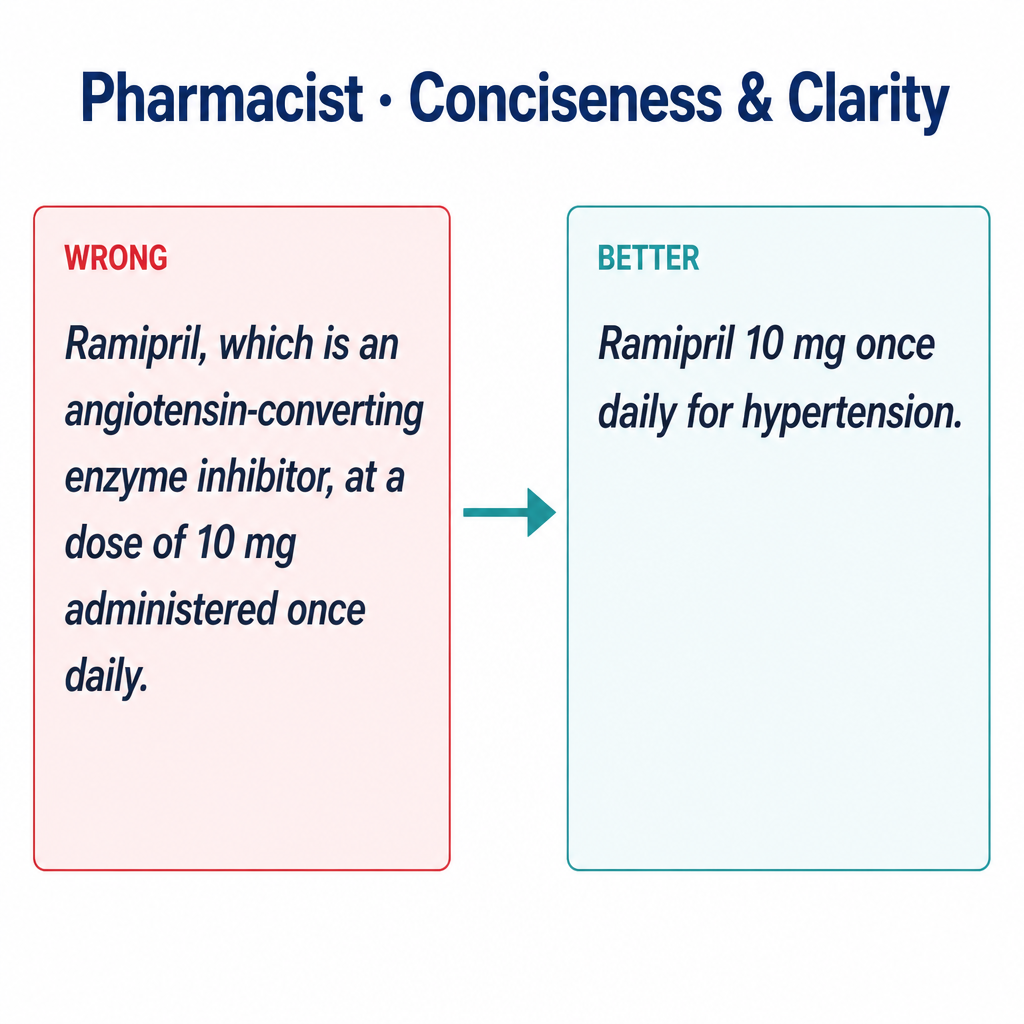
7 pharmacist Conciseness mistakes — wrong vs right
1. Mechanism padding around dose statements
Impacts: Conciseness & Clarity
Wrong
"Ramipril, which is an angiotensin-converting enzyme inhibitor, at a dose of 10 mg administered once daily in the morning for hypertension."
Better
"Ramipril 10 mg once daily for hypertension."
Why it loses marks: Mechanism and class descriptors are textbook content. The reader already knows what ramipril is.
2. Using BD, TDS, QDS in prose
Impacts: Conciseness & Clarity
Wrong
"Metformin 500 mg BD and amoxicillin 500 mg TDS for 7/7."
Better
"Metformin 500 mg twice daily and amoxicillin 500 mg three times daily for seven days."
Why it loses marks: Prescription abbreviations belong in prescriptions, not letters. Genre and Conciseness both expect expanded prose.
3. Long interaction explanations
Impacts: Conciseness & Clarity
Wrong
"Warfarin's anticoagulant effect is potentiated by amiodarone through inhibition of hepatic CYP enzymes which results in increased INR and a higher risk of bleeding events..."
Better
"Amiodarone potentiates warfarin; please check INR and adjust dose."
Why it loses marks: Mechanism detail does not change the recipient's action. One-sentence interaction summaries beat paragraph-length ones.
4. Repeating the recommendation in multiple paragraphs
Impacts: Conciseness & Clarity
Wrong
"I recommend stopping simvastatin… Please discontinue simvastatin… I have asked the patient to stop simvastatin."
Better
State the recommendation once in the relevant paragraph; reinforce only with a specific action in the closing.
Why it loses marks: Repetition inflates length without adding information and suggests poor planning.
5. Listing every patient parameter
Impacts: Conciseness & Clarity
Wrong
"Patient: 67-year-old male, 78 kg, 1.72 m, BMI 26.4, eGFR 65, LFTs normal, BP 142/86…"
Better
"Mr Carter is a 67-year-old man with stage 2 chronic kidney disease (eGFR 65) and well-controlled hypertension."
Why it loses marks: A full parameter sheet is record-keeping. Letter prose selects parameters that affect the recommendation.
6. Over-explaining basic patient instructions
Impacts: Conciseness & Clarity
Wrong
"Take one tablet by swallowing with water (preferably one full glass), at the same time each day, ideally morning…"
Better
"Take one tablet with water each morning at the same time."
Why it loses marks: Parenthetical detail and stacked qualifiers inflate instructions without adding clarity.
7. Long courtesy paragraphs
Impacts: Conciseness & Clarity
Wrong
"I really appreciate your time and consideration of this matter, and look forward to working together for the best outcomes for the patient…"
Better
"Thank you for your assistance with this patient."
Why it loses marks: Extended closing courtesies pad without informing. One short polite sentence is correct register.
Pre-submission self-check (5 items)
- 1.Is the letter between 180 and 200 words?
- 2.Have I expanded BD/TDS/QDS to plain English?
- 3.Have I limited drug detail to what supports the recommendation?
- 4.Are interactions stated in one-sentence form?
- 5.Have I avoided repeating the recommendation?
2026 update
What changed in 2026 for pharmacists on Conciseness
The 2026 stricter scoring guidance applies the 2018 criteria with tighter expectations for reduction of irrelevant detail. Mechanism-heavy explanations and exhaustive parameter lists now drop a band on Conciseness more reliably.
For pharmacists this means active editing: each sentence must justify its presence by changing the recipient's action.
Frequently asked questions
How long should an OET pharmacy letter be?
Aim for 180–200 words.
Write doses in full?
Yes for clarity, no for padding around them.
Can I use BD/TDS/QDS?
No. Expand in prose.
How do I describe an interaction concisely?
Drugs, effect, action — one sentence.
Cut polite phrases?
Keep one short polite sentence in the closing.
Include age and weight always?
Only when they affect dosing.
Keep learning
Scoring criteria
Want Dr Mariam to mark your pharmacy letter against Conciseness & Clarity?
See OET Writing Correction packs →