Nurse · Criterion focus: Organisation & Layout
Organisation & Layout Failures: Paragraphing and Sequencing in Nursing Letters
A focused clinic for nurses who lose marks on Organisation & Layout. Practical fixes drawn from thousands of marked OET letters.
In short
- →Three to four body paragraphs: purpose → background → current status → request.
- →One topic per paragraph; topic sentence first, supporting detail after.
- →No headings, no bullet points, no numbered lists — prose only.
Why nurses lose marks on Organisation & Layout
In over 11,000 letters I have personally marked as lead corrector at WCS, nurses lose marks on Organisation & Layout in two distinct ways: under-organised (a single block of prose with no paragraphs) and over-organised (headings, bullets, sub-sections imported from clinical documentation). Both signal that the candidate has not internalised letter format.
Organisation & Layout is scored 0–7 under the August 2018 OET rubric. For nurses, the high-yield fix is paragraph discipline: one topic per paragraph, topic sentence first, supporting clinical detail after. This single change reliably moves the criterion up a band.
Mistake → fix at a glance
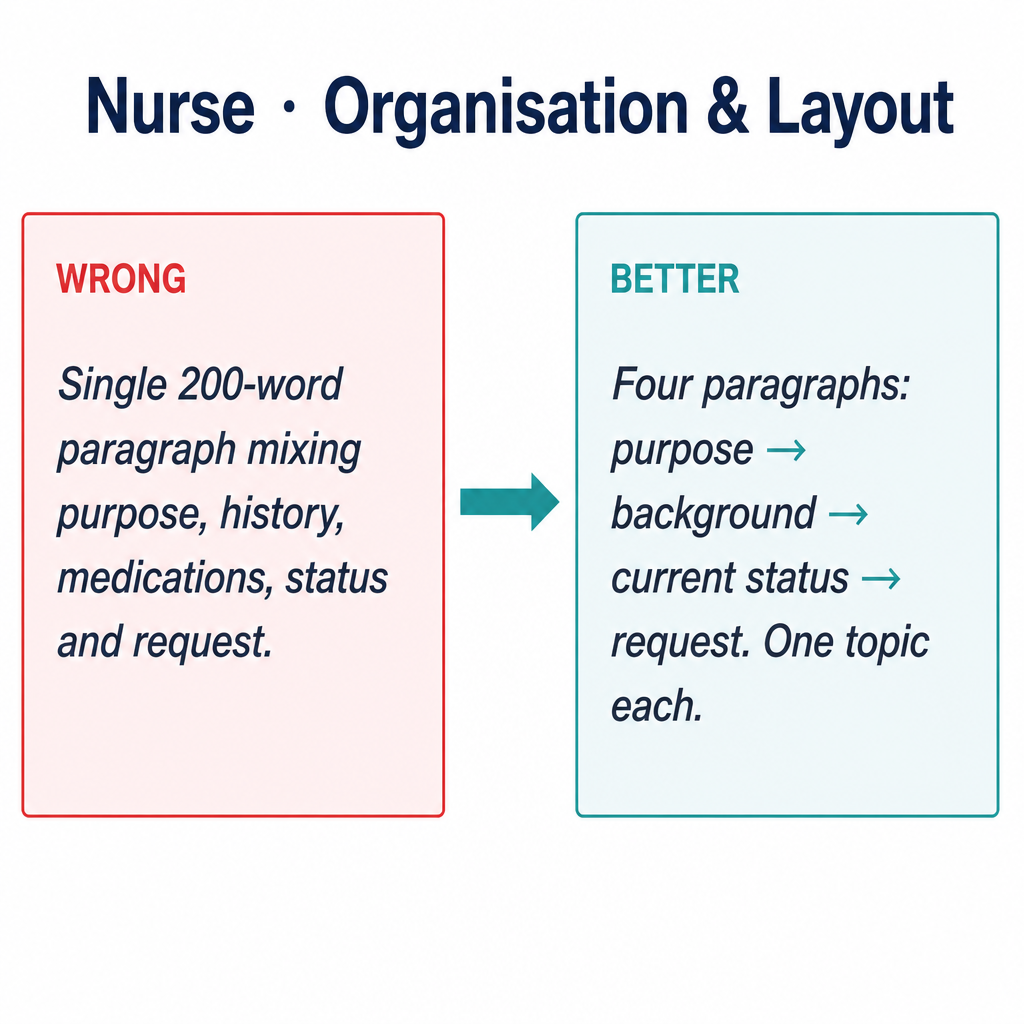
7 nurse Organisation mistakes — wrong vs right
1. Single-block letter with no paragraph breaks
Impacts: Organisation & Layout
Wrong
One 200-word paragraph covering purpose, admission, medications, current status and request, with no breaks.
Better
Three to four paragraphs separated by blank lines, each with a topic sentence and 2–4 supporting sentences.
Why it loses marks: Single-block prose forces the reader to extract structure. Examiners penalise lack of visible organisation regardless of content quality.
2. Using headings imported from clinical documentation
Impacts: Organisation & Layout
Wrong
"Background:" / "Treatment:" / "Discharge Plan:" used as section headings within the letter.
Better
Use topic sentences. "Mrs Patel was admitted on 10 March following a fall…" signals a new section without a heading.
Why it loses marks: OET letters are prose, not structured reports. Headings break the genre convention and signal the wrong document type.
3. Multiple topics in one paragraph
Impacts: Organisation & Layout
Wrong
A single paragraph covering admission, current medications, family situation and discharge plan.
Better
Split into: a paragraph on admission and clinical course, a paragraph on current status and social context, a paragraph on the discharge plan and request.
Why it loses marks: Multiple-topic paragraphs blur logical progression. The criterion rewards clear topic-per-paragraph structure.
4. Bullet points or numbered lists
Impacts: Organisation & Layout
Wrong
"Current needs: • wound dressing twice weekly • monitoring blood pressure • support with medication"
Better
"Ongoing care needs include twice-weekly wound dressing, blood pressure monitoring and support with medication administration."
Why it loses marks: Bullets are not letter format. Listing in prose preserves meaning while keeping genre.
5. Out-of-sequence chronology
Impacts: Organisation & Layout
Wrong
Paragraph 2: discharge plan. Paragraph 3: admission three weeks ago. Paragraph 4: current medications today.
Better
Paragraph 2: admission/background. Paragraph 3: current status and medications. Paragraph 4: discharge request.
Why it loses marks: Mid-letter chronology should run oldest to newest. Jumbled sequencing forces the reader to reconstruct timeline.
6. No topic sentence at the start of paragraphs
Impacts: Organisation & Layout
Wrong
Paragraph opens: "On the second day she was given paracetamol and reviewed in the afternoon."
Better
Paragraph opens: "Mrs Patel's hospital course was uncomplicated. Pain was managed with paracetamol…"
Why it loses marks: Topic sentences orient the reader. Without them, paragraphs read as undifferentiated facts and Organisation marks drop.
7. Salutation and closing run into the body
Impacts: Organisation & Layout
Wrong
"Dear Community Nurse, I am writing to refer Mrs Patel..." with no line break before the body, and "Yours sincerely Susan Nurse" run together at the end.
Better
"Dear Community Nurse," on its own line, blank line, then body. At the end: "Yours sincerely," on a line, then "Susan Nurse" on the next line.
Why it loses marks: Layout includes spacing. Run-together salutation/closing signals that the candidate has not followed letter format conventions.
Pre-submission self-check (5 items)
- 1.Does the letter have three or four distinct paragraphs?
- 2.Does each paragraph cover one topic?
- 3.Have I avoided headings, bullets and numbered lists?
- 4.Does the structure flow purpose → background → current status → request?
- 5.Are salutation and closing on their own lines with correct spacing?
2026 update
What changed in 2026 for nurses on Organisation & Layout
The 2026 stricter scoring guidance treats layout conventions as a clearer band marker than before. Letters with bullet-style information, missing paragraph breaks, or run-together salutation/closing now drop a band more reliably.
The practical implication: layout is no longer a forgiveable slip. Treat paragraph discipline and letter-format conventions as non-negotiable, alongside spelling and grammar.
Frequently asked questions
How many paragraphs should a nursing letter have?
Three to four body paragraphs work for most tasks.
One idea per paragraph?
Yes. If a paragraph contains admission and discharge and medication, it needs to be split.
Are headings acceptable?
No. Use topic sentences to signal sections.
Where does the closing go?
On a new line at the end, with appropriate spacing.
Chronology oldest to newest?
Within background paragraphs, yes. The letter as a whole opens with purpose, not history.
Can I use bullets?
No. OET letters are continuous prose.
Keep learning
Scoring criteria
Want Dr Mariam to mark your nursing letter against Organisation & Layout?
See OET Writing Correction packs →