Nurse · Criterion focus: Conciseness & Clarity
Conciseness & Clarity Failures: Why Nursing Letters Read as Padded
A focused clinic for nurses who lose marks on Conciseness & Clarity. Practical fixes drawn from thousands of marked OET letters.
In short
- →Target 180–200 words; padding past 220 costs marks rather than adding value.
- →Cut hedges, nominalisations and repeated information across paragraphs.
- →Use appropriate medical terminology — it is concise, not verbose.
Why nurses lose marks on Conciseness & Clarity
Nursing documentation training rewards thoroughness — capture everything observed, record every intervention. That instinct produces letters with strong content but inflated word counts. In over 11,000 letters I have personally marked as lead corrector at WCS, the most common nurse Conciseness failure is not what is included but how it is worded: nominalised phrases, hedges, repeated patient identifiers and redundant transitions.
Conciseness & Clarity is scored 0–7 under the August 2018 OET rubric. Nurses who keep content unchanged and only tighten sentence-level expression reliably gain a band — Conciseness is one of the most edit-responsive criteria on the OET.
Mistake → fix at a glance
7 nurse Conciseness mistakes — wrong vs right
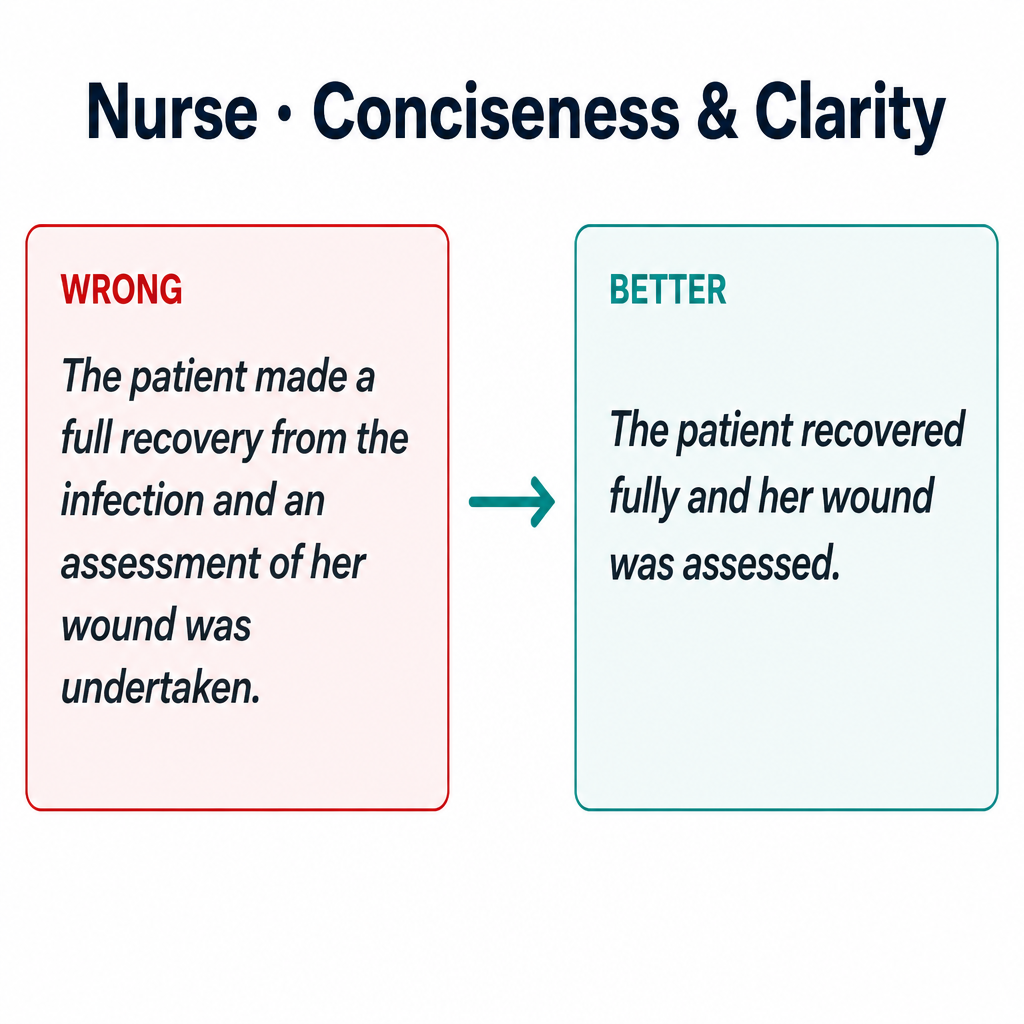
1. Nominalised phrases instead of verbs
Impacts: Conciseness & Clarity
Wrong
"The patient made a full recovery from the infection and an assessment of her wound was undertaken."
Better
"The patient recovered fully and her wound was assessed."
Why it loses marks: Nominalisations ("made a recovery", "an assessment was undertaken") double word count without adding meaning. Verbs are tighter and clearer.
2. Hedges and filler phrases
Impacts: Conciseness & Clarity
Wrong
"It is worth noting that the patient appears to have been making some progress, although it should be mentioned that pain has not yet fully resolved."
Better
"The patient is improving, though pain persists."
Why it loses marks: Hedges signal verbosity to examiners and dilute the clinical message. Direct statements score higher on Clarity.
3. Repeating patient identifiers in every sentence
Impacts: Conciseness & Clarity
Wrong
"Mrs Patel was admitted on 10/03. Mrs Patel reported abdominal pain. Mrs Patel was started on IV fluids. Mrs Patel responded well."
Better
"Mrs Patel was admitted on 10/03 with abdominal pain, started on IV fluids and responded well."
Why it loses marks: Repeating the patient name signals fragmented sentence structure. Combining clauses tightens the prose.
4. Repeated information across paragraphs
Impacts: Conciseness & Clarity
Wrong
Paragraph 2: "Mrs Khan has diabetes." Paragraph 3: "As mentioned, Mrs Khan is a known diabetic." Paragraph 4: "Her diabetes is an important factor."
Better
State the diabetes once in the relevant paragraph; reference it later only when a new clinical implication is added.
Why it loses marks: Cross-paragraph repetition signals poor planning and inflates word count. Each clinical fact appears once in the most relevant location.
5. Long lay phrasing instead of medical terminology
Impacts: Conciseness & Clarity
Wrong
"The patient was experiencing difficulty in passing urine and was getting up several times during the night to use the bathroom."
Better
"The patient reports nocturia and hesitancy."
Why it loses marks: Professional letters between healthcare workers benefit from appropriate terminology. Lay paraphrasing inflates word count without adding precision.
6. Excess transitions between sentences
Impacts: Conciseness & Clarity
Wrong
"In addition to this, furthermore, it should also be noted that, moreover, the patient is also taking aspirin."
Better
"She also takes aspirin."
Why it loses marks: Stacked transitions are noise. One transition word per sentence boundary is plenty; most sentences need none.
7. Dates and times included where they don't affect care
Impacts: Conciseness & Clarity
Wrong
"At 14:32 on 12 March, the patient was given paracetamol. At 16:45 the same day she was offered tea."
Better
"She was given paracetamol and tolerated oral intake."
Why it loses marks: Timestamps belong in the clinical record. In a handover letter, only dates that affect ongoing care belong in the prose.
Pre-submission self-check (5 items)
- 1.Is the letter between 180 and 200 words?
- 2.Have I removed hedges and filler phrases?
- 3.Have I converted nominalised phrases to verbs?
- 4.Are dates and times included only when they affect care?
- 5.Have I avoided repeating information across paragraphs?
2026 update
What changed in 2026 for nurses on Conciseness & Clarity
The 2026 stricter scoring regime applies the 2018 criteria with tighter expectations for reduction of irrelevant detail. Examiners are explicitly directed to mark down more harshly for verbosity that obscures purpose.
For nurses, this means small habits — repeating the patient name, hedging sentences, padding with transitions — now cost more marks than under earlier marking. Word-count discipline is now a meaningful differentiator at band boundaries.
Frequently asked questions
How long should an OET nursing letter be?
Aim for 180–200 words. Below 150 typically omits content; above 220 typically includes filler.
Difference between Conciseness and Content?
Content asks whether the right items are present; Conciseness asks whether each is expressed efficiently.
Can I use bullet points to save words?
No. OET letters are prose. Aim for compact sentences instead.
Should I avoid medical jargon to save space?
No. Appropriate medical terminology is concise. Jargon is only penalised with a lay reader.
How do I cut padding without losing meaning?
Replace hedges, redundant pairs, and nominalisations. Each cut adds clarity.
Can a concise letter still feel polite?
Yes. Politeness comes from courteous salutation and closing, not from filler in the body.
Keep learning
Scoring criteria
Want Dr Mariam to mark your nursing letter against Conciseness & Clarity?
See OET Writing Correction packs →