Doctor (GP) · Criterion focus: Organisation & Layout
Organisation & Layout Failures: SOAP Habits That Cost Doctor Letters Marks
A focused clinic for doctors who lose marks on Organisation & Layout. Practical fixes drawn from thousands of marked OET letters.
In short
- →Open with a purpose paragraph; then history, current findings, request.
- →No SOAP headings, no labelled sections — continuous prose only.
- →Place differential immediately before the requested action.
Why doctors lose marks on Organisation & Layout
In over 11,000 letters I have personally marked as lead corrector at WCS, doctors approach OET Organisation with one of two failed templates: SOAP structure (Subjective / Objective / Assessment / Plan, with or without labels), or undifferentiated prose with no internal logic. Both miss the OET genre, which is a continuous letter with implicit topic-driven sections.
Organisation & Layout is scored 0–7 under the August 2018 rubric. For doctors, the highest-yield fix is replacing SOAP habits with paragraph-led structure: each paragraph carries one topic, signalled by its opening sentence, with the differential placed deliberately before the request so the reader understands the reasoning that drives the action.
Mistake → fix at a glance
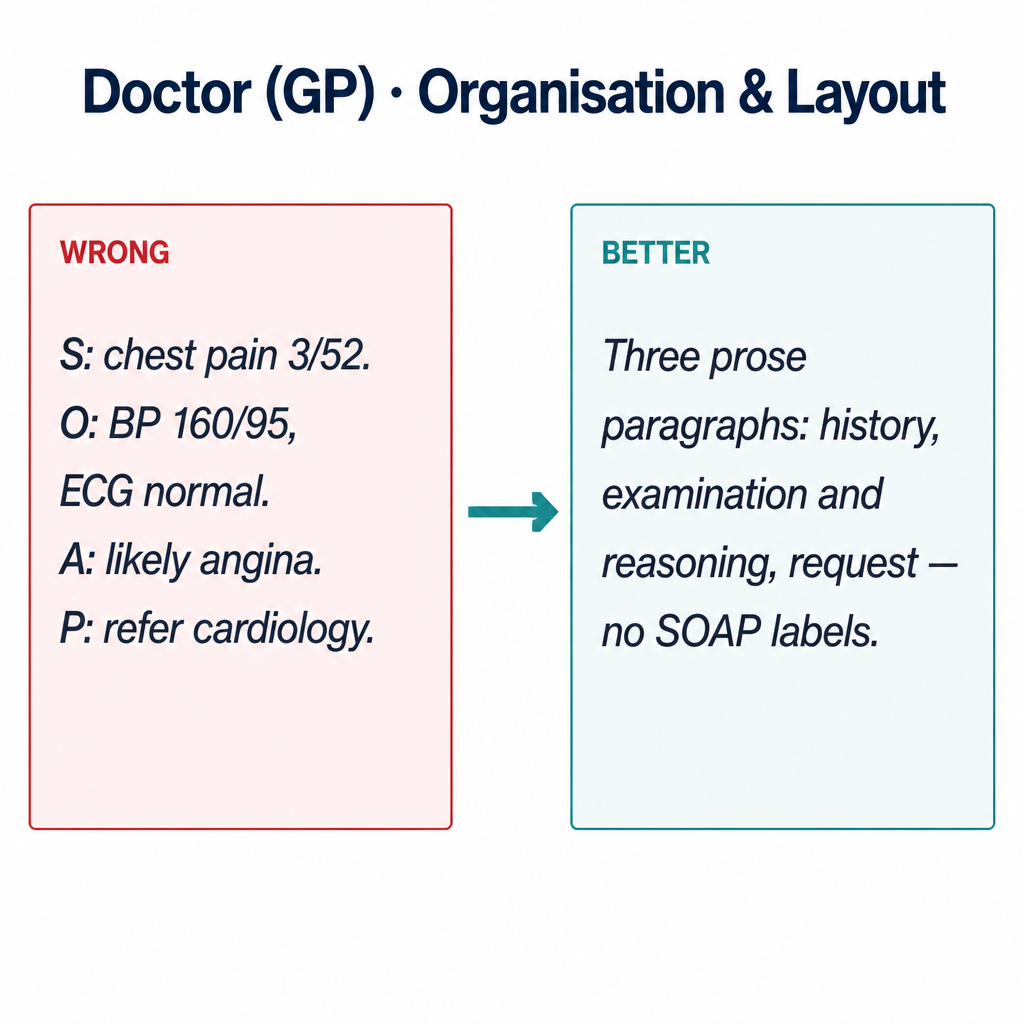
7 doctor Organisation mistakes — wrong vs right
1. Labelled SOAP sections
Impacts: Organisation & Layout
Wrong
"S: chest pain three weeks. O: BP 160/95, ECG normal. A: likely angina. P: refer cardiology."
Better
Three paragraphs of prose covering history, examination/reasoning, and request — no headings.
Why it loses marks: SOAP is record format. OET letters require continuous prose. Labelled headings instantly drop the Organisation band.
2. Differential buried after the request
Impacts: Organisation & Layout
Wrong
"Please assess and manage. The differential includes angina and reflux."
Better
"The clinical picture is most consistent with angina, with reflux as a less likely alternative. Please arrange specialist assessment and ECG."
Why it loses marks: The differential is the reasoning that justifies the request. Placing it after the request inverts logical flow.
3. Standalone medication block
Impacts: Organisation & Layout
Wrong
A standalone block: "Medications: ramipril 5 mg, metformin 1 g BD, aspirin 75 mg."
Better
"His regular medications are ramipril 5 mg daily, metformin 1 g twice daily and aspirin 75 mg daily."
Why it loses marks: Block-style medication lists break the prose flow. Integrating medications into the history sentence preserves letter format.
4. Single dense paragraph
Impacts: Organisation & Layout
Wrong
200 words in one paragraph covering purpose, history, examination and request.
Better
Three to four paragraphs, each opening with a topic sentence.
Why it loses marks: Dense single-paragraph letters force the reader to extract structure. Examiners penalise lack of visible organisation.
5. Examination findings scattered across paragraphs
Impacts: Organisation & Layout
Wrong
Blood pressure mentioned in paragraph 1, ECG in paragraph 3, examination of chest in paragraph 4.
Better
Examination findings consolidated in one paragraph, opening with "On examination today…"
Why it loses marks: Scattered findings force the reader to reassemble the clinical picture. Topic-led paragraphs keep related material together.
6. Discussion of treatment before history of presenting complaint
Impacts: Organisation & Layout
Wrong
"I have started him on ramipril and atorvastatin. He has had chest pain for three weeks."
Better
"He has had chest pain for three weeks. I have commenced ramipril and atorvastatin in primary prevention."
Why it loses marks: Treatment without context inverts cause and response. The reader needs the presenting issue before any management.
7. Closing paragraph that just repeats the opening
Impacts: Organisation & Layout
Wrong
Opens "I am writing to refer Mr Brown..." Closes "I hope you can review Mr Brown."
Better
Closes with a specific action: "Please arrange an ECG and exercise tolerance test, and consider cardiology review if results are abnormal."
Why it loses marks: A closing that restates the opening adds no information. The criterion rewards a closing that specifies the requested action.
Pre-submission self-check (5 items)
- 1.Does the letter open with a purpose paragraph?
- 2.Does each paragraph cover one topic?
- 3.Have I avoided SOAP headings?
- 4.Is the differential placed before the requested action?
- 5.Does the closing specify the requested action?
2026 update
What changed in 2026 for doctors on Organisation & Layout
The 2026 stricter scoring guidance treats letter format as more central than under earlier marking. SOAP-style sections, block medication lists, and undifferentiated single-paragraph letters now drop bands more reliably.
For doctors the practical implication is treating layout as an active editing pass. After drafting, check paragraph count, topic-per-paragraph integrity, and the logical position of the differential.
Frequently asked questions
How to structure a referral letter?
Purpose, history, current findings and reasoning, request. Three to four paragraphs.
Where should the differential appear?
In the findings paragraph, immediately before the request.
Should I use SOAP?
No. OET letters are continuous prose.
Where does the medication list go?
Integrated into the history paragraph.
Separate examination paragraph?
Often best as part of a current-findings paragraph that ends with reasoning.
Should the closing repeat the purpose?
It should reinforce the request specifically, not restate the opening verbatim.
Keep learning
Scoring criteria
Want Dr Mariam to mark your doctor letter against Organisation & Layout?
See OET Writing Correction packs →