Doctor (GP) · Criterion focus: Genre & Style
Genre & Style Failures: Where Doctor Letters Slip Out of Professional Register
A focused clinic for doctors who lose marks on Genre & Style. Practical fixes drawn from thousands of marked OET letters.
In short
- →Use full names in the salutation when the case notes provide one.
- →Expand all clinical shorthand — letters are prose, not chart notes.
- →Match salutation register to closing: Dr Smith → Yours sincerely; Colleague → Yours faithfully.
Why doctors lose marks on Genre & Style
Doctors write more clinical notes than formal letters. That habit produces OET letters in chart-note register: bullet-style facts, heavy abbreviation, and clipped sentences. In over 11,000 letters I have personally marked as lead corrector at WCS, the most common doctor Genre & Style errors are not gross informality but small register slips — a contraction here, an unexpanded abbreviation there, a mismatched salutation–closing pair.
Genre & Style is scored 0–7 under the August 2018 OET rubric. For doctors, the criterion does not reward florid prose — it rewards consistent professional register from salutation to sign-off. Most letters can move up a band by fixing salutation choice, abbreviation expansion, and closing match alone.
Mistake → fix at a glance
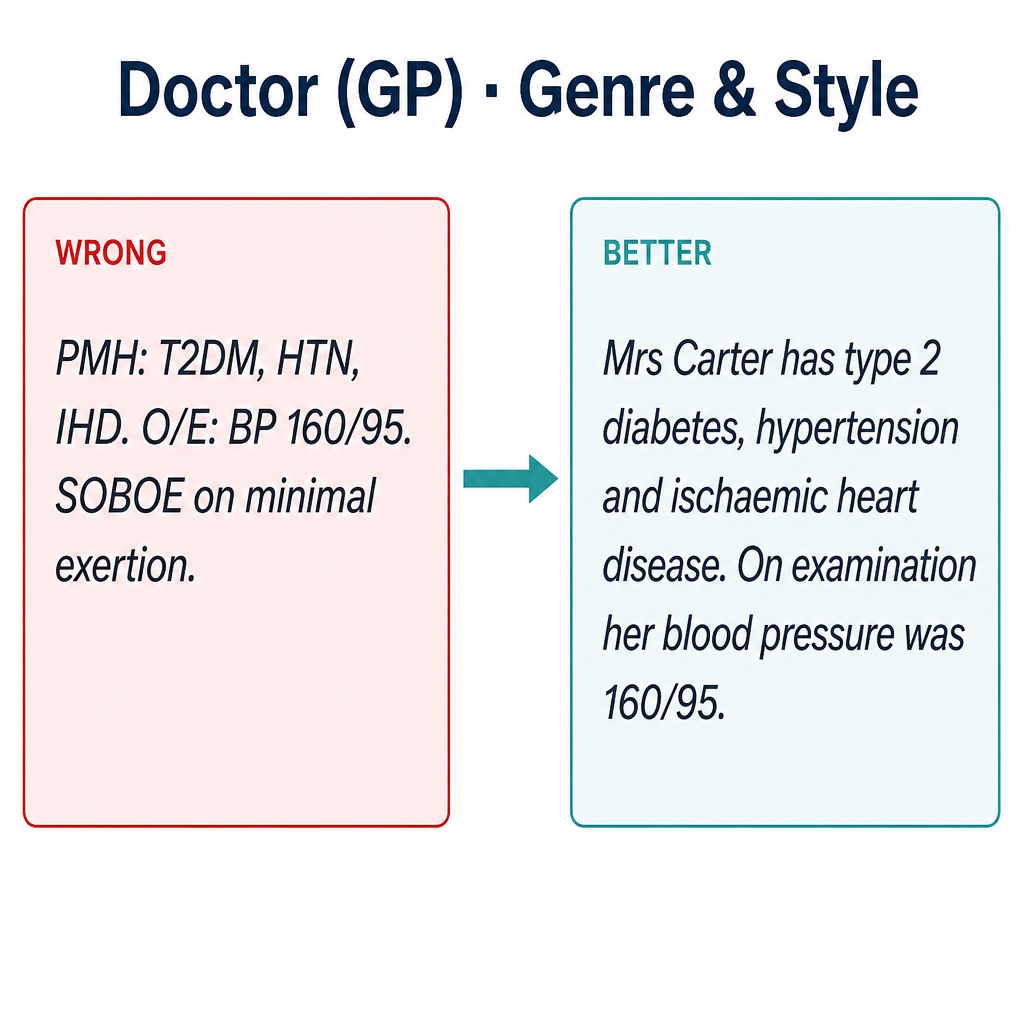
7 doctor Genre & Style mistakes — wrong vs right
1. Unexpanded clinical abbreviations in prose
Impacts: Genre & Style
Wrong
"PMH: T2DM, HTN, IHD. O/E: BP 160/95. SOBOE on minimal exertion."
Better
"Mrs Carter has a past medical history of type 2 diabetes, hypertension and ischaemic heart disease. On examination her blood pressure was 160/95 and she was breathless on minimal exertion."
Why it loses marks: Clinical shorthand is record-keeping register, not letter register. Genre marking penalises chart-style abbreviation in prose.
2. Contractions in formal letter prose
Impacts: Genre & Style
Wrong
"She's been complaining of chest pain and doesn't tolerate exertion well."
Better
"She has reported chest pain and does not tolerate exertion well."
Why it loses marks: Contractions are too informal for a professional referral. Examiners check for them as a quick register marker.
3. Mismatched salutation and closing
Impacts: Genre & Style
Wrong
Opening: "Dear Dr Patel," ... Closing: "Yours faithfully."
Better
Opening: "Dear Dr Patel," ... Closing: "Yours sincerely."
Why it loses marks: Named salutation pairs with "sincerely"; unnamed pairs with "faithfully". Mismatch is a clear Genre marker.
4. Over-personal commentary about the patient
Impacts: Genre & Style
Wrong
"She is a lovely lady who has had a difficult time and you'll really like her."
Better
"She has been engaged and adherent throughout her treatment."
Why it loses marks: Personal commentary breaks professional register. Where adherence or engagement is clinically relevant, state it factually.
5. Bullet-style sentence fragments
Impacts: Genre & Style
Wrong
"64M. CP 3/52. ECG normal. Bloods pending. Refer cardio."
Better
"Mr Brown, a 64-year-old man, has had three weeks of chest pain. His ECG is normal and blood test results are pending. I am referring him for cardiology assessment."
Why it loses marks: Fragments belong in clinical records, not letters. Genre rewards full sentences with subject and verb.
6. Over-deferential or apologetic tone
Impacts: Genre & Style
Wrong
"I do apologise for troubling you and I hope you will not mind if I refer this patient to your expert hands."
Better
"I am writing to refer Mrs Lee for your assessment and management."
Why it loses marks: Excessive deference is non-peer register. Doctor-to-doctor letters are courteous but collegial.
7. "Hope this helps" closings
Impacts: Genre & Style
Wrong
"Hope this helps. Thanks!"
Better
"Thank you for your assistance with this patient."
Why it loses marks: Conversational sign-offs break register. The standard professional formula is short, courteous and complete-sentence.
Pre-submission self-check (5 items)
- 1.Is the salutation named where possible?
- 2.Have I avoided all contractions?
- 3.Have I expanded all clinical abbreviations?
- 4.Does the closing match the salutation register?
- 5.Have I avoided over-personal commentary?
2026 update
What changed in 2026 for doctors on Genre & Style
The 2026 stricter scoring guidance treats register inconsistency as a clearer band marker than before. A letter with named salutation but "faithfully" closing, or formal prose with one contraction, now reliably drops a band on Genre & Style.
The implication: register checks belong in the final proofread, alongside spelling. Doctors should treat salutation–closing match and contraction-free prose as non-negotiable.
Frequently asked questions
What does Genre & Style measure for doctors?
Whether the letter uses the appropriate professional register for doctor-to-doctor communication.
Can I use contractions?
No. Use full forms throughout.
"Dear Doctor" or "Dear Dr Smith"?
Use the named form when the case notes provide it.
Is medical shorthand acceptable?
No. Expand abbreviations in letter prose.
How formal should the closing be?
Match opening to closing. Named → sincerely; unnamed → faithfully.
Should I avoid first person?
No. "I am writing to refer…" is appropriate.
Keep learning
Scoring criteria
Want Dr Mariam to mark your doctor letter against Genre & Style?
See OET Writing Correction packs →