Speech Pathologist · Criterion focus: Genre & Style
Genre Mismatches in OET Letters: Speech Pathologist Genre & Style
A focused clinic for Speech Pathologists who are losing marks on the Genre & Style criterion. Practical, profession-specific fixes to bring letters into the professional-to-professional register required by OET.
In short
- →Genre errors cost marks when letters read like therapy notes, not professional referrals.
- →Use a concise clinical summary, objective findings and clear requests for action.
- →Check recipient, tone, structure, and explicit recommendations before submitting.
Why Speech Pathologists lose marks on Genre & Style
Speech Pathologists often lose Genre & Style marks because clinical practice notes and therapy plans differ from the professional referral letter OET expects. In 11,000+ letters I have marked, common patterns include overly detailed session notes, first‑person reflective language, and therapy goals without clear management requests. Candidates frequently fail to shift from a patient‑facing or multidisciplinary documentation style to a concise, clinician‑to‑clinician tone that highlights assessment, clinical implications and explicit recommendations. Correcting these genre mismatches reliably improves scores under the 2018 criteria applied in the 2026 stricter regime.
Mistake → fix at a glance
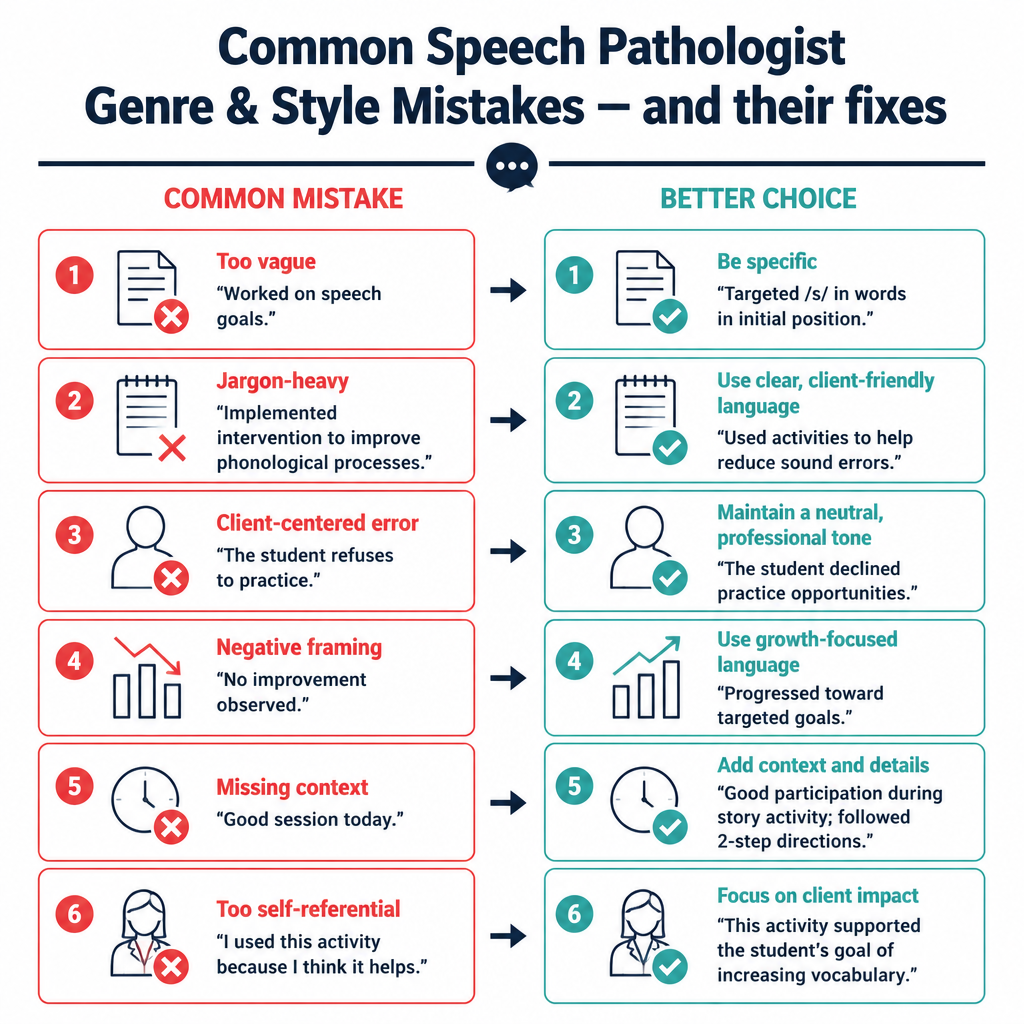
7 Speech Pathologist mistakes — wrong vs right
1. Submitting therapy-session notes instead of a referral letter
Impacts: Genre & Style
Wrong
"Session 1: 45 minutes, exercises A–F, cueing level reduced to minimal; family education given about home practice."
Better
"Summary: 45‑minute direct therapy session with reduced cueing. Clinical implication: continue regular weekly therapy; recommend community SLT follow‑up."
Why it loses marks: Examiners expect a professional letter that summarises assessment and requests action. Detailed session logs read as notes and fail to meet the formal, purpose‑driven genre.
2. Using reflective, patient‑facing language instead of clinical objectivity
Impacts: Genre & Style
Wrong
"I felt that Mr Khan was a bit anxious and didn’t always try his best during tasks."
Better
"Clinical observation: Mr Khan displayed anxiety during assessment, affecting task participation and reliability of results."
Why it loses marks: Subjective reflections shift the tone away from professional reporting. Examiners look for objective clinical language that supports clear recommendations.
3. Writing in SOAP or progress‑note format rather than a formal letter
Impacts: Genre & Style
Wrong
"S: Patient complained of slurred speech. O: Dysarthria noted. A: Mild to moderate. P: Continue weekly therapy."
Better
"Dear Dr Lee, Assessment indicates mild–moderate dysarthria affecting intelligibility. Recommendation: weekly SLT review and review of respiratory support."
Why it loses marks: SOAP entries lack the salutation, sign‑off and cohesive narrative expected in a referral. The genre requires clarity for the receiving clinician, not clinical shorthand alone.
4. Addressing the patient rather than the multidisciplinary clinician
Impacts: Genre & Style
Wrong
"You should practise your tongue exercises twice daily and keep a diary of progress."
Better
"Recommendation for GP: reinforce home practice of tongue exercises twice daily and review adherence at next appointment."
Why it loses marks: Directives to the patient change the audience and tone. OET letters must be written to the clinician, outlining management needs and responsibilities.
5. Overloading with specialised jargon without linking to management
Impacts: Genre & Style
Wrong
"Findings: oral‑motor hypotonia, reduced ROM, hypernasality due to velopharyngeal dysfunction."
Better
"Findings: reduced oral‑motor tone and velopharyngeal dysfunction causing hypernasality. Management: referral for nasoendoscopy and SLT targeting resonance management."
Why it loses marks: Jargon alone does not fulfil genre expectations. Examiners require clinical terms tied to implications and clear next steps for patient care.
6. Including long-term therapy goals instead of immediate, actionable requests
Impacts: Genre & Style
Wrong
"Long term goals: improve intelligibility by 30% within 12 months through motor planning and phonological therapy."
Better
"Immediate request: commence weekly motor‑planning therapy and review progress in eight weeks to evaluate intelligibility gains."
Why it loses marks: OET letters should prioritise immediate actions and timelines. Extensive long‑term plans obscure the immediate clinical request the receiving clinician must act on.
7. Informal abbreviations and colloquial phrasing in a professional letter
Impacts: Genre & Style
Wrong
"Patient shows probs with fluency; advised SLT tx x1/wk — fam onboard."
Better
"The patient exhibits fluency difficulties. I recommend weekly SLT sessions; family are supportive of the plan."
Why it loses marks: Informal abbreviations and colloquialisms reduce formality and clarity. Examiners expect full professional phrasing suitable for clinical communication.
Pre-submission self-check (7 items)
- 1.Is the recipient a clinician and is the tone professional (not patient‑facing)?
- 2.Does the first paragraph give a concise clinical summary and reason for the letter?
- 3.Are findings stated objectively with clear clinical implications?
- 4.Are recommendations actionable, with who, what and timeframe specified?
- 5.Have I removed session‑by‑session therapy logs and unnecessary detail?
- 6.Are abbreviations defined and formal register maintained throughout?
- 7.Does the letter include a salutation, sign‑off, and clinician details?
2026 update
What changed in 2026 for Speech Pathologists on this criterion
The 2026 stricter scoring regime enforces the 2018 OET criteria more rigorously, so genre mismatches that may once have been tolerated now cost clearer penalties.
Speech Pathologists who continue to submit therapy notes, reflective language or informal directives will see larger deductions because examiners prioritise a formal clinician‑to‑clinician register, precise recommendations and clear structure under the tightened marking approach. Adapting letters to explicit professional genre conventions is now essential to retain marks.
Frequently asked questions
Why is genre important for Speech Pathologists in OET writing?
Genre signals the expected professional register and structure. Examiners assess whether a letter functions as a clinician‑to‑clinician communication with clear requests and implications.
Can I include therapy goals in an OET referral letter?
Include brief, relevant goals only if they support immediate management. Prioritise short‑term recommendations and actions for the receiving clinician.
Is it acceptable to use clinical abbreviations?
Use standard abbreviations sparingly and define them at first use. Excessive or informal abbreviations lower clarity and can reduce Genre & Style marks.
How formal should the tone be?
Maintain a professional, objective, clinician‑to‑clinician tone. Avoid patient‑facing language, reflective comments and colloquialisms.
What structure should my letter follow to meet Genre & Style?
Start with a concise summary, present objective findings, state clinical implications, and finish with clear, actionable recommendations and timeframe.
How does the 2026 scoring change affect small genre errors?
Under the stricter regime, even small genre inconsistencies can combine to lower the score. Consistent adherence to professional letter conventions is more important than before.
Keep learning
Scoring criteria
Want Dr Mariam to mark your speech pathologist letter against Genre & Style?
See OET Writing Correction packs →