Occupational Therapist · Criterion focus: Organisation & Layout
Organisation & Layout Issues: Occupational Therapist Letters
A focused clinic for Occupational Therapists losing marks on the Organisation & Layout criterion. Practical, clinically specific fixes from 11,000+ letters I have marked.
In short
- →Poor signposting and buried recommendations cost Organisation & Layout marks; separate headings and bullets fix this.
- →Chronology and unclear current function confuse readers — lead with the up-to-date functional status.
- →Use a succinct occupational profile, bulleted problems and prioritised recommendations to meet 2018 criteria under 2026 scoring.
Why Occupational Therapists lose marks on Organisation & Layout
Occupational Therapists often lose Organisation & Layout marks because clinical narratives become case histories rather than structured referral letters. In 11,000+ letters I have marked, I repeatedly see recommendations buried inside long paragraphs, assessment details mixed with goals, and inconsistent headings that make it hard for assessors (and receiving clinicians) to locate the same four things: activity limitations, functional status now, prioritised recommendations, and follow‑up. OT content naturally requires context, but without clear signposting and concise blocks (profile, assessment, goals, recommendations) the letter fails the criterion.
Mistake → fix at a glance
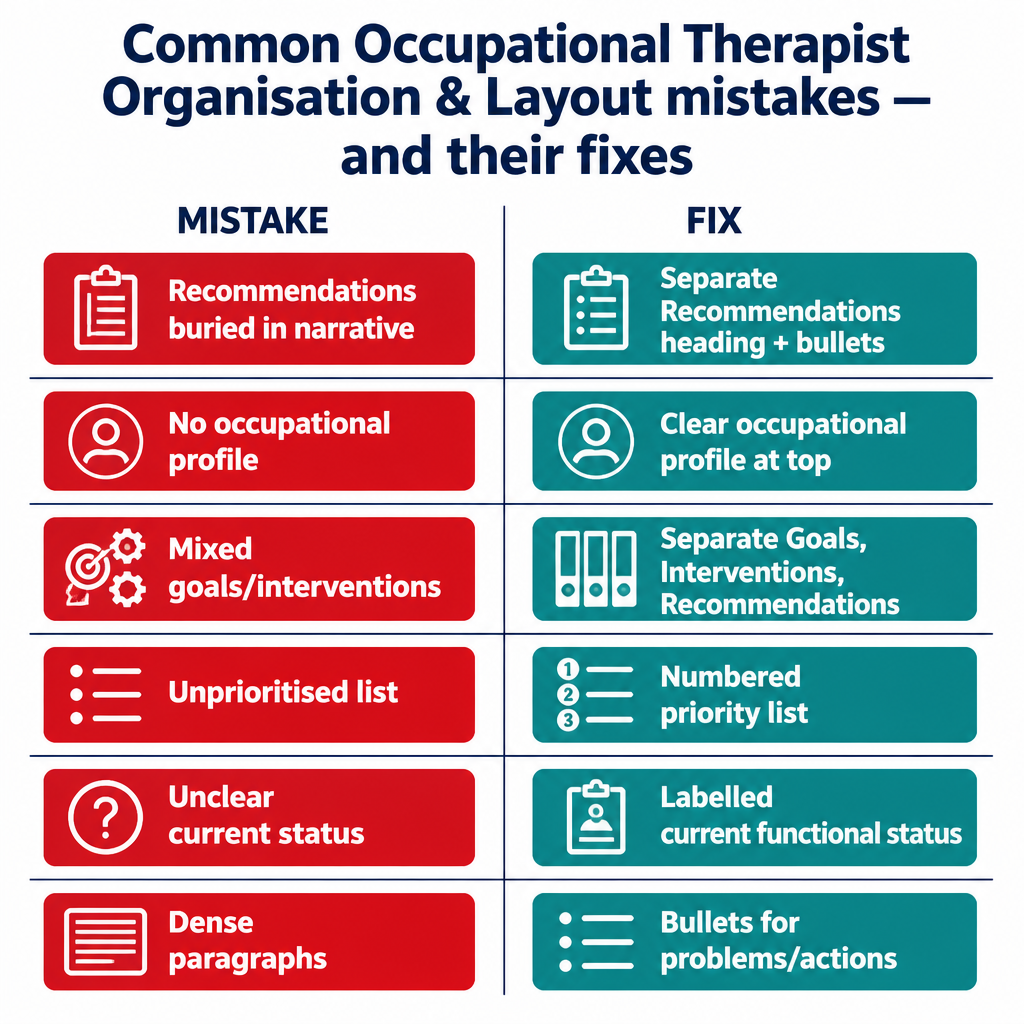
7 Occupational Therapist mistakes — wrong vs right
1. Buried recommendations within long assessment paragraphs
Impacts: Organisation & Layout
Wrong
"Following the home visit I noted decreased grip and difficulty with meal prep so I suggested a reacher, energy conservation education and carer training during sessions over the next four weeks."
Better
"Assessment: decreased grip strength and difficulty with meal preparation. Recommendations: 1) Provision of reacher; 2) Energy conservation training; 3) Carer training (four sessions)."
Why it loses marks: Examiners expect recommendations to be clear and easy to find; embedding them in narrative forces the reader to search and disrupts logical flow, losing marks for layout.
2. No clear occupational profile at the top of the letter
Impacts: Organisation & Layout
Wrong
"Mr Khan is a 72‑year‑old man who fell at home and has several medical notes attached below that describe hospital progress and therapy notes across two pages."
Better
"Occupational profile: Mr Khan, 72, lives alone in a two‑storey house; recent fall at home; mobilises with a stick; requires assistance dressing and with stair negotiation."
Why it loses marks: Without a concise occupational profile at the start, readers must wade through background to understand context, weakening the letter’s organisation and immediate usefulness.
3. Mixing goals, interventions and recommendations in one paragraph
Impacts: Organisation & Layout
Wrong
"We aim to improve transfers and independence with practice, adaptive equipment, and carer education and we will review in two weeks to see if new equipment has improved safety."
Better
"Goals: improve independence with transfers to level of supervision. Interventions: transfer training, trial of raised toilet seat. Recommendations: trial raised toilet seat; review in two weeks to evaluate safety."
Why it loses marks: Combining different sections makes it hard to identify action points; clear, separated headings help examiners match content to purpose and award marks.
4. Lack of prioritised or numbered recommendations
Impacts: Organisation & Layout
Wrong
"Consider equipment, home modification or carer input depending on availability — these are options we discussed."
Better
"Priority recommendations: 1) Immediate: provide bath rail and raised toilet seat. 2) Medium term: occupational therapy home modification assessment. 3) Consider carer support if progress limited."
Why it loses marks: Examiners look for clear priorities so receivers can act; vague, unprioritised lists reduce clarity and the letter’s practical utility.
5. Poor chronology — unclear current functional status
Impacts: Organisation & Layout
Wrong
"He was independent with ADLs before admission but now needs help; during last session he managed feeding though with difficulty but sometimes needed prompting."
Better
"Premorbid: independent with all ADLs. Current: requires supervision and prompting for feeding; dependent for dressing and bathing."
Why it loses marks: Unclear timelines force the reader to infer the patient’s present status; clear chronological headings make functional information immediately accessible.
6. Using dense narrative instead of bullets for problems and actions
Impacts: Organisation & Layout
Wrong
"The client reports fatigue, pain at the shoulder and problems with memory so I taught pacing, suggested analgesia review and gave written energy conservation tips but the family were unsure about equipment."
Better
"Key problems: - Fatigue - Right shoulder pain - Short‑term memory problems Actions taken: - Pacing and energy conservation education (written handout provided) - Advised analgesia review - Family follow‑up re: equipment needs"
Why it loses marks: Dense prose hides clinically important items; bullets and short lines let examiners and referrers scan quickly for problems and actions.
7. Inconsistent or missing headings that fail to mirror requested referral format
Impacts: Organisation & Layout
Wrong
"Clinical notes: I saw Mrs Lee and assessed ADLs and gave some suggestions which are mixed below without labels."
Better
"Referral response format: - Occupational profile - Assessment findings - Functional goals - Recommendations (Each clearly headed and succinct.)"
Why it loses marks: Examiners expect conventional headings; inconsistent or absent headings reduce navigability and make the letter appear unstructured.
Pre-submission self-check (8 items)
- 1.Is there a short occupational profile at the top (living, supports, baseline)?
- 2.Are assessment findings separated from goals, interventions and recommendations?
- 3.Are recommendations bulleted, numbered and prioritised (Immediate/Medium/Long term)?
- 4.Is current functional status clearly labelled and dated relative to admission/assessment?
- 5.Have I removed long narrative blocks and converted key points into bullets or short lines?
- 6.Do headings follow the receiving service’s requested format and appear in the same order?
- 7.Can a busy clinician find the single most important action within five seconds?
- 8.Have I limited each paragraph to one topic and ensured white space between sections?
2026 update
What changed in 2026 for Occupational Therapists on this criterion
The 2026 stricter scoring regime places greater emphasis on clarity, immediate accessibility and how information is organised under the 2018 criteria framework.
For Occupational Therapists this raises the cost of layout failures: recommendations buried in narrative or missing headings no longer attract leniency. Examiners now expect concise signposting and prioritised action points; failing to provide these directly reduces band scores in Organisation & Layout even when clinical content is sound.
Frequently asked questions
How many headings should I include in an OT OET letter?
Include clear headings: Occupational profile, Assessment findings, Functional status, Goals, Recommendations. This mirrors clinician expectations and aids rapid scanning.
Do recommendations need to be prioritised?
Yes. Numbered priorities (Immediate, Medium, Long term) help the receiver act and are favoured under the Organisation & Layout criterion.
Is a short occupational profile necessary?
Yes. A concise profile (living situation, supports, baseline) at the top gives immediate context and improves letter navigation.
Should I use bullets or full sentences for recommendations?
Use bullets with short clear phrases; verbs like 'provide', 'trial', 'refer' make actions explicit and improve layout readability.
How do I show current function clearly?
Label it 'Current functional status' and use dated, concise statements (e.g. 'Requires supervision for dressing; dependent for bathing').
Will a neat layout compensate for less clinical detail?
No. Good layout makes clinical content accessible but cannot replace necessary assessment detail; both are required for higher bands.
Keep learning
Scoring criteria
Want Dr Mariam to mark your occupational therapist letter against Organisation & Layout?
See OET Writing Correction packs →