Nurse · Criterion focus: Genre & Style
Tone Mistakes That Drop Your Genre & Style Score — Nurse
A short clinic for Nurses who repeatedly lose marks under the Genre & Style criterion. Learn the tone errors I see most and how to fix them.
In short
- →Match recipient: write to the clinician, not the patient or family, in referral/discharge letters.
- →Avoid over-familiar or apologetic language; use objective, professional voice.
- →Make recommendations clear and professionally phrased, not tentative or directive.
Why Nurses lose marks on Genre & Style
Nurses often struggle with Genre & Style because clinical workplace language differs from formal referral or discharge letters. In 11,000+ letters I have marked, common patterns include writing as if in bedside notes, addressing the patient rather than the clinician, and using hedging or cosy language that undermines recommended actions. These tone slips confuse the reader about purpose and urgency. Fixing voice, audience and recommendation phrasing consistently raises Genre & Style scores and improves clarity for other health professionals.
Mistake → fix at a glance
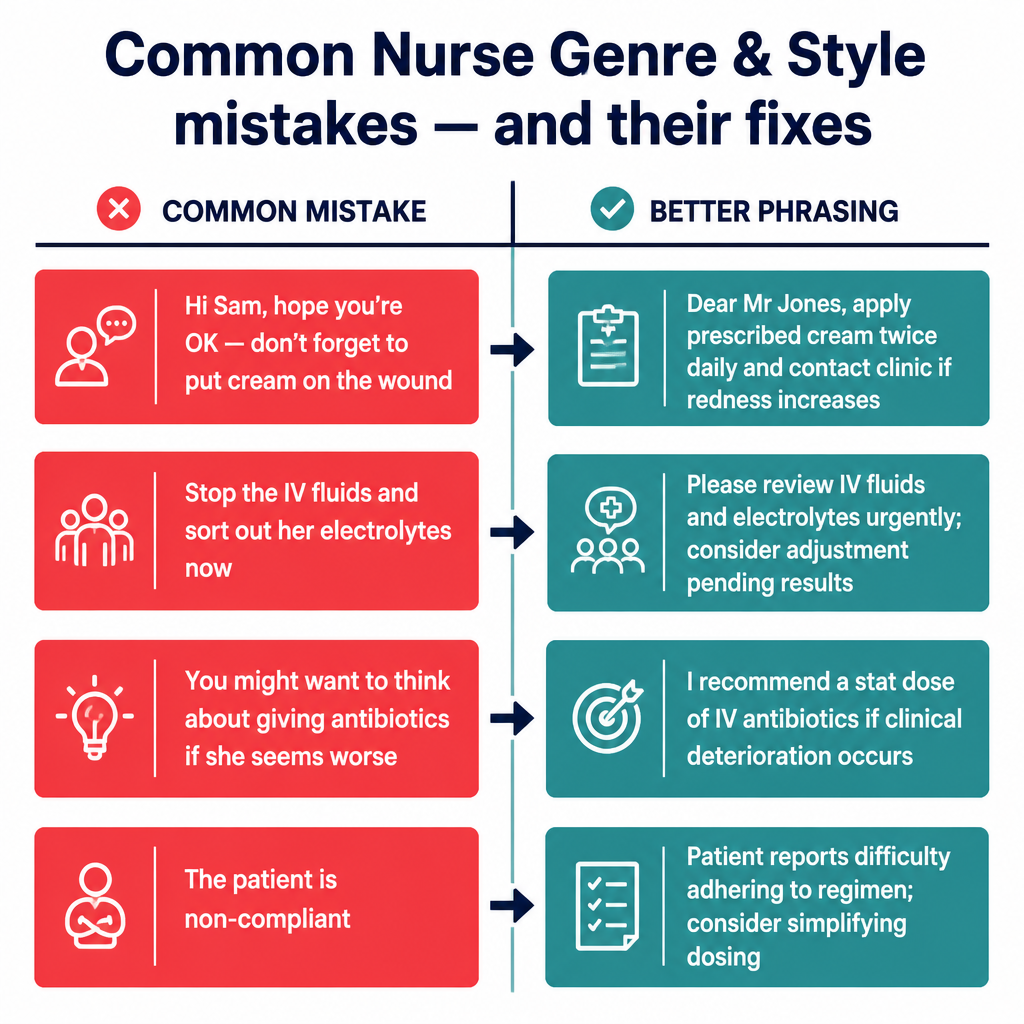
8 Nurse mistakes — wrong vs right
1. Writing to the patient instead of the clinician
Impacts: Genre & Style
Wrong
"Hi Mrs Patel — I asked the patient to stop her tablets this morning and she agreed."
Better
"Mrs Patel was advised to discontinue hydrochlorothiazide this morning; she agreed to contact her GP for review."
Why it loses marks: Examiner expects the letter to address the recipient (usually another clinician). Patient‑direct language signals wrong audience and reduces professional tone and clarity.
2. Using overly informal or colloquial language
Impacts: Genre & Style
Wrong
"Patient is a bit muddled and a lovely, chatty woman who gets confused easily."
Better
"Patient demonstrates intermittent confusion and disorientation on mobilisation; cognitive assessment recommended."
Why it loses marks: Informal descriptors and subjective phrasing weaken professional register and detract from an objective clinical voice required for interprofessional communication.
3. Over‑apologetic or personal asides
Impacts: Genre & Style
Wrong
"Sorry to bother you, but I wondered if you could maybe review her meds?"
Better
"Please review the patient’s current medications and advise on ongoing antihypertensive therapy."
Why it loses marks: Apologetic or tentative language undermines authority and obscures the letter’s purpose; examiners mark down when professional tone is compromised.
4. Giving orders instead of making professional recommendations
Impacts: Genre & Style
Wrong
"Tell the patient to stop taking the NSAID immediately."
Better
"Recommend the patient discontinue NSAID therapy and arrange analgesia review with GP."
Why it loses marks: Commanding language is inappropriate in a referral/discharge letter; examiners expect collaborative, professionally phrased recommendations.
5. Using nursing shorthand and ward note style
Impacts: Genre & Style
Wrong
"Pt c/o SOB; O2 2l via NC, obs stable, q4h obs, see GP for follow‑up."
Better
"Patient reports shortness of breath. Oxygen 2 L/min via nasal cannula; observations are within acceptable range. Arrange GP follow‑up in one week."
Why it loses marks: Ward-note abbreviations and telegraphic style signal the wrong genre. Letters require full phrasing and a formal tone suitable for the recipient.
6. Hedging recommendations with weak language
Impacts: Genre & Style
Wrong
"You might consider reducing the opioid dose if you think it's safe."
Better
"Consider reducing the opioid dose to 30 mg daily if pain remains controlled; reassess in two weeks."
Why it loses marks: Excessive hedging makes clinical intent unclear. Examiners penalise letters that fail to present clear, professionally framed recommendations.
7. Including unnecessary personal detail that changes tone
Impacts: Genre & Style
Wrong
"She lives alone and has an active social life — she loves knitting and sees friends most days."
Better
"Lives alone but maintains regular social contact; able to perform activities of daily living independently."
Why it loses marks: Personal or anecdotal detail alters the professional tone and can distract from relevant clinical information expected in a letter.
8. Switching between casual and formal voice within the letter
Impacts: Genre & Style
Wrong
"The wound is healing well. He’s happy with pain control and we’ll see how he goes."
Better
"The wound is healing satisfactorily. Pain is adequately controlled; arrange outpatient review in two weeks."
Why it loses marks: Inconsistent register confuses the reader and signals poor control of genre; examiners expect a consistent, professional style throughout.
Pre-submission self-check (8 items)
- 1.Have I clearly identified the recipient and written to a clinician, not the patient or family?
- 2.Is the register consistently professional and objective throughout the letter?
- 3.Are my recommendations phrased as professional suggestions, not commands or weak hedges?
- 4.Have I removed ward‑note abbreviations and expanded shorthand into full phrases?
- 5.Have I avoided personal, emotive or anecdotal language that does not affect clinical care?
- 6.Does the opening sentence state the purpose (referral/discharge) and set the tone immediately?
- 7.Have I kept sentences formal but concise, avoiding colloquialisms or slang?
- 8.Would another nurse or doctor understand the clinical intent on a single read?
2026 update
What changed in 2026 for Nurses on this criterion
The 2018 OET writing criteria still define Genre & Style, but the 2026 scoring regime applies them more strictly to tone and audience alignment.
Examiners now penalise subtle tone mismatches that were previously overlooked: overly familiar phrasing, hedging that obscures clinical intent, and letters written in ward‑note style attract lower marks. For Nurses this means maintaining a consistently professional, recipient‑focused voice is essential to protect your Genre & Style score under the stricter regime.
Frequently asked questions
What exactly does Genre & Style assess in an OET Nurse letter?
It assesses whether your letter uses an appropriate professional tone, addresses the correct recipient, and matches the conventions of clinical letters rather than bedside notes.
How formal should my tone be in a referral or discharge letter?
Use a formal, objective clinical voice aimed at another health professional. Avoid colloquialisms, personal asides and patient‑direct language.
Can I use abbreviations common on the ward?
Avoid ward shorthand. Expand abbreviations so the recipient receives a clear, formal letter; this supports the expected genre and tone.
Is it OK to suggest rather than instruct the GP?
Yes. Frame actions as professional recommendations (e.g. 'Recommend X' or 'Consider Y') rather than orders or weak hedges.
Will short, telegraphic sentences lose Genre & Style marks?
Telegraphic style can be acceptable if clear, but frequent choppy notes resembling ward documentation will be marked down for wrong genre and tone.
How can I practise improving Genre & Style?
Rewrite ward notes into full sentences for a clinician, focus on audience‑appropriate phrases, and get targeted feedback on tone from an experienced OET tutor.
Keep learning
Scoring criteria
Want Dr Mariam to mark your nurse letter against Genre & Style?
See OET Writing Correction packs →