Doctor (GP) · Criterion focus: Purpose
Referral Letter Mistakes That Tank Purpose Score — Doctor (GP)
A targeted clinic for Doctor (GP)s who repeatedly lose marks on the Purpose criterion in OET referral letters. Practical, profession-specific fixes drawn from thousands of real corrections.
In short
- →Be explicit: state one clear reason for referral in the first lines.
- →Prioritise a single primary question for the specialist and define expected action.
- →Give urgency and timeframe; vague requests invite mark deductions under Purpose.
Why Doctor (GP)s lose marks on Purpose
In my 11,000+ marked referral letters I see the same pattern: GPs write clinically rich notes but fail to make the referral purpose explicit. They either bury the question in long history, mix several goals without priority, or omit the action they want from the specialist. The OET Purpose criterion rewards a clear, recipient-focused opening that states the issue, the precise question, and any required urgency. Fixing this is high-yield: clear purpose saves marks even when other areas need work.
Mistake → fix at a glance
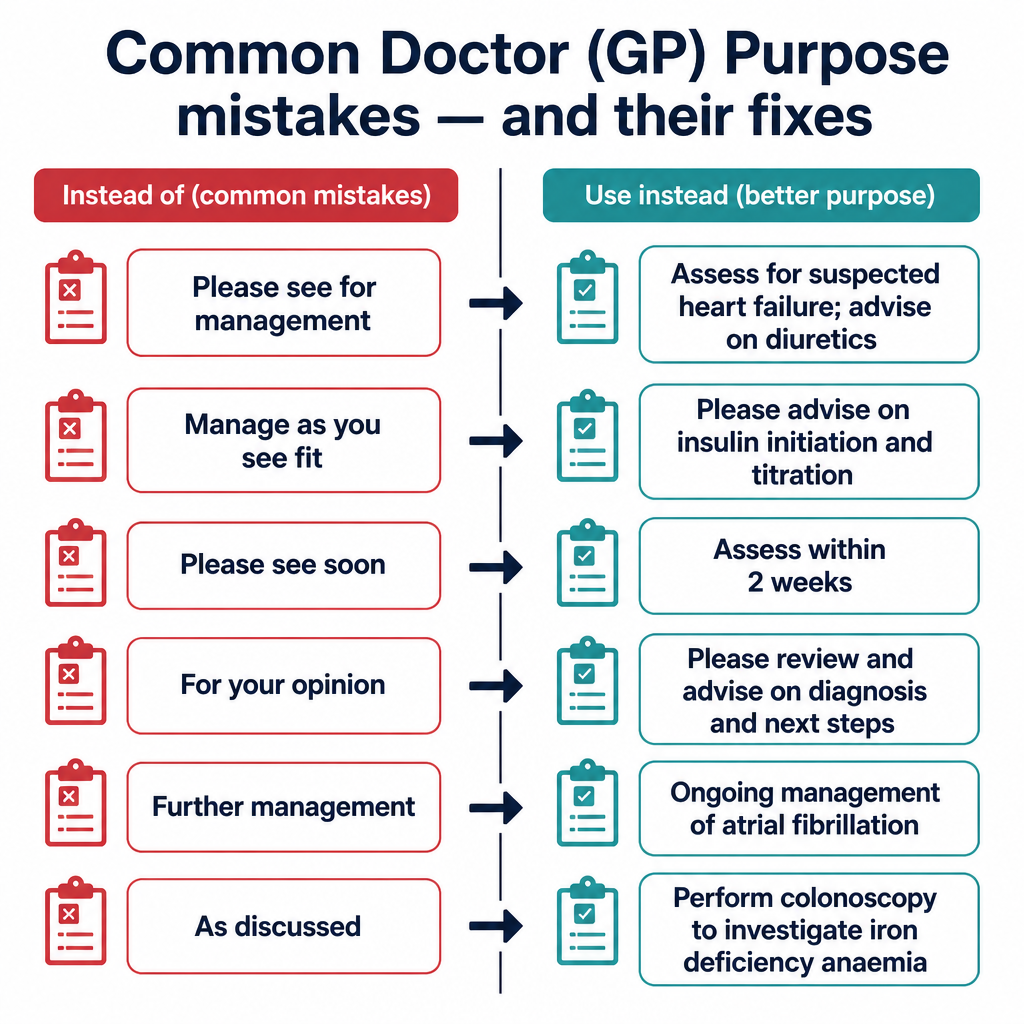
7 Doctor (GP) mistakes — wrong vs right
1. Vague opening: no explicit reason stated
Impacts: Purpose
Wrong
"Please see Mr Ahmed in clinic for further management."
Better
"Please assess Mr Ahmed for suspected congestive heart failure and advise on initiation of diuretic therapy."
Why it loses marks: Examiners need a clear clinical reason immediately; generic 'please see' does not tell the specialist what problem or decision is required, so the letter fails to fulfil the recipient-focused purpose.
2. Multiple equal requests — no primary question
Impacts: Purpose
Wrong
"Refer for diagnosis, opinion and possible surgery for persistent shoulder pain."
Better
"Primary request: orthopaedic assessment to determine surgical candidacy for persistent shoulder pain; secondary: if unsuitable for surgery, please advise conservative management."
Why it loses marks: When several aims are listed without hierarchy, the specialist cannot tell which action is most important; the Purpose mark falls because the letter does not focus the reader on a single, clear task.
3. No specified urgency or timeframe
Impacts: Purpose
Wrong
"Please see Ms Patel soon for this lump in her neck."
Better
"Please assess Ms Patel within two weeks for a 3 cm cervical lump suspicious for malignancy and advise about urgent diagnostic biopsy."
Why it loses marks: Purpose includes communication of urgency; 'soon' is subjective. Examiners penalise missing timeframes because the specialist cannot prioritise appropriately from the referral.
4. Purpose buried after long background
Impacts: Purpose
Wrong
"Patient has a five-year history of back pain with multiple medications tried. Previous GP notes attached. Please see for an opinion."
Better
"Please see Mr Jones for specialist assessment regarding chronic low back pain and consideration of epidural steroid injection. Brief history and treatments provided below."
Why it loses marks: If the purpose appears only after lengthy history, the recipient must search for the task. The Purpose criterion expects the referral aim to be prominent and immediately clear.
5. Open‑ended instruction: 'manage as you see fit'
Impacts: Purpose
Wrong
"Refer to respiratory clinic — please manage as you feel appropriate."
Better
"Please evaluate Mrs Ng for poorly controlled asthma and advise whether inhaled corticosteroid dose should be increased or if specialist biologic therapy is indicated."
Why it loses marks: Open-ended requests shift the burden to the specialist and leave the GP's expectations unclear; examiners mark down because the letter does not state the decision or action sought.
6. Missing explicit question about investigation or procedure
Impacts: Purpose
Wrong
"Patient with intermittent haematuria — please see and investigate."
Better
"Please assess Mr Lewis and perform urine cytology and CT urogram to exclude upper tract malignancy, and advise on urology follow-up."
Why it loses marks: Without a stated investigative question, specialists cannot tell which tests or next steps are expected; the Purpose score drops because the referral lacks a clear requested action.
7. Unclear GP vs specialist responsibilities after referral
Impacts: Purpose
Wrong
"Refer to endocrinology for diabetes issues. Will follow up as required."
Better
"Please advise on initiation of insulin and titration plan; GP will continue routine monitoring and implement specialist recommendations pending review."
Why it loses marks: If the expected roles are not stated, the recipient cannot determine whether the specialist should only advise or take ongoing management; examiners penalise ambiguous handover of care.
Pre-submission self-check (8 items)
- 1.Have I stated the primary reason for referral in the first two lines?
- 2.Is there a single, clearly prioritised question for the specialist?
- 3.Have I given an explicit urgency or timeframe if clinically important?
- 4.Does the letter state the specific action or investigation I want performed?
- 5.Have I avoided burying the purpose behind long history or excessive detail?
- 6.Is it clear who will do routine follow-up and who will implement specialist advice?
- 7.Have I removed open‑ended phrases like 'manage as you see fit'?
- 8.Is the purpose phrased for the reader (specialist), not as a note to the record?
2026 update
What changed in 2026 for Doctor (GP)s on this criterion
The 2026 stricter scoring regime narrows tolerance for ambiguity in Purpose: examiners now expect a recipient-focused first line that states the clinical problem, the single question, and any urgency. Vague language or buried requests are less likely to be interpreted generously.
As a result, common GP habits — long narrative intros, multiple equal aims, or open-ended 'manage as you see fit' requests — are more costly. Explicit, concise purpose statements and a clear expected action are essential to protect Purpose marks under the new regime.
Frequently asked questions
How long should the purpose sentence be?
One clear sentence is ideal: state the problem, the precise question, and any timeframe. Keep it direct; supporting details follow in subsequent sentences.
Can I list more than one request?
Yes, but prioritise. State one primary question first and label any secondary requests. Examiners reward a clearly prioritised purpose.
How do I show urgency appropriately?
Use specific timeframes (e.g. 'within 48 hours', 'within two weeks') and clinical reason for urgency. Avoid subjective terms like 'soon' or 'urgent' alone.
Should I include all previous test results?
Include only relevant results that justify the referral and the requested action. Excessive data can bury the purpose; attach full records if needed.
Is it acceptable to ask the specialist to 'advise and manage'?
Phrase the request precisely: specify whether you want advice only, a treatment plan, or transfer of care. Clarity about the expected role protects marks.
Will a clear purpose compensate for weaker language?
Yes—Purpose is a separate criterion. A precise, well-framed purpose can secure marks even if other areas need work, but aim to improve all criteria.
Keep learning
Scoring criteria
Want Dr Mariam to mark your doctor (gp) letter against Purpose?
See OET Writing Correction packs →