Decision guide · For candidates considering both exams · 2026 update
OET Writing vs IELTS Academic Task 1: Guide for Healthcare Professionals
A 2026-current decision guide comparing OET Writing and IELTS Academic Task 1 for clinicians and healthcare applicants. Use this to match test choice to regulator and workplace needs.
In short
- →OET Writing mirrors clinical letters and case-note tasks; preferred by many healthcare regulators.[check regulator guidance]
- →IELTS Academic Task 1 assesses academic data description; useful for university admission and general writing evidence.[check institution rules]
- →Scoring and thresholds tightened under the 2018 criteria applied in 2026; always confirm required grade with your regulator.
OET Writing vs IELTS Academic Task 1 at a glance
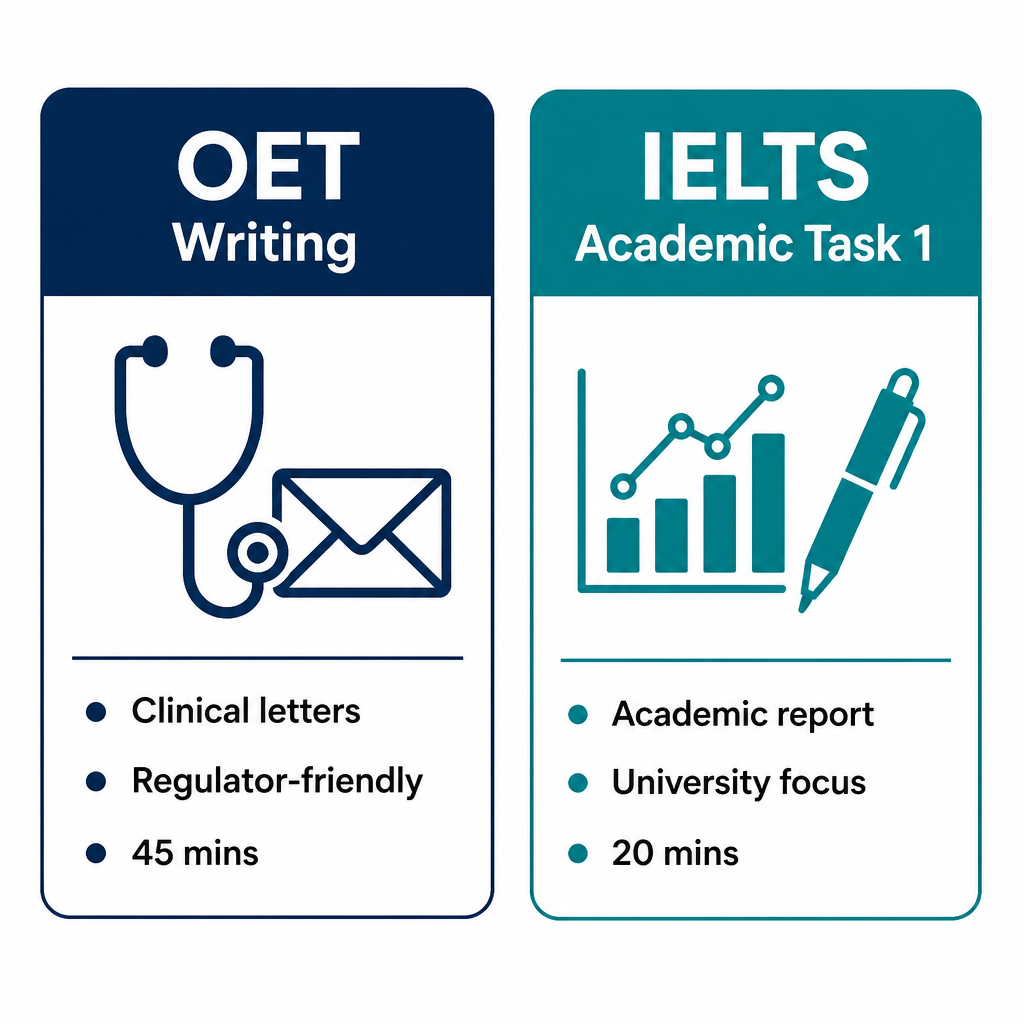
The full comparison
| Dimension | OET Writing | IELTS Academic Task 1 |
|---|---|---|
| Accepted by | Widely accepted by healthcare regulators and employers worldwide | Accepted by universities and employers; less common among healthcare regulators |
| Exam length | 45 minutes per writing sub-test, one task based on clinical case notes | About 20 minutes; write a 150-word report describing visual data |
| Scoring band | Grade A–E using 2018 OET criteria under stricter 2026 scoring regime | Band score 0–9; Task 1 contributes to the overall Writing band |
| Cost | Usually more expensive than IELTS; fees vary by test centre and country | Generally lower registration fees; varies by country and centre |
| Retake rules | Can be retaken; booking depends on local test dates and availability | Retake anytime; multiple sessions monthly at most centres |
| Writing skill transfer | High transfer: clinical letter-writing and case-note summarising are directly relevant | Different skillset: academic data description; less direct clinical relevance |
| Healthcare relevance | Designed for healthcare communication; tasks mirror workplace writing | Academic focus; not healthcare-specific but useful for general academic employers |
| Format | Available paper and computer-based; many centres offer both modes | Computer and paper options; computer delivery increasingly common |
| Results turnaround | Typically results within 10 working days; computer tests may be faster | Results around 13 days for paper, 3–5 days for computer delivery |
When to choose OET Writing
Choose OET Writing when your primary aim is clinical registration, workplace communication or direct evidence of healthcare writing ability. The tasks replicate authentic clinical letters, referral notes and discharge summaries, so the task type aligns with day-to-day practice.
Under the 2018 OET criteria (applied under the stricter 2026 scoring regime), examiners assess genre, content, organisation and language accuracy with a workplace emphasis. If a regulator or employer explicitly lists OET in their accepted tests, OET is often the more efficient, relevant choice.
Pros
- • Tasks reflect real clinical writing and workplace scenarios
- • Favoured by many healthcare regulators and employers
- • Clear task alignment with professional communication needs
Cons
- • Typically higher test fee than IELTS
- • Less useful for academic data-reporting tasks
- • Availability varies by region and test centre
When to choose IELTS Academic Task 1
Choose IELTS Academic Task 1 if you need evidence of academic writing for university admission, research or institutions that specifically request IELTS. Task 1 tests description and comparison of visual data and is embedded in the broader academic Writing paper.
If your regulator or employer accepts IELTS, and your role values academic-report style skills rather than clinical correspondence, IELTS may be preferable. Remember Task 1 contributes to the overall Writing band rather than standing alone as healthcare-specific evidence.
Pros
- • Widely available and recognised by universities globally
- • Generally lower registration fees and frequent sessions
- • Useful for academic study and research pathways
Cons
- • Task 1 is academic in focus, not clinical
- • Less directly persuasive for healthcare-specific registration
- • Task 1 contributes only to the overall Writing band
What each healthcare regulator currently accepts
| Profession | Requirement (2026) |
|---|---|
| Nurse | NMC: commonly requires OET Grade B in each sub-test; conditional C+ in Writing sometimes accepted. Verify NMC guidance. |
| Doctor | GMC: commonly accepts OET (Grade B) or IELTS (overall 7.0, Writing 7.0); check current GMC registration rules. |
| Pharmacist | GPhC: accepts recognised English tests; many candidates use OET Grade B or IELTS 7.0. Confirm GPhC thresholds. |
| Dentist | GDC: frequently accepts OET or IELTS as evidence; applicants should confirm exact grade requirements with GDC. |
| AHP / Physiotherapist | HCPC: accepts OET and IELTS as English evidence; candidates commonly aim for OET Grade B or IELTS equivalent. |
| Surgeon / Specialist doctor | Follow GMC requirements for doctors; many surgical applicants present OET Grade B or IELTS 7.0 as evidence. |
2026 update
What changed in 2026 for this comparison
Regulators and test bodies implemented tighter application of the 2018 OET marking criteria through 2024–2026; examiners now apply more rigorous standards for content, genre and language accuracy. This tighter scoring has affected pass thresholds cited by some registration bodies.
Also in 2026, several regulators clarified accepted tests and minimum grades. Always check the regulator’s live guidance before booking. Computer-delivered options and faster reporting windows have expanded, but policy differences between regulators remain the deciding factor for many candidates.
Frequently asked questions
Can I use IELTS Academic Task 1 for medical registration?
Some regulators accept IELTS as evidence of English. Check your specific regulator’s required band and whether they accept IELTS for registration.
Is OET Writing easier than IELTS Task 1?
‘Easier’ depends on your skills. OET suits clinical writers; IELTS favours academic data description. Match test to your strengths and goals.
How long do results remain valid?
Most regulators accept English test results for two years, but always confirm the exact validity period with your regulator or employer.
Do universities accept OET?
Some universities accept OET for healthcare courses; many still require IELTS. Check the institution’s English language requirements.
Can I switch tests if my regulator changes policy?
Yes. If a regulator updates accepted tests, you can choose whichever test meets the new threshold; check timelines and validity.
How should I prepare for OET Writing?
Practise clinical letter formats, summarising case notes, and follow the 2018 OET task criteria. Target accurate, clear workplace language.
Keep learning
Scoring criteria
Decided on OET? Get expert feedback on your letters.
See OET Writing Correction packs →