Decision guide · For all healthcare professions · 2026 update
OET On Paper vs OET On Computer — Healthcare Professionals' Guide
A 2026-current decision guide comparing OET on paper and on computer for all healthcare professions. Use this to choose the format that suits your skills, regulator requirements and test access.
In short
- →Paper suits writers who prefer handwriting, longer review time and fewer onscreen controls (OET 2026).
- →Computer suits fast typists, offers digital editing tools and often quicker results (OET 2026).
- →Check your regulator — many accept both formats but may state preferred bands or single‑sitting rules (2026).
OET on paper vs OET on computer at a glance
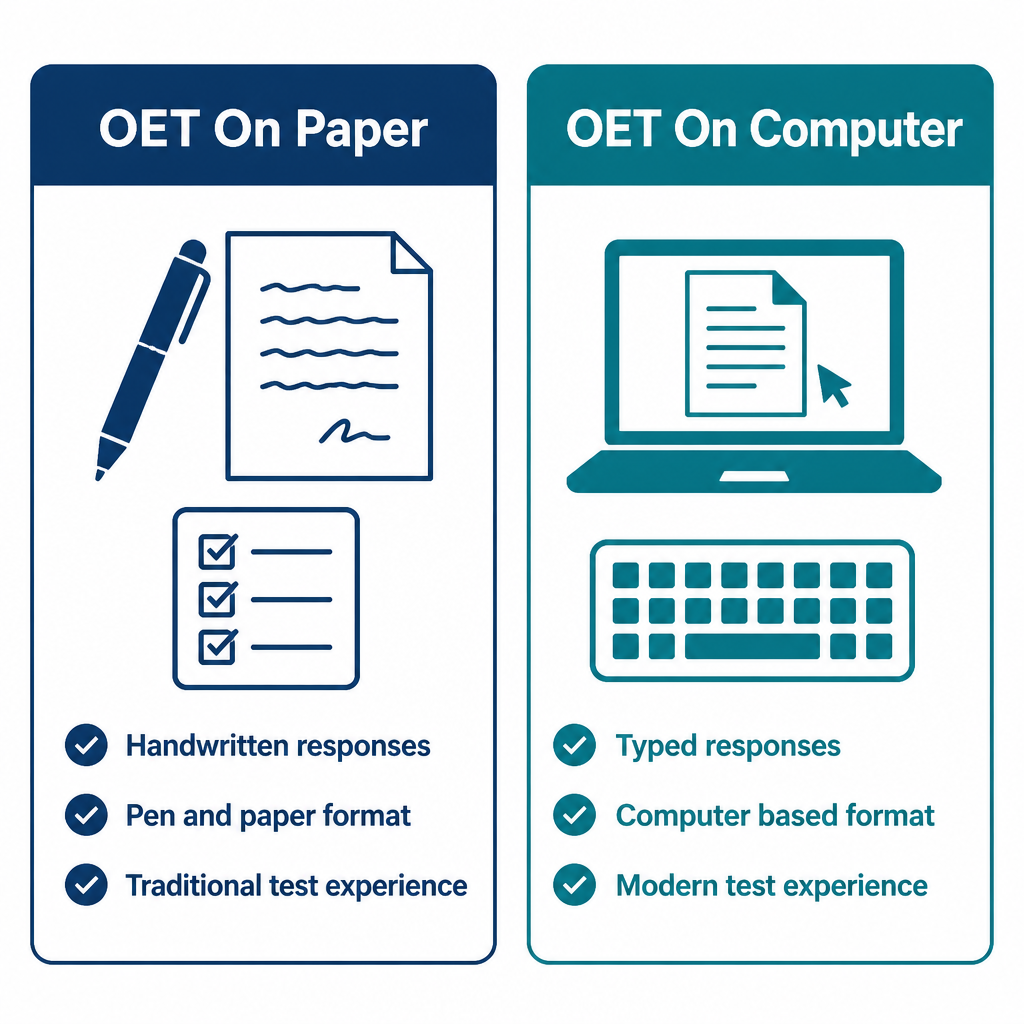
The full comparison
| Dimension | OET on paper | OET on computer |
|---|---|---|
| Accepted by | Most regulators accept OET paper; always confirm specific band rules | Most regulators accept OET computer; confirm single‑sitting or format rules |
| Exam length | Same subtests and timings as computer; writing unseen handwriting component | Same subtests and timings; writing completed on keyboard within allotted time |
| Scoring band | Scored to 2018 writing criteria; assessed under 2026 stricter regime | Scored to 2018 writing criteria; assessed under 2026 stricter regime |
| Cost | Fees vary by centre; may differ from computer testing locations | Fees vary by test centre; sometimes slightly higher due to computer facilities |
| Retake rules | Same retake regulations; can retake paper or switch formats between attempts | Same retake regulations; can retake computer or switch formats between attempts |
| Writing skill transfer | Handwriting can aid planning and editing for some candidates | Typing benefits those with fast, accurate keyboard skills and digital editing |
| Computer / paper | Physical answer sheet, handwriting required for Writing subtest | Digital interface; use keyboard, on‑screen tools and navigation |
| Results turnaround | Turnaround similar but sometimes marginally slower for paper processing | Often marginally faster due to digital processing and automated delivery |
| Accessibility | Paper accommodates some familiar access arrangements; request adaptations early | Computer offers adaptive tools; some adjustments require advance approval |
When to choose OET on paper
Choose OET on paper if you plan and edit better by hand, or if you frequently practice using handwritten notes and find typing reduces clarity. Many candidates who write at a moderate speed find handwriting helps them structure case letters in line with the 2018 writing criteria under the 2026 stricter scoring regime.
Also consider paper where local computer test centres are scarce or if your regulator accepts both formats but you feel more confident with a pen. Book accessibility adjustments early; centres may differ in available support.
Pros
- • Natural handwriting may improve planning and clarity for some candidates
- • No reliance on keyboard‑speed or onscreen navigation
- • Often preferred where local computer centres are limited
Cons
- • Handwriting legibility can affect perceived language clarity
- • Slightly slower editing compared with digital cut/copy/paste
- • Processing may be marginally slower for results delivery
When to choose OET on computer
Choose OET on computer if you type quickly and can edit text efficiently onscreen. Computer testing reduces manual transcription time, gives precise control over layout, and often returns results marginally faster under current processing systems.
Computer format suits candidates who practise formal clinical correspondence on a keyboard and who prefer digital navigation tools. Ensure you allow practice time for the specific test software and check any regulator rules about format or single‑sitting evidence.
Pros
- • Fast editing and digital tools for coherent paragraphing
- • Often quicker results due to digital processing
- • Useful for candidates who type accurately and quickly
Cons
- • Keyboard speed and familiarity with test interface matters
- • Some candidates find onscreen reading and navigation taxing
- • Not all centres provide identical software; practise required
What each healthcare regulator currently accepts
| Profession | Requirement (2026) |
|---|---|
| Nurse (NMC, UK) | NMC accepts OET; many applicants aim for Grade B in each subtest—confirm current NMC guidance before applying. |
| Doctor (GMC, UK) | GMC recognises OET for English language evidence in many routes; check exact band or alternative evidence requirements. |
| Pharmacist (GPhC, UK) | GPhC accepts OET as evidence of English language competence; check whether Grade B is advised for registration. |
| Dentist (GDC, UK) | GDC recognises OET submissions for some registration routes; verify the required subtest bands with GDC. |
| Allied Health Professions (HCPC, UK) | HCPC accepts OET for many AHPs; applicants generally aim for strong bands in Writing and Speaking. |
| Australian Registrations (AHPRA) | AHPRA commonly accepts OET with specified band thresholds; check the profession‑specific standards for 2026. |
| International Medical Graduates (various) | Many national regulators accept OET; exact band, single‑sitting and documentation rules vary—always confirm early. |
2026 update
What changed in 2026 for this comparison
From 2026, institutions and regulators are increasingly explicit about format-agnostic acceptance but stricter application of the 2018 OET writing descriptors is now standardised. That means writing assessment emphasises task fulfilment, organisation and language accuracy more consistently across formats.
Some regulators now state format preferences or require single‑sitting evidence for specific routes; ECFMG and a few national bodies have introduced tighter evidence rules. Always check your regulator’s 2026 guidance and plan practice under the 2018 criteria applied in the current stricter scoring regime.
Frequently asked questions
Will one format score higher than the other?
No format has an inherent scoring advantage; both use the 2018 writing criteria under 2026 stricter scoring. Performance depends on your skills and preparation.
Can I switch formats between attempts?
Yes. Candidates may switch between paper and computer formats on retakes, subject to local availability and booking rules.
Which format returns results faster?
Computer tests often return results marginally faster due to digital processing, though turnaround can vary by centre and scheduling.
Do regulators prefer one format?
Most regulators accept both formats. Some specify additional rules (single‑sitting or band thresholds); always confirm with your regulator for 2026 guidance.
How does the 2018 writing criteria affect me?
The 2018 criteria focus on task fulfilment, coherence and language accuracy; under the 2026 stricter regime these are applied more rigorously across both formats.
Can I request accessibility adjustments?
Yes. Request adjustments early. Paper and computer centres offer different accommodations; approval and provision depend on documentation and centre capabilities.
Keep learning
Scoring criteria
Decided on OET? Get expert feedback on your letters.
See OET Writing Correction packs →